Behind Church Street, where Friarscot now looks across its quiet garden, there was once a narrow yard containing nine houses, three privies and enough foul air for an official inspector to record the smell in two blunt words: “stench great”.
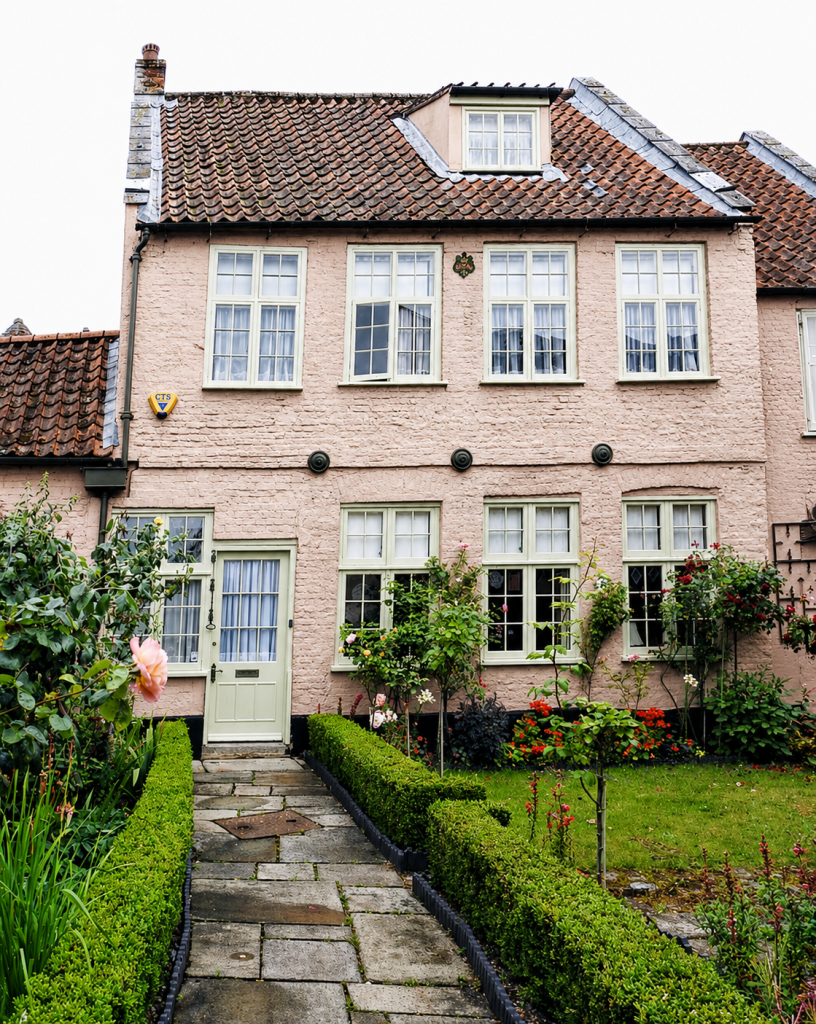
Photo © James Rye 2026
That yard was Linay’s Yard. Today it has almost vanished from sight. Its name survives chiefly because Historic England records Friarscot’s former address as “The Cottage, Linays Yard”, and because William Lee’s mid nineteenth-century report on King’s Lynn’s sanitary condition caught the place at a particularly grim moment. Put those fragments together and a lost corner of Lynn briefly reappears: not the town of guildhalls, merchants and carved doorways, but the town of cramped courts, labouring families and shared privies hidden behind respectable street fronts.
A yard behind Church Street
Linay’s Yard lay behind the west side of Church Street, in the area now associated with Friarscot, 27 Church Street. The name should not be confused with Friarscot itself. Friarscot was the old house within or adjoining the yard, formerly known more plainly as The Cottage. Linay’s Yard was the small enclosed court around it.
This was a familiar pattern in old Lynn. The principal streets presented houses, shops and workshops to the public. Behind them stretched long plots, reached through passages or archways, where there might be gardens, warehouses, stables, sheds, cottages and later tenements. Some yards kept a commercial character. Others became small residential neighbourhoods, densely packed into spaces never designed for comfort.
Friarscot shows how deep that history could run. Historic England dates the building to about 1530, with a late seventeenth-century façade and later restoration. Its interior still preserves sixteenth-century roll-moulded joists and traces of early mullioned windows. By the nineteenth century, however, this old house was no longer standing in the setting for which it had first been built. It had become part of a crowded yard.
The exact entrance to Linay’s Yard has not yet been securely traced on a detailed historic plan. It was probably reached from Church Street through or beside the frontage buildings. A Norfolk Historic Environment Record entry for 23 to 27 Church Street refers to rear structures facing into Linay’s Yard, confirming that the name belonged to the hidden space behind the street frontage rather than to the listed house alone.
Who gave the yard its name?
The most likely source of the name is the Linay family, who were connected with sailmaking and ship chandlery in early nineteenth-century Lynn. This fits the geography and the chronology.
Thomas Linay senior was a sailmaker and ship chandler. A local trade-history account records that he had premises in Church Street by the time of Pigot’s directory of 1822. By 1836 the family business had moved elsewhere, and Joseph Linay, Thomas’s son, was operating as a sailmaker and ship chandler from 120 High Street. There, the Linay business occupied exactly the sort of mixed commercial site common in Lynn: a front shop, an archway, a yard, warehouses and workshops behind.
The Linays belonged to the working port rather than to the genteel world of shop windows alone. Sailmaking, rope, tarpaulins, pitch, oakum, paints and ship chandlery were the materials of a maritime town. Joseph Linay’s business later became Linay and Cooper, then Linay and Bullen. In 1879 the firm advertised itself as ship chandlers, rope manufacturers, sail and cover makers, and dealers in paints, oils, tar, pitch and oakum.
It is therefore quite plausible that a Church Street yard acquired the Linay name from Thomas Linay’s earlier premises there. What has not yet been found is the decisive document saying that Thomas Linay owned, leased or occupied the specific property later known as Linay’s Yard. Until that appears, the connection should remain a strong inference rather than a settled fact.
Nine houses, three privies
The sharpest glimpse of Linay’s Yard comes from William Lee’s investigation into King’s Lynn’s drainage, water supply and public health. Lee inspected the town in the early 1850s for the General Board of Health, recording court after court where overcrowding, bad paving, defective drains and shared privies made daily life unpleasant and sometimes dangerous.
His note on Linay’s Yard is brief but vivid. Under Church Street he recorded: “Linay’s-yard, nine houses; a very narrow yard; three privies; stench great.” He also noted that Mr Sayle had attended cases of sickness among men in the yard.
There is no decoration in that description. Lee did not pause to moralise. He simply counted the houses, noted the narrowness of the space, counted the privies and recorded the smell.
Those few details tell us a great deal. Nine houses depended on three privies. The yard was narrow enough for air to stagnate, and waste disposal was plainly inadequate. There is no evidence here of private water closets, proper sewerage or effective ventilation. The inhabitants lived with the smell close at hand.
Lee’s wider report shows that Linay’s Yard was not unusual. Many of Lynn’s courts suffered from surface drainage, foul channels, defective privies and overcrowding. Yet the reference still matters because it gives Linay’s Yard a physical and social reality. It was not just a name on an address. It was a place where families lived, fetched water, emptied slops, endured smells and fell ill.
The people in the yard
The names of Linay’s Yard’s residents are harder to recover than the smell. Poorer households often appear only fleetingly in the records, especially when they lived in rented rooms or small court dwellings.
Family-history work has identified a Saunders family in Linay’s Yard in the later nineteenth century, including Mary Elizabeth Saunders, reportedly born there in 1884. A transcription of the 1891 census places David Saunders, a general labourer, with his household at Linay’s Yard, Church Street, in St Margaret’s parish. That evidence should be checked against the original census image before publication in a fully documented account, but it strongly suggests that the yard remained a recognised address long after Lee’s inspection.
A labourer’s household in Linay’s Yard sits naturally within the world Lee described. This was not a picturesque court tucked behind an ancient house. It was part of working-class Lynn, close to the town’s river, markets, churches, workshops and small trades. Its inhabitants probably worked wherever casual labour could be found: on the quays, in yards, in service, in shops, in building work or in the many small occupations that sustained a port town.
We should be careful not to flatten their lives into misery. People made homes in such places. Children were born there, families formed there, neighbours knew one another and yards often developed their own close social worlds. But the physical conditions were harsh, and Lee’s report leaves little doubt that the sanitary arrangements were poor.
Friarscot inside the yard
The presence of Friarscot gives Linay’s Yard an unusual depth of history. The yard was not simply a row of nineteenth-century cottages. At its heart, or at least within its immediate setting, stood a house dating back to the early sixteenth century.
By the time Lee saw Linay’s Yard, Friarscot’s Tudor origin may not have been obvious. The house had been altered in the late seventeenth century, and other changes had followed. Chimneys were inserted, windows blocked and internal arrangements adapted. To a nineteenth-century visitor, it may have appeared simply as an old cottage in a cramped yard.
It is possible that Friarscot had once been the principal house on a larger plot and that the smaller dwellings of Linay’s Yard grew up around it as land was divided and more intensively used. That would fit a common pattern of urban development. A substantial early house might lose its original status, become subdivided or surrounded by poorer accommodation and survive almost unnoticed behind later street buildings.
This remains a reconstruction rather than a proven sequence. What can be said securely is that the official name “The Cottage, Linays Yard” preserves the memory of Friarscot before it became celebrated as Friarscot.
What disappeared?
By the twentieth century, the old yard was changing again. A later local account says that a building on the Church Street frontage was damaged by fire and demolished in 1951. Its removal exposed the much older house behind it. Friarscot was listed on 1 December 1951, which suggests that its significance was recognised quickly once it came into clearer view.
The old name did not disappear at once. Historic England’s archive photograph of 2000 still records the building as “The Cottage, Linays Yard / Friarscot”. Yet in public memory, Linay’s Yard has largely been replaced by Friarscot. The older yard, with its nine houses and three privies, has faded behind the survival story of the Tudor house.
That is understandable, but it leaves something missing. Friarscot is an architectural survival. Linay’s Yard is the social setting that helps explain how such a building could be absorbed into the everyday life of a crowded nineteenth-century town.
A small place with a large story
Linay’s Yard was never one of Lynn’s great historic set pieces. It had no guildhall, no grand merchant frontage and no famous public building. Its surviving record is scattered and incomplete.
Yet it tells a powerful story about how old towns work. Behind a known street could be another world, entered through a passage and invisible to the casual passer-by. A Tudor house could become a cottage in a yard. A maritime family name could attach itself to a cramped residential court. Nine households could share three privies within sight of some of Lynn’s most historic streets.
Today the garden at Friarscot looks quiet and almost secluded. William Lee’s note reminds us that this ground once held a denser and noisier life. Linay’s Yard was a small place, but it belonged to the real fabric of King’s Lynn: old, practical, crowded, changing and easily lost unless the fragments are put back together.
© James Rye 2026
Book a Guided Tour with a Trained and Qualified King’s Lynn Guide Through Historic Lynn
References
- Historic England. “Friarscot.” National Heritage List for England, list entry 1195346. https://historicengland.org.uk/listing/the-list/list-entry/1195346
- Historic England Archive. “The Cottage, Linays Yard / Friarscot.” Images of England Collection, photograph IOE01/00201/31, 19 October 2000. https://historicengland.org.uk/images-books/photos/item/IOE01/00201/31
- King’s Lynn History. “120, 120a & 120b High Street.” https://kingslynn-history.uk/shops/no-120/
- Lee, William. Report to the General Board of Health on the Sewerage, Drainage and Supply of Water, and the Sanitary Condition of the Inhabitants of the Borough of King’s Lynn. London: General Board of Health, 1849. Online transcription: https://www.thornburypump.co.uk/FiddamansLynn/leerept.html
- Norfolk Heritage Explorer. “King’s Lynn Workers’ Club, 23 to 27 Church Street.” Norfolk Historic Environment Record MNF33408. https://www.heritage.norfolk.gov.uk/record-details?Index=30602&MNF33408-King%27s-Lynn-Workers%27-Club-23-to-27-Church-Street=&RecordCount=61672