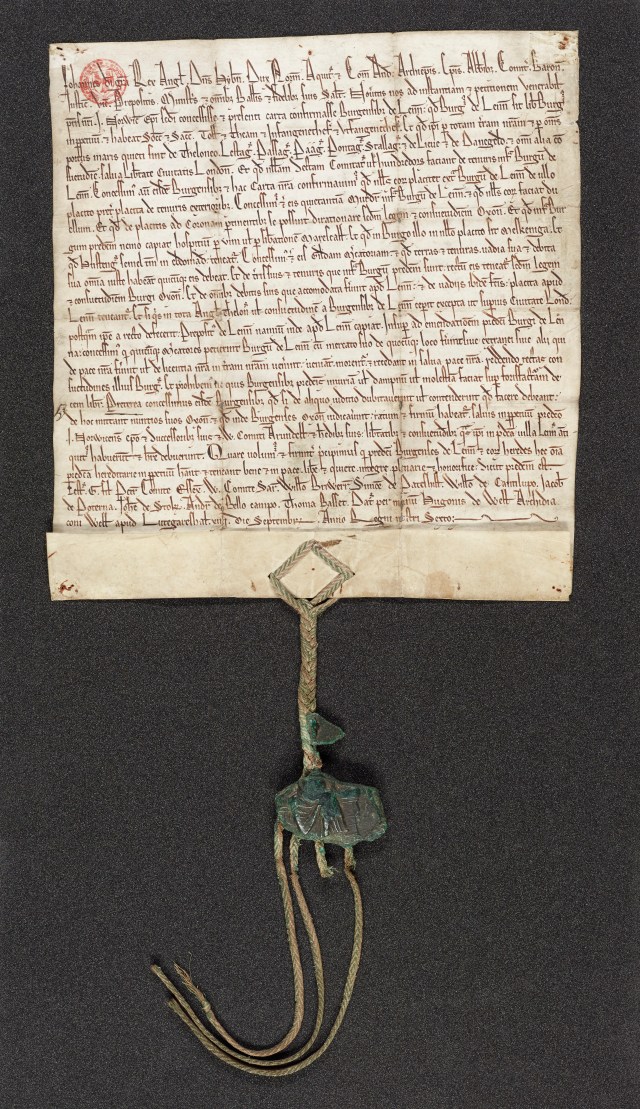
On 15 September 1204, the morning after King John granted Lynn its royal charter, the town probably looked much as it had the day before. Ships came and went on the river, merchants opened their shops, and the Bishop of Norwich remained lord of Lynn. There was no new mayor, elected council, or declaration of independence.
Something important had nevertheless changed. Lynn’s burgesses could now produce a sealed royal document stating that their town was to be a “free borough for ever”. It protected them from numerous tolls, allowed more of their legal business to be settled locally, authorised a merchant gild, and gave them a recognised body of borough law.
The charter did not free Lynn from its bishop. It strengthened the townsmen within the bishop’s lordship.
A charter for an existing town
King John did not found Lynn. By 1204, it was already a thriving port, with markets, merchants, burgage properties, workshops, and ships trading around the North Sea. The charter placed an existing urban community upon firmer legal foundations.
It was issued on 14 September at Ludgershall in Wiltshire. John acted at the request of John de Gray, Bishop of Norwich, who was one of the king’s most trusted administrators. De Gray was therefore closely involved in obtaining privileges for a town which still belonged to his bishopric.
John declared that Lynn was to be a free borough for ever. “Free” had a particular medieval meaning. It did not make the town independent or democratic. It meant that its burgesses possessed defined liberties which distinguished them from people living in ordinary villages and rural manors.
Nor did the word “burgesses” include everyone in Lynn. It referred to a privileged section of the population, principally recognised householders, property holders, and merchants. Servants, labourers, temporary residents, and poorer inhabitants might live within the borough without sharing all its liberties.
A merchant leaves Lynn
The charter’s value becomes clearer if we follow a Lynn merchant on a trading journey.
Medieval commerce was burdened by local charges. A merchant might be asked to pay when he entered a town, crossed a bridge, passed along a road, unloaded a cargo, or erected a market stall. A succession of such payments could substantially reduce his profit.
John’s charter exempted Lynn’s burgesses from toll, lastage, passage, payage, pontage, stallage, Danegeld, and various other customs throughout the king’s lands and seaports. London was expressly excluded because the capital defended its own privileges.
A burgess carrying grain, salt, cloth, fish, or imported goods to another borough could therefore claim exemption from charges imposed upon ordinary outsiders. His status as a Lynn burgess gave him a commercial advantage.
The charter also provided a remedy if another town ignored that exemption. When the offending authority refused justice, Lynn’s reeve could use distraint within Lynn. This probably meant seizing the goods of merchants from the offending place until compensation was made.
The system was collective. If a toll collector mistreated one Lynn merchant, entirely different merchants from the same town might find their goods detained when they arrived in Lynn. Crude though it sounds, this gave the borough a practical means of defending its trading privileges beyond its boundaries.
Justice without leaving home
A burgess could not normally be required to plead outside Lynn over property or agreements arising within the borough. He was also excused from attending county and hundred courts for holdings situated in the town.
This saved time and expense. Travelling to an external court might mean leaving a shop or warehouse unattended, transporting documents, and paying for food and accommodation. Witnesses had to be persuaded to travel as well. A hearing in Lynn kept the dispute close to the people, property, and transactions concerned.
Debts and securities arranged in the town could also be pursued there. Credit was fundamental to medieval commerce. Merchants frequently supplied goods before receiving full payment, while purchases, partnerships, freight charges, and loans created complicated chains of obligation. The ability to enforce an agreement locally made credit less hazardous.
The charter confirmed that Lynn was to have a weekly husting, a borough court particularly associated with property, debt, and local custom. Burgesses were also freed from “miskenning”, a penalty incurred through a procedural mistake when presenting a case. Medieval pleading required exact forms of words, and an error could be expensive even when the underlying claim was sound.
Lynn’s burgesses could not be subjected to trial by combat. The charter also granted them “quittance of murder”. This alarming phrase did not provide immunity for homicide. It referred to exemption from the murdrum, a collective fine imposed in certain circumstances when a person was found dead and the killer was not produced.
Thieves, tolls, and difficult words
The charter granted Lynn “soke and sake, toll and team, infangenthief and outfangenthief”. These imposing words formed a conventional description of legal and commercial privileges.
“Soke and sake” broadly concerned the right to hold a court, hear certain cases, and receive the resulting fines. “Toll and team” covered tolls and procedures for proving ownership or warranty, particularly when goods were suspected of having been stolen.
“Infangenthief and outfangenthief” referred to jurisdiction over thieves caught within the liberty and, in some circumstances, offenders associated with it who were caught elsewhere. The formula implied substantial judicial authority, although it does not tell us how frequently each power was exercised in Lynn.
These rights did not give the burgesses complete control over criminal justice. The bishop still had his own officers, courts, and legal privileges. The boundaries between borough jurisdiction and episcopal lordship were not always clearly drawn.
A gild for Lynn’s merchants
King John authorised Lynn’s burgesses to have a merchant gild. This gave royal recognition to an organised commercial community capable of protecting its members and defending their shared privileges.
Membership helped define who could trade upon favourable terms. An outsider was not necessarily forbidden from doing business in Lynn, but he might have to pay customs or obtain permission from which members of the privileged community were exempt. The gild could regulate aspects of commerce, admit members, settle internal disputes, and represent the interests of its merchants.
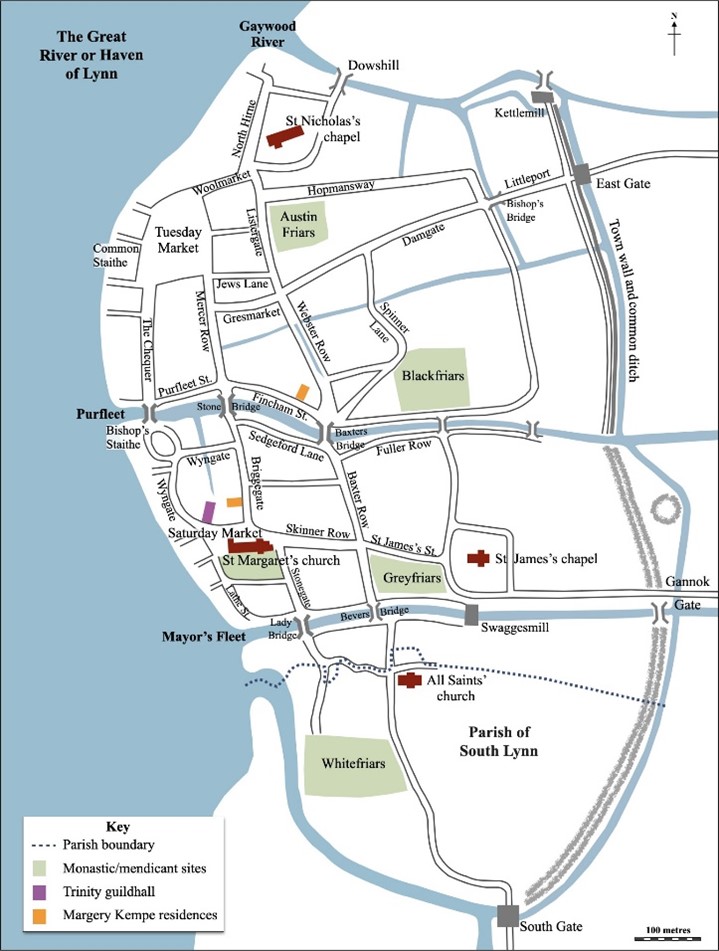
It would be misleading to treat it simply as a medieval town council. A merchant gild combined commercial, social, legal, and religious functions. Nor should it automatically be identified in every respect with Lynn’s later and much better documented Trinity Guild. The town’s gild institutions developed over several centuries, and their membership and responsibilities could overlap without being identical.
When Lynn had to ask Oxford
The charter gave Lynn a surprising connection with Oxford. Its burgesses were to follow the law and custom of Oxford in specified matters. If Lynn’s court was uncertain or divided over a judgement, representatives could travel to Oxford and ask its burgesses what should be done. Oxford’s decision was then to be accepted in Lynn.
This did not place Lynn under Oxford’s government. It gave the town an established model of borough law. Rather than constructing every procedure for itself, Lynn could draw upon the customs of an older borough.
Much of this law rested upon precedent and remembered practice rather than a single written code. The journey to Oxford provided a way of resolving questions which Lynn’s own officials could not answer confidently.
There is an intriguing practical question here. The charter clearly authorised consultation with Oxford, but surviving evidence is needed to establish how often Lynn actually sent messengers there. A legal right written into a charter was not necessarily used regularly.
Protection for visiting merchants
John’s charter also addressed merchants coming into Lynn. English and foreign traders who were at peace with the king, or had permission to enter his territories, were to be allowed to arrive, remain, and depart safely. They were required to pay the lawful customs of the borough but were not to be injured or obstructed.
Lynn therefore received the better end of both arrangements. Its burgesses were exempt from many charges when travelling elsewhere, while visiting merchants paid the customs properly due in Lynn.
Royal protection made the port more attractive. Overseas commerce already involved storms, piracy, shipwreck, war, and rapidly changing prices. Merchants needed some assurance that local officials would recognise their right to trade and that their goods would not be seized arbitrarily.
The charter threatened anyone who injured or harassed Lynn’s burgesses with a forfeiture of £10. That was a formidable sum, although the document alone cannot show how often the penalty was enforced.
No compulsory lodgers
One provision reached directly into the burgess’s home. No one was to take lodgings in Lynn by force or through the authority of the royal marshals.
The movements of the king, his household, officials, and soldiers could impose a heavy burden upon a town. Residents might be expected to supply rooms, food, drink, fuel, fodder, and horses. A large royal party could consume provisions quickly and disrupt ordinary business.
The charter gave Lynn’s burgesses grounds for resisting compulsory billeting. It did not prevent royal servants from visiting the town or arranging accommodation. It meant that official authority was not supposed to be used simply to take over a burgess’s house.
For an ordinary householder, that protection may have been more immediately understandable than the grand legal language concerning soke, sake, and outfangenthief.
The bishop still ruled Lynn
The final saving clause placed a firm limit upon the burgesses’ liberties. The charter preserved the existing rights and customs of John de Gray and his successors as bishops of Norwich. It also protected those of William d’Aubigny, Earl of Arundel, and his heirs.
Lynn had become a free borough, but it remained within the Bishop of Norwich’s lordship. The bishop retained property, revenues, courts, officials, and customary authority. The charter gave the burgesses greater freedom to conduct their own affairs without transferring ownership of the town to them.
It did not grant Lynn a mayor. The reeve remained the principal official named in the document, and the town would not receive its fully incorporated mayoral constitution until Henry VIII’s charter of 1524.
The settlement contained the seeds of later conflict. The burgesses could point to royal confirmation of their liberties, while the bishop could point to the clause preserving his ancient rights. Neither side possessed an entirely free hand.
The parchment in the courtroom
The charter’s greatest practical value appeared whenever someone challenged Lynn’s customs. A privilege based only upon memory could be questioned. A privilege recorded in a royal charter carried the authority of the king’s seal.
A Lynn merchant confronted by a toll collector elsewhere could claim exemption. A burgess summoned to an outside court could insist that a local matter belonged in Lynn. The town could defend its merchant gild, its weekly court, and its right to collect customs from visiting traders.
The charter did not produce an independent borough on 14 September 1204. It gave an established group of burgesses firmer control over trade, debts, property, and legal procedure while leaving the bishop’s lordship intact. For centuries afterwards, Lynn preserved the document because those carefully worded rights remained worth defending.
© James Rye 2026
Book a Guided Tour with a Trained and Qualified King’s Lynn Guide Through Historic Lynn
References
- Hudson, John. The Oxford History of the Laws of England. Volume II: 871–1216. Oxford: Oxford University Press, 2012.
- Norfolk Record Office. “One of King’s Lynn Borough Archives’ Earliest Documents: The Charter of King John to the Burgesses of Lynn, 14 September 1204.” 21 October 2016. https://norfolkrecordofficeblog.org/2016/10/21/one-of-kings-lynn-borough-archives-earliest-documents-the-charter-of-king-john-to-the-burgesses-of-lynn-14-september-1204/
- Owen, Dorothy M., ed. The Making of King’s Lynn: A Documentary Survey. Records of Social and Economic History, New Series 9. London: British Academy, 1984.
- Phillips, Megan. “Urban Conflict and Legal Strategy in Medieval England: The Case of Bishop’s Lynn, 1346–1350.” Urban History 42, no. 3 (2015): 365–382. https://doi.org/10.1017/S096392681500009X