Behind the former Methodist chapel near London Road stands a fragment of flint wall containing a broad, altered window. It is an unassuming remnant of what was once one of medieval Bishop’s Lynn’s principal places of worship.

St James’ was no wayside chapel. It was a large cruciform church, with a nave, transepts, chancel and central tower. Priests celebrated Mass there every day. Religious guilds maintained decorated altars, and crowds gathered in its churchyard to hear sermons. Margery Kempe worshipped there, while William Sawtry publicly renounced his alleged heresies before the bishop and townspeople.
Yet St James’ did not survive the Reformation. Its plate was sold, its guild priests disappeared and most of the building was pulled down. Stone, timber, glass and lead were carried away. What remained became a municipal workhouse.
Why did Lynn dismantle a functioning church, while preserving both St Margaret’s and St Nicholas’?
A chapel for an expanding town
The precise foundation date is uncertain. Older local accounts sometimes give 1135 or attribute the chapel to William Turbe, Bishop of Norwich from 1146. The architectural and documentary evidence establishes only that St James’ existed before 1146. It may have been founded during the episcopate of Turbe’s predecessor, Bishop Eborard, who held the see from 1121 to 1145.
St James’ stood about 400 metres east of St Margaret’s, towards the inland edge of the developing town. The direct route between them survives as St James’ Street. Its construction suggests that Bishop’s Lynn was spreading away from the river and the Saturday Market Place.
Like St Nicholas’ in the Newland, St James’ was a chapel of ease. It belonged to St Margaret’s parish but allowed people living further from the mother church to attend services closer to their homes.
The comparison with St Nicholas’ is revealing. Both began as subsidiary chapels, but St Nicholas’ served a densely inhabited northern district and continued to grow. The eastern area served by St James’ remained more lightly populated, with gardens and open land nearby. When the Reformation forced Lynn to reconsider how many churches it required, St James’ was the easier chapel to lose.
A substantial medieval church
The earliest building was Norman, although much of it was reconstructed around 1300. The medieval church was cruciform, its nave reportedly measuring about 100 feet by 24 feet, excluding the crossing and eastern end. An octagonal tower rose above the crossing, and the chancel had narrow side aisles.
The surviving fragment contains reused twelfth-century limestone, including moulded stones and what may be part of a Norman cushion capital. Until the collapse of the central tower in 1854, the original crossing piers were still visible beneath later work.
The size of the building reflects the importance of the chapel. St James’ served its own district of Lynn, probably including parts of Damgate, now Norfolk Street, Broad Street, Black Boy Street and Codling Lane. In 1361 the town authorities ordered the clerks of St James’ to carry holy water through the southern part of Damgate and Webster’s Row. The clergy of St Nicholas’ were assigned the northern side.
The guild priests who kept St James’ alive
Before 1547, the religious life of St James’ depended heavily upon priests supported by Lynn’s guilds.
The most powerful fraternity in the town was the Guild of the Holy and Undivided Trinity. It maintained thirteen chaplains: six at St Margaret’s, four at St Nicholas’ and three at St James’. These were not simply occasional visiting priests. They formed part of the regular religious establishment of the town’s churches.
Their duties included daily prayers for the king, the welfare of the kingdom and the members and benefactors of the Trinity Guild. They also celebrated Masses for deceased guild members and for “all the faithful departed”. Medieval people believed that prayers and Masses could assist souls passing through Purgatory, so maintaining priests after one’s death was a serious religious obligation.
The three Trinity Guild chaplains therefore provided St James’ with an important part of its regular ministry. Other fraternities supported their own altars and observances within the chapel, and there may have been additional priests maintained by private endowments.
Among the devotional sites inside St James’ were an altar of St Lawrence, a chapel dedicated to the Trinity and an altar used by the Guild of St Giles and St Julian. The latter owned embroidered curtains, cushions, brass candlesticks and painted altar cloths. One showed the Virgin and Child, while another represented the Annunciation.
At the east end stood a revered image of Christ where worshippers left offerings. Such images, lights, altars and guild Masses were central to the religious life of St James’. After 1547, almost every one of them became vulnerable.
A stage for public religion
St James’ churchyard was large enough to hold public gatherings. On 25 May 1399, William Sawtry, a Lynn priest accused of heresy, made a public recantation there before Henry Despenser, Bishop of Norwich, local clergy and townspeople.
Sawtry had questioned accepted teaching about the Eucharist, images and pilgrimages. He later returned to his former opinions and was burnt at Smithfield in 1401, becoming the first person executed under the statute against relapsed heretics.
A generation later, St James’ appeared in The Book of Margery Kempe. On St James’ Day, a celebrated friar preached in the chapel yard. Margery’s conspicuous weeping angered him, and he refused to allow her to hear his sermons unless she stopped crying. His hostility encouraged some townspeople to accuse her of deceit or possession.
These episodes show that St James’ was not a neglected neighbourhood chapel. It was a recognised setting for preaching, religious discipline and crowded public worship.
The dismantling begins
The first clear step towards closure came before Edward VI’s Protestant government.
On 17 December 1544, Lynn Corporation ordered the sale of what it described as the unnecessary plate belonging to St James’. The town had recently suffered damage through the “raging of the sea”, and the proceeds were used to repair its broken sea walls. The Corporation undertook to pay an annual sum of £1 6s 8d in compensation.
The chapel did not necessarily close at once. A church could continue using less valuable vessels. The decision nevertheless revealed that the Corporation was already treating its religious property as a civic asset.
A chalice or other piece of church silver had value because it was used at the altar. Once sold, it acquired a different value: it could help maintain the banks protecting Lynn from flooding. The removal of the plate anticipated the more destructive changes that followed.
St James’ decline and closure
No surviving record identifies the date of the final service. Its closure must be reconstructed from the stripping and alteration of the building.
| Date | Stage in the chapel’s decline |
|---|---|
| 17 December 1544 | The Corporation sold plate considered unnecessary and used the proceeds to repair sea defences damaged by the “raging of the sea”. |
| 1547 | Edward VI’s Chantries Act suppressed chantry and guild endowments. The financial system supporting the three Trinity Guild chaplains and other endowed services at St James’ was dismantled. |
| 1548 | Historic England dates the demolition of the nave to this year. Regular public worship probably ended by this point. |
| 1549 | William Richards and the principal archaeological study give 1549 for the removal of the nave. Demolition may have begun in 1548 and continued into the following year. |
| 1550 | Four bells were reportedly sold to help buy artillery. Orders allowed the Corporation to take lead, timber and stone, although the timberwork of the choir was to be preserved and covered with tiles. |
| 1559 | The remaining structure was extensively robbed of reusable materials. |
| 1561 | The retained choir and transepts were re-roofed, but the building was not restored as a public chapel. |
| 1566 | The Dean and Chapter of Norwich formally surrendered their remaining rights in St James’ to Lynn Corporation. |
| 1568 | The Duke of Norfolk was allowed to remove twenty loads of freestone from the disused chapel. |
| 1580–82 | The surviving crossing, transepts and eastern end were converted into a workhouse. |
The safest conclusion is that St James’ ceased to function as a regular public chapel in or shortly before 1548. The destruction continued over several years, while the legal ownership was not fully settled until 1566.
Why did St James’ close?
It is often said that St James’ was closed during the Dissolution of the Monasteries. That is broadly correct as a description of the period, but legally misleading. St James’ was not a monastery. It was a parochial chapel belonging to St Margaret’s, although its ecclesiastical rights had been connected with Norwich Cathedral Priory.
William Richards regarded its closure as puzzling because it was a public place of worship rather than a conventual church. One possibility is that officials treated it as former monastic property because of its relationship with Norwich Priory. The archaeological study of the chapel offers a more convincing explanation: St James’ probably fell victim to the reorganisation of Lynn’s churches and was judged surplus to local requirements.
The destruction of its guild-supported ministry was decisive. St James’ had relied upon three Trinity Guild chaplains, supplemented by priests and observances attached to other fraternities and endowed altars. When the government abolished religious guilds and confiscated property supporting prayers for the dead, the chapel lost much of the system that kept its altars active.
Protestant reform also rejected the devotional practices around which St James’ had developed. The revered image of Christ, offerings before images, Masses for departed souls and guild-sponsored lights were no longer acceptable. The building might theoretically have been adapted for Protestant worship, but Lynn already possessed St Margaret’s and the heavily used St Nicholas’.
There was a financial incentive to close it. Plate could be sold. Lead, timber, iron, glass and freestone were valuable commodities in a region where good building stone was scarce. Some materials went to St Margaret’s, windows were later reused at St Nicholas’, and the Duke of Norfolk carried away freestone for building work in Norwich.
St James’ was therefore not destroyed for one simple reason. Its ministry lost its funding, its traditional worship was prohibited and the Corporation considered the chapel less necessary than Lynn’s other principal churches. Once that judgement had been made, the building itself became a quarry.
From prayers for the dead to work for the poor
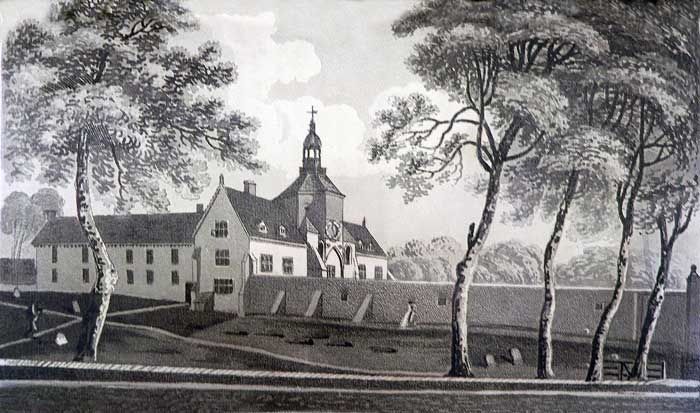
In October 1580, the Corporation began planning to turn the surviving structure into a workhouse. The poor were to be employed making baize, a coarse woollen cloth, and £600 was allocated for alterations. The scheme was operating by the early 1580s, although the attempt to establish a successful cloth industry soon failed.
The old chapel subsequently became inseparable from Lynn’s treatment of poverty. During the plague outbreak of 1597–98, infected people were sent to St James’, then sometimes called the “new house”.
In 1681–82 the remains were reconstructed as an orphanage, hospital and workhouse, possibly with the involvement of Henry Bell. A clock tower and octagonal belfry rose over the medieval crossing. The Latin inscription above the entrance declared that the new institution had been built from the ruins of St James’ Chapel.
Religious observance continued inside the workhouse, but this was not a revival of the medieval chapel. The children attended Sunday services at St Margaret’s, while prayers and instruction took place in an internal room described as the workhouse chapel.
In August 1854, the central tower and the old crossing arches collapsed, killing a workman and one inmate. A new Union Workhouse was subsequently erected on Exton’s Road. Most of what remained at St James’ was cleared in 1910.
The last wall
St James’ Chapel was not abandoned because medieval Lynn had ceased to need religion. It was selected because the Reformation had removed the guild priests, endowed Masses and devotional customs upon which it depended. St Margaret’s remained the mother church, while St Nicholas’ served a larger and more densely inhabited district.
The small surviving wall near County Court Road is therefore more than a fragment of an old church. It marks the place where Lynn’s medieval religion was converted into something tangible and saleable. Plate became sea defences. Bells helped provide weapons. Windows, timber and carved stone were taken for other buildings.
The chapel disappeared piece by piece, and the town found new uses for almost everything.
© James Rye 2026
Book a Walk with a Trained and Qualified King’s Lynn Guide
References
Batcock, Neil. The Ruined and Disused Churches of Norfolk. East Anglian Archaeology 51. Dereham: Norfolk Archaeological Unit, 1991.
Hillen, Henry J. History of the Borough of King’s Lynn. 2 vols. Norwich: East of England Newspaper Company, 1907.
Historic England. “Ruins of St James’ Chapel, County Court Road, King’s Lynn.” National Heritage List for England, entry 1298188.
Kempe, Margery. The Book of Margery Kempe. Edited by Sanford Brown Meech and Hope Emily Allen. London: Oxford University Press, 1940.
Richards, William. The History of Lynn. 2 vols. Lynn: W. G. Whittingham, 1812.