The book rather than the monument
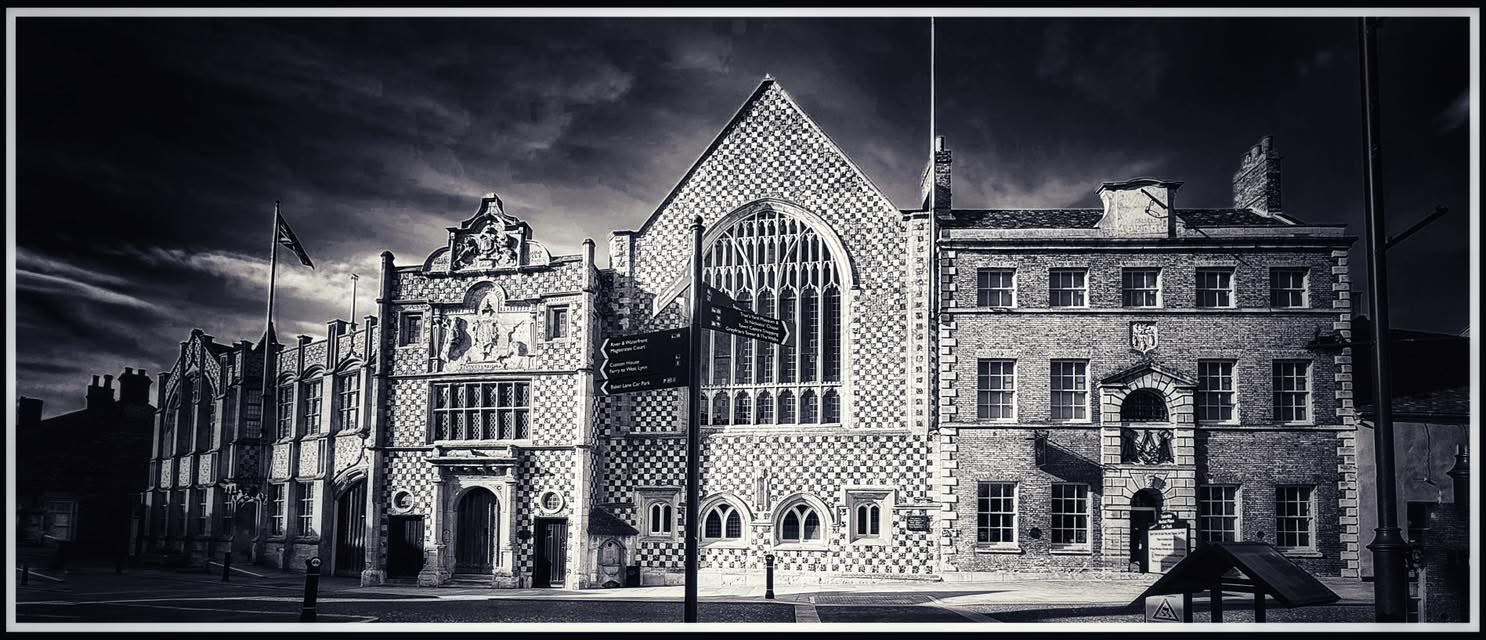
King’s Lynn has never lacked visible evidence of its medieval importance. The Guildhall still holds the eye. St Margaret’s, now King’s Lynn Minster, gives scale to the old town’s ecclesiastical ambition. The quays and streets still hint at the trade that turned Bishop’s Lynn into one of the great ports of eastern England.
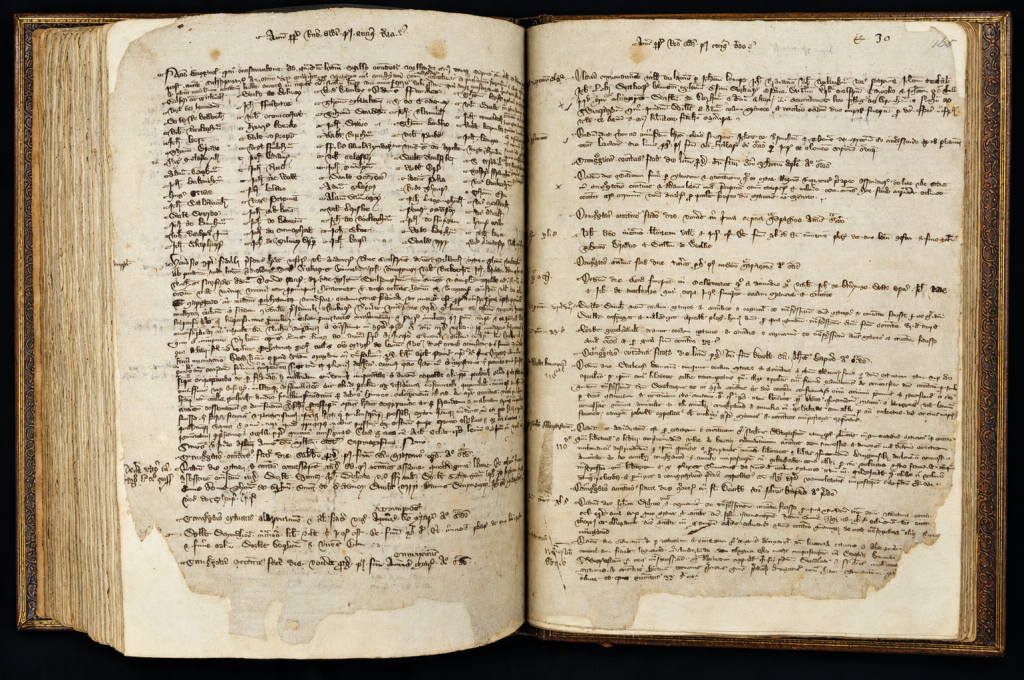
The Red Register is less obvious. It is not a tower, a gate, a chapel, or a merchant’s house. It is a book: practical, administrative, and densely written. Yet few survivals from medieval Lynn are more revealing.
Now part of the King’s Lynn Borough Archives and catalogued as KL/C 10/1, the Red Register dates broadly from about 1300 to 1395. UNESCO describes it as an exceptionally early paper book, reputedly the earliest archival paper book in England, and as the core record of Lynn’s borough government for almost the whole of the fourteenth century. It contains civic memoranda, wills, deeds, and records of matters brought before the mayor and community in the Guildhall.
It was not made to impress posterity. It was made because the town needed a reliable memory.
Bishop’s Lynn in its wider sea
In the fourteenth century, King’s Lynn was still Bishop’s Lynn, held under the lordship of the Bishop of Norwich. Its prosperity rested on geography. The town stood where inland routes and sea routes met: the Great Ouse, the Wash, the waterways of eastern England, and the North Sea world beyond.
Lynn traded with France, the Low Countries, Scandinavia, Iceland, and the Hanseatic towns of Germany. UNESCO describes it as England’s third most important port in this period.
That status created paperwork. Trade brought agreements, debts, tolls, inheritances, property transfers, disputes, and civic privileges. A port that handled people, property, goods, and money needed records. The Red Register belongs to that world of proof.
A medieval port was not only a waterfront. It was also an archive.
Paper in a parchment age
One reason the Red Register is so remarkable is its material. It was written on paper at a time when major English records were still commonly written on parchment, the prepared skin of animals. Paper was becoming more available, but it was still a newer material in English archival practice.
The Norfolk Record Office notes that the paper was almost certainly imported from continental Europe. That suits Lynn perfectly. The book’s physical fabric belongs to the same commercial world as the town whose business it records.
So the Red Register tells two stories at once. Its entries record a borough. Its pages record a network.
A town that even recorded its toilets
The best way to understand the Red Register is to notice how practical it is.
One entry from the reign of Edward II records the common consent of Lynn for John de Walton to make “a common chamber with necessaries” in a common lane, for the convenience of the town. The Historical Manuscripts Commission printed the Latin summary: the “communa Lenne”, the community of Lynn, gave licence for this facility to last “imperpetuum”, permanently.
In plainer English, this was civic permission for a public convenience. The Norfolk Record Office’s modern summary rightly includes public toilets among the kinds of works recorded in the Red Register.
That single entry is wonderfully useful. It reminds us that medieval town government was not only charters, seals, robes, and solemn words. It was also sanitation, lanes, permission, maintenance, and collective agreement. Lynn’s leaders were not just defending privileges. They were trying to make a crowded town function.
The Guildhall as a place of memory

Much of the register concerns business brought before the mayor and community in the Guildhall. The Guildhall was not just a grand civic setting. It was where decisions were made, witnessed, and written down.
The register records admissions of burgesses, elections of the mayor, taxes raised for town business, and money needed for public works, including defence.
The evidence can be very precise. On 9 October in the forty-eighth year of Edward III, that is 1374, a committee of twelve burgesses was appointed and sworn to choose two “prudent and discreet” men to attend the king’s parliament at Westminster. They selected Robert Bathe and John Waryn as Bishop’s Lynn’s representatives. The Historical Manuscripts Commission described this as the earliest Red Register memorandum of a named election of two men to represent the borough in parliament.
That is a small but sharp window into Lynn’s political world. Parliamentary representation existed, but it was not a modern popular election. The choice was made through a committee drawn from the ruling civic body. Ordinary burgesses were not all standing in line to vote. The register shows government as it operated: ordered, restricted, and controlled by the town’s leading men.
Wills, property, and the borough court
The Red Register is especially rich in wills. These were not simply private family documents. In a borough such as Lynn, wills concerning tenements, rents, and burgage property had to be made secure in civic record.
One example is the will of John Burghard, made on 5 April 1339 and proved in the borough court on 18 August 1344. The record states that the will, so far as it concerned tenements and rents, was approved before Adam de Walsoken, then mayor of Lynn, John de Swerdestone, then alderman, and the whole community of the borough then present in the hall.
That gives us a vivid picture. A will was not merely a dying man’s instruction. It was brought into the public machinery of the town. Property, inheritance, and civic authority met in the Guildhall. The seal of the mayoralty gave the transaction force.
A technical phrase helps here. A “tenement” was not simply a building in the modern sense, but a piece of property held by a person, often including the buildings and rights attached to it. A “burgage” was a form of town property holding, usually associated with the rights and obligations of a burgess. The Red Register cared about such things because they shaped wealth, family security, rent, and civic status.
John Ode’s family, 1307
One of the most human examples comes from the will of John Ode in 1307.
John Ode left his immovable property and annual rents to his three sons and four daughters, but with a major condition: his children were not to take possession until after the death of their mother, Alice. His son John was to inherit the capital messuage in Wyngate. His son Michael was to inherit a messuage near Meyrisflete called Duffecoteyard. His third son, James, was a Dominican friar and received an annual rent of 10 shillings for his needs. His four daughters, Margaret, Muriel, Etheldreda, and Agnes, each received annual rents, varying between 20 and 33 shillings. Ode also allowed his wife, if necessary, to sell four shops that he had left her.
That is a compact family drama. The widow is protected. The sons receive named property. The daughters receive income. The friar son is not forgotten. Shops can be sold if need presses.
The details also place the family inside the town. Wyngate and Meyrisflete are not decorative names. They are fragments of Lynn’s urban map. A will in the Red Register can therefore tell us about inheritance, gender, religion, family strategy, rental income, shops, streets, and neighbourhoods all at once.
1349: the register and the Black Death
The Red Register also catches Lynn in crisis.
A later analysis of Lynn wills shows that more than 14 per cent of the wills studied, eighteen in all, were concentrated in the six months between the end of March 1349 and the end of September 1349. The list includes Henry de Betele on 25 March, Philip Wythe on 9 April, Margeria de Betele on 16 April, Adam de Walsoken on 28 April, Richard de Wottone on 13 May, John de Wigenhale on 15 May, John de Walsingham on 20 May, Thomas de Melchebourne on 26 May, William Erl on 9 June, John de Swerdstone senior on 17 June, and others through to William de Massingham on 30 September.
The Red Register does not need to say “the Black Death has arrived” for the pressure to be visible. The dates do the work. Wills crowd into the months when plague was tearing through English towns.
That is one of the reasons the register is so moving. It does not write history as a story of catastrophe. It records business. But the business itself becomes evidence of fear, illness, death, inheritance, and hurried settlement.
Unborn children and anxious fathers
The wills also preserve intimate worries.
Eustach de Toftes, in 1309, made provision for a child not yet born and stated that he would make no difference whether the child was male or female. The child was to receive an annual rent of 4 shillings from a capital messuage in Dampgate. Peter de Melchebourne, in 1350, left £5 and a tenement in Briggegate to the child in the womb of his wife Alice, “God granting it to be born.” William de Swanton, in 1361, made provision for an expected child if it should be male, giving instructions involving two messuages and a wharf.
These entries are formal, but they are not cold. They show fathers trying to arrange a future they might not live to see. They also show how property, gender, expectation, and family continuity were bound together in a mercantile town.
A wharf was not a sentimental gift. In Lynn, it could be part of a commercial life.
The people behind the property
The Red Register’s wills are weighted towards Lynn’s upper civic and mercantile society. Jacques Beauroy’s study of Bishop’s Lynn will-makers found that many testators belonged to the richer part of the town’s society. Among twenty-one will-makers who also appeared in the 1332 lay subsidy list, seventeen were in the upper third of taxpayers. The known occupations include smith, tailor, apothecary, butcher, merchant, carpenter, tavern-keeper, and mercer. Twenty-two of the will-makers were mayors of Lynn in the fourteenth century.
That does not make the register less valuable. It tells us whose voices the civic archive preserves most clearly: burgesses, office-holders, merchants, property-owners, and families with something to pass on.
But through them we also glimpse others: wives, daughters, servants, apprentices, clerics, friars, neighbours, tenants, and unnamed townspeople affected by the decisions of the powerful.
Not the lost Red Book
A necessary caution belongs here, because the names are easily confused. The surviving Red Register is not the same as the lost Red Book of Lynn.
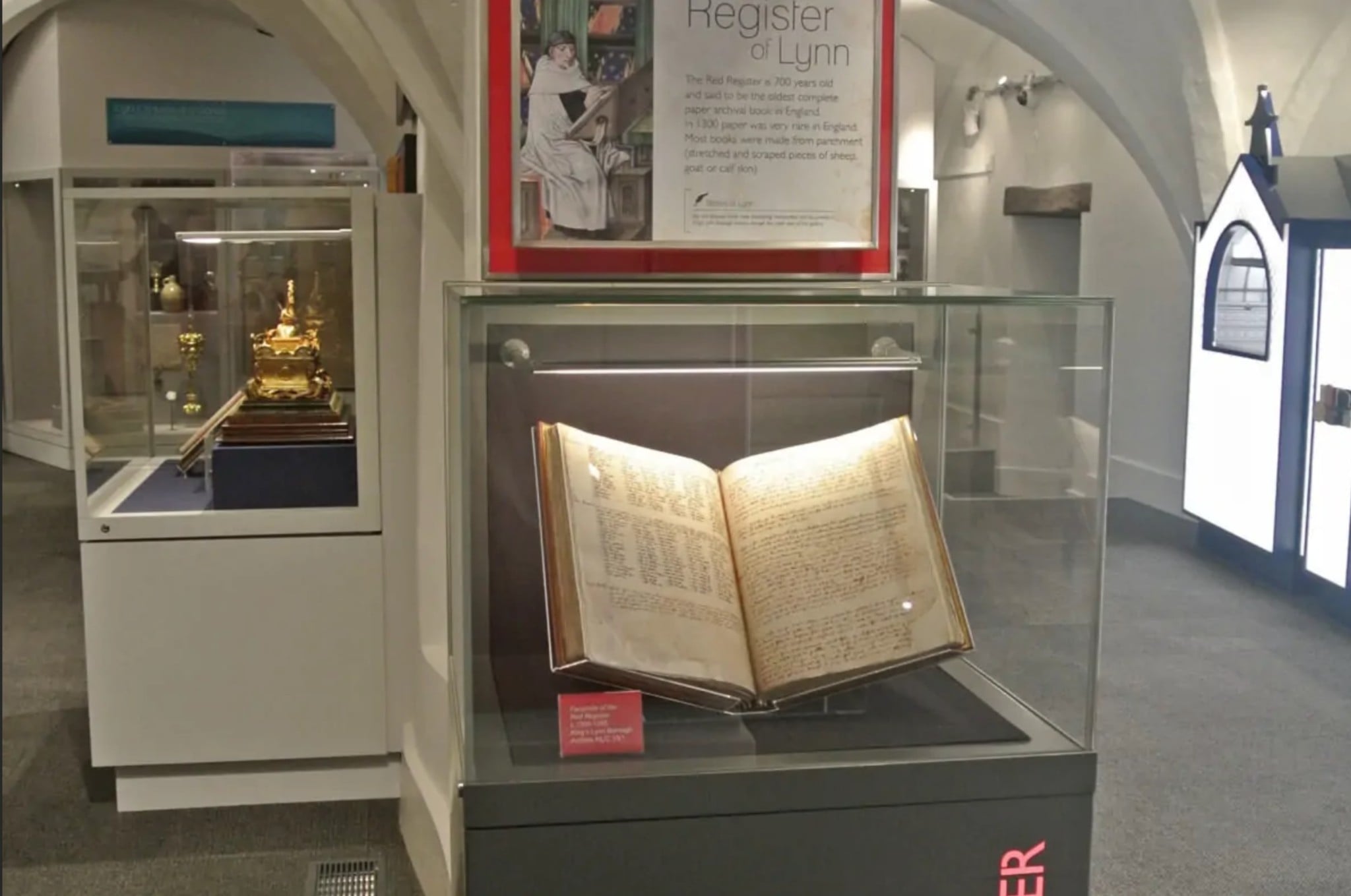
Holcombe Ingleby, who edited the early twentieth-century printed edition of the Red Register, warned that the two had often been mistaken for one another. The lost Red Book seems to have contained charters and corporation memoranda beginning early in the reign of Edward III and continuing at least into the reign of Richard II. Ingleby knew references to it between about 1340 and 1550, including one in which it was to be taken to counsel at Thetford for use in a lawsuit.
He suspected that the book may have left the borough archives through antiquarian hands, perhaps in connection with Francis Blomefield and Thomas Martin of Palgrave, but he could not prove the circumstances of its disappearance. The distinction should remain clear. The Red Book is a missing source known from references. The Red Register is the surviving manuscript.
From working record to recognised treasure
The Red Register did not begin life as a treasure. It became one because it survived.
It was made accessible through the edition transcribed by R. F. Isaacson and edited by Holcombe Ingleby, published in King’s Lynn by Thew in two volumes between 1919 and 1922. HathiTrust lists the work as two volumes, with plates and facsimiles.
Today the register is held by the Norfolk Record Office in partnership with the Borough Council of King’s Lynn & West Norfolk. It forms part of the wider King’s Lynn Borough Archives, one of the finest borough collections in the country, with records dating back to the 1200s.
Its recognition through the UNESCO UK Memory of the World National Register is fitting. UNESCO lists its year of inscription as 2024 and identifies the nominating institution as the Norfolk Record Office.
The page and the port
The Red Register holds together two scales of history that are often separated. On one scale, it is intimate: John Ode protecting Alice, his widow; a Dominican son receiving rent for his needs; unborn children given property before birth; families trying to make order before death.
On another scale, it is civic and international: imported paper, Guildhall government, parliamentary representation, borough taxation, public works, North Sea trade, and one of medieval England’s busiest ports.
That is why it is such a satisfying survival. Buildings can tell us that Bishop’s Lynn was prosperous. The Red Register tells us how prosperity was organised, recorded, inherited, taxed, disputed, and remembered.
© James Rye 2026
Book a Guided Tour with a Trained and Qualified King’s Lynn Guide Through Historic Lynn
References
Beauroy, Jacques. “Family Patterns and Relations of Bishop’s Lynn Will-makers in the Fourteenth Century.” In Lloyd Bonfield, Richard M. Smith, and Keith Wrightson, eds., The World We Have Gained: Histories of Population and Social Structure. Oxford: Basil Blackwell, 1986. Available through Internet Archive: https://archive.org/stream/TheWorldWeHaveGained/TheWorldWeHaveGained_djvu.txt
Da Rold, Orietta. Paper in Medieval England: From Pulp to Fictions. Cambridge: Cambridge University Press, 2020. https://www.cambridge.org/core/books/paper-in-medieval-england/paper-stories/25397A85B75961170D6B14F30841A1C4
Great Britain. Historical Manuscripts Commission. The Manuscripts of the Corporations of Southampton and King’s Lynn. London: Eyre and Spottiswoode, 1887. Online text: https://www.calameo.com/books/005828276931dbe123a88
HathiTrust. “Catalog Record: The Red Register of King’s Lynn.” https://catalog.hathitrust.org/Record/008887230
Ingleby, Holcombe, ed. The Red Register of King’s Lynn. Transcribed by R. F. Isaacson. 2 vols. King’s Lynn: Thew, 1919–1922. https://catalog.hathitrust.org/Record/008887230
Ingleby, Holcombe. “The ‘Red Book’ of Lynn.” Notes and Queries, Series 12, vol. 10, 1922, 344. https://en.wikisource.org/wiki/Page:Notes_and_Queries_-Series_12-_Volume_10.djvu/422
Norfolk Record Office. “An Introduction to the King’s Lynn Borough Archives.” 30 September 2016. https://norfolkrecordofficeblog.org/2016/09/30/an-introduction-to-the-kings-lynn-borough-archives/
UNESCO in the UK. “The Red Register of King’s Lynn, 14th Century Paper Register.” https://unesco.org.uk/our-network/memory-of-the-world/the-red-register-of-kings-lynn-14th-century-paper-register
Borough Council of King’s Lynn & West Norfolk. “King’s Lynn’s Medieval ‘Red Register’ Recognised by UNESCO.” 9 June 2026. https://www.west-norfolk.gov.uk/news/article/2059/king_s_lynn_s_medieval_red_register_recognised_by_unesco