Source: https://www.kingslynncivicsociety.co.uk/heritage/marriotts-warehouse/
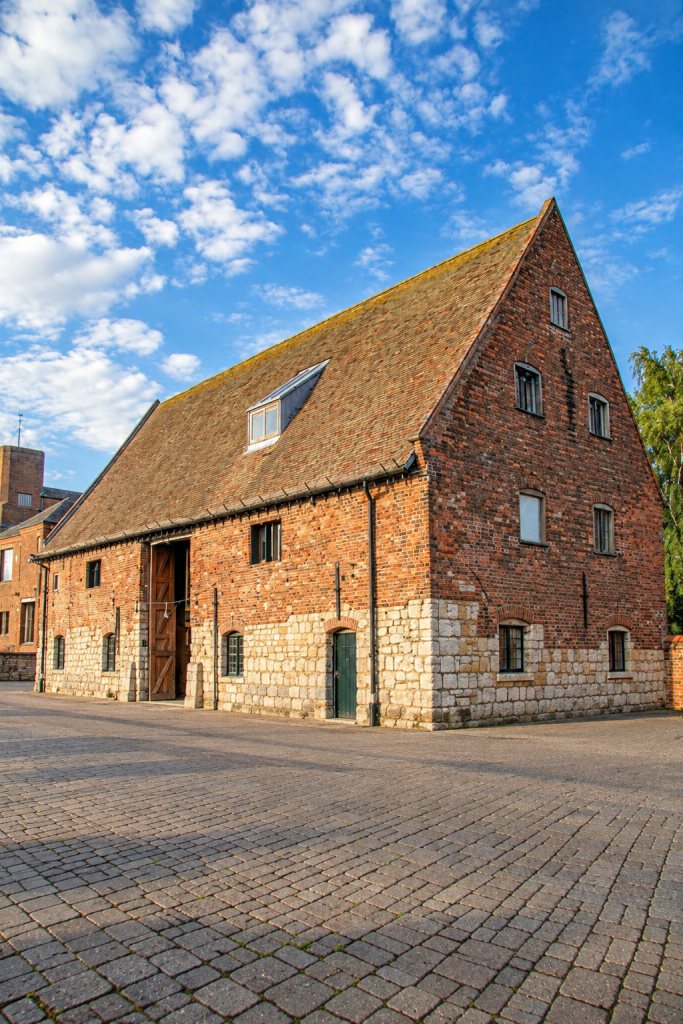
Marriott’s Warehouse has been standing beside the Great Ouse for so long that its familiar name is almost misleading. The Marriotts belong to only the later chapters of its history. Beneath the brick upper storeys is stonework dating from the early fourteenth century. Before the Marriotts came the Claybornes, one of Tudor Lynn’s leading merchant families. Before them there was Pygot’s Stand, a medieval quay on a waterfront that looked very different from South Quay today.
The building is therefore not simply a Tudor warehouse constructed around 1580, as it is sometimes described. It is the product of perhaps seven centuries of rebuilding and commercial use.
Pygot’s Stand
Historic England dates the ashlar stone ground floor to the early fourteenth century and suggests that the original building may have been single-storeyed, standing on an island in the Ouse estuary and perhaps reached by a causeway. Medieval Lynn did not have the neat river frontage we recognise today. Creeks, fleets, quays, reclaimed ground, and islands formed a constantly changing boundary between town and river.
By the fifteenth century this site was known as Pygot’s Stand. John and Simon Pygot were associated with its development towards the end of the century. A “stand” was a working landing place or quay where merchandise could be landed, held, and loaded again. Long before anyone called the building Marriott’s Warehouse, therefore, this was already a place where Lynn made money from the river.
The Claybornes Rebuild
The next major change came with the Clayborne family. By the later sixteenth century they controlled Pygot’s Stand and were prosperous merchants dealing particularly in corn and salt. Thomas Clayborne the elder, who became mayor of Lynn in 1573, is closely associated with the great rebuilding of about 1570–80. Brick upper storeys were added above the older stone structure, creating something much closer to the warehouse standing today.
Its architecture was dictated by trade. Heavy timbers supported floors loaded with merchandise, while large openings allowed goods to be moved in and out. Corn and salt were stored inside, and coal was probably kept outside. Doors and windows were subsequently altered as each generation adapted the building to its own requirements.
The Claybornes also give the warehouse an unexpected connection with early America. Thomas’s son, another Thomas Clayborne, followed his father into Lynn’s merchant elite and became mayor in 1592. His son William Claiborne, born in 1600 after the family had moved towards Kent, sailed to Virginia in 1621 as a surveyor for the Virginia Company. He became a prominent merchant, colonial administrator, and political figure in Virginia and Maryland. A family whose wealth had been rooted partly in the commercial world of Tudor Lynn had moved, within three generations, into England’s expanding Atlantic world.
Was It Really Hanseatic?
Marriott’s Warehouse was once commonly called the “Hanseatic Warehouse”, but the description needs qualification. Lynn certainly had close commercial relations with the Hanseatic towns of northern Europe, and German merchants were a familiar presence on its waterfront. Their much better documented base, however, was nearby Hanse House.
Historic England describes Marriott’s Warehouse only as “possibly” connected with the Hanseatic League. There is no need to exaggerate that connection. The warehouse already has a substantial history of its own as part of Lynn’s international trading waterfront, and its association with local merchants such as the Claybornes is much better supported.
The Missing Years
What happened after the Claybornes is less clear. The building certainly remained in commercial use and continued to change. Some of its surviving shuttered windows probably date from the later eighteenth century, while other blocked openings reveal repeated attempts to adapt an old structure to new purposes.
There is, however, a frustrating gap in our knowledge. The ownership and occupation of the warehouse through much of the seventeenth and eighteenth centuries have not yet been satisfactorily reconstructed. Somewhere among property deeds, borough rentals, wills, rate books, and land-tax records there may be a chain connecting the Clayborne property with the warehouse later occupied by the Marriotts.
The Marriotts and the River Nar
By 1845 a Marriott corn merchant was associated with the warehouse. The family had already built a substantial business involving corn, coal, malt, river transport, and eventually agricultural fertiliser.
The Marriotts’ interests stretched far beyond South Quay. John and Robert Marriott inherited commercial interests developed by their father, the Rev. Robert Marriott, and became closely involved with navigation on the River Nar. Barges linked King’s Lynn with their businesses around Narborough. Coal and imported materials could travel inland from the port, while agricultural produce moved towards Lynn. The brothers also developed the Narborough Bone Mill, where animal bones, some imported through Lynn, were crushed to make agricultural fertiliser.
Seen in this context, Marriott’s Warehouse was more than an isolated granary. It stood at the seaward end of a commercial network reaching into rural Norfolk. By 1878 Marriott interests were also operating granaries and maltings associated with nearby Hanse House. Their presence on the waterfront became substantial enough for their name eventually to eclipse the earlier identities of the building.
The Warehouse Survives
The setting changed around it. River engineering and reclamation altered the relationship between the warehouse and the Ouse, leaving a building created for waterside trade farther from the river than it had once been. Railways, larger ships, new docks, and modern cargo handling gradually made warehouses of this kind less useful.
Marriott’s Warehouse nevertheless survived. It was listed in 1951 and is now Grade II*. After serious deterioration, restoration in the late twentieth century secured the building, which later housed the Green Quay interpretation centre. Today it combines restaurant use with the heritage and educational work of the Marriott’s Warehouse Trust.
Its history can still be read in the fabric. At ground level is stone from medieval Lynn. Above it rises the brick warehouse associated with the commercial ambitions of the Claybornes. Later windows, blocked openings, altered doors, and heavy internal timbers record centuries of practical change.
And the name above the door belongs to only part of the story. Before Marriott’s Warehouse there was the Clayborne warehouse. Before the Claybornes there was Pygot’s Stand. Beneath them all remains a fragment of the waterfront where medieval Lynn first turned the river into trade.
© James Rye 2026
Book a Guided Tour with a Trained and Qualified King’s Lynn Guide Through Historic Lynn
References
Bonemill.org.uk. “A Brief History of Narborough Bone Mill.” https://bonemill.org.uk/images/Downloads/BriefHistoryA4.pdf
Claiborne Society. Claiborne Newsletter. October 2008. https://www.claibornesociety.org/newsletters/Claiborne_Newsletter_Oct_2008.pdf
Historic England. “Hanse House.” National Heritage List for England, no. 1195393. https://historicengland.org.uk/listing/the-list/list-entry/1195393
Historic England. “Marriott’s Warehouse.” National Heritage List for England, no. 1212000. https://historicengland.org.uk/listing/the-list/list-entry/1212000
King’s Lynn Civic Society. “Marriott’s Warehouse.” https://www.kingslynncivicsociety.co.uk/heritage/marriotts-warehouse/
Maryland State Archives. “William Claiborne.” Archives of Maryland. https://msa.maryland.gov/megafile/msa/speccol/sc2900/sc2908/000001/000426/html/am426–221.html
Society for the Protection of Ancient Buildings. “Building Focus: Hanse House, King’s Lynn.” https://www.spab.org.uk/news/building-focus-hanse-house-kings-lynn