On 5 July 1832, the curate of St Margaret’s recorded the near destruction of one Lynn family. Mrs Ormiston had been buried on Monday afternoon. One of her daughters followed at six o’clock on Tuesday morning, and another was buried at nine the following night. Mr Ormiston died at noon on 5 July and was in the ground by eight that evening. Within ten days, nine members of the family had died.
“This is only the 5th of July,” wrote the curate, Thomas Edwards Hankinson, “and there have been 14 funerals. I have not heard of any recoveries.”
Cholera had reached Lynn.
The Blue Death
Cholera could reduce an apparently healthy person to helplessness within hours. Violent diarrhoea and vomiting stripped the body of water and salts. The eyes sank, the hands became wrinkled, the pulse weakened, and the skin turned cold, grey, or blue. This appearance helped to give cholera its most frightening name: the Blue Death.
The cause was unknown. Some doctors believed that the disease passed from one person to another. Others blamed marsh vapours, atmospheric disturbances, decomposing matter, or the collection of poisonous smells known as miasma. The actual cause, the bacterium Vibrio cholerae, spread principally when human waste contaminated water or food.
In 1832 there was no reliable cure. Doctors employed opium, brandy, bleeding, purging, mustard plasters, hot baths, and a range of other treatments. Some temporarily relieved symptoms. Others weakened patients who were already dangerously dehydrated. The modern treatment, rapid replacement of water and salts, had yet to be developed.
Cholera first appeared in Britain at Sunderland in the autumn of 1831. It travelled between ports, along roads, and through communities connected by trade and migration. Lynn, with its coastal shipping, crowded housing, open drains, and busy markets, had good reason to be afraid.
Lynn prepares for the epidemic
Lynn’s doctors acted before the disease appeared in the town. In 1831 they formed a Cholera Medical Committee and examined the nine wards of St Margaret’s parish and the ward covering South Lynn. Separate reports were drawn up for each district.
On 5 November the committee issued a printed sheet of precautions. Walls and ceilings were to be whitewashed. Floors should be swept daily, but washed only occasionally and dried quickly afterwards. Filth was to be removed when the dust-cart bell rang. Windows should be opened after rising in dry weather, and damp clothes changed as soon as possible.
The committee warned that drunkenness must be “totally avoided”. Beer was permitted in moderation, but spirits were to be taken only as medicine. The advice reflected a widespread belief that cholera selected those weakened by excessive drinking, poor habits, or moral failure.
Some of these precautions were useful. Washing, removing refuse, cleaning rooms, and handling food carefully could reduce exposure to infection. The committee did not, however, understand the greatest danger. Waste from a cholera patient had to be kept entirely separate from drinking water.
That was difficult in a town where several families might share one water source, one yard, and one privy.
Nine deaths in one family
The sudden outbreak in July 1832 produced Lynn’s most serious recorded cholera crisis. Henry Hillen’s history of the borough states that ninety-nine cases were sent to the Lynn Dispensary and that approximately one-third proved fatal. That suggests about thirty-three deaths among the dispensary patients, though it does not provide a complete total for the borough.
The deaths of nine members of the Ormiston family within ten days suggest that everyone in the household had been exposed to a common source of infection. Alternatively, waste from the first patient may have contaminated the family’s water, food, utensils, or immediate surroundings.
Nursing a cholera patient was demanding and dangerous. Soiled bedding had to be washed, chamber pots emptied, food prepared, and water fetched. This work usually fell to women and older children. Without an understanding of contaminated water, the very acts intended to help the patient could spread the infection through the household.
The outbreak did not remain within the borough. Cases were reported at Watlington, Stow Bardolph, Pot Row near Grimston, and other neighbouring settlements. Lynn’s role as a port and market allowed infection to travel through the same networks that carried passengers, sailors, labourers, food, and merchandise.
The Lynn Dispensary in St James’ Street treated between 1,200 and 2,000 patients each year. The outbreak demonstrated the value of the service, but also its limitations. Doctors could prescribe medicines and offer advice. They could not provide every poor household with clean running water, rebuild leaking privies, drain enclosed courts, or compel landlords to improve unhealthy property.
A healthier town on the surface
Cholera arrived in a town already burdened by disease. Lynn stood on low ground beside a tidal river. Dampness entered houses, drainage was incomplete, and old waterways had become receptacles for refuse.
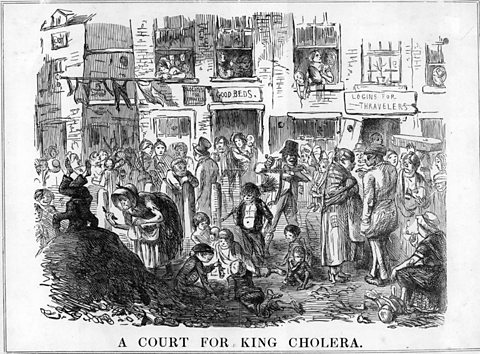
The main streets did not reveal the full extent of the problem. High Street, King Street, and the market places contained prosperous shops, inns, warehouses, and merchants’ houses. Behind them were courts and yards reached through narrow passages. By the early 1850s, approximately one-third of Lynn’s population lived in these enclosed spaces.
Houses had often been divided into smaller tenements. A family might occupy one room for cooking, eating, working, and sleeping. Some upper floors were reached by external staircases so that individual rooms could be rented separately. The buildings were frequently old, damp, and poorly ventilated.
One tap might serve several houses. One privy might be shared by five, twelve, or more families. Some households had none and used portable boxes or chamber vessels. Their contents were carried to a street grating, emptied into a surface channel, or thrown into one of the fleets.
Cholera did not create these conditions. It revealed what ordinary life in parts of Lynn already involved.
The second visitation
Britain experienced another major cholera epidemic in 1848 and 1849. Once again, the disease appears to have reached Lynn through its maritime connections.

Hillen believed that it arrived from Sunderland. The master and mate of a Lynn vessel were reportedly the first to die. On 5 October 1849, John Dowdy, mate of the Eliza, died from cholera while the vessel lay at anchor in Lynn Roads, the offshore anchorage in the Wash used by ships waiting to enter the port.
Dowdy therefore died aboard a vessel connected with Lynn rather than in a house within the town. His death demonstrates the danger faced by Lynn’s seamen, but it does not prove that he carried cholera into the borough.
Ships were vulnerable environments. Drinking water was stored for long periods, sanitation was rudimentary, and men lived in confined quarters. A vessel arriving from an infected port could carry a sick seaman or contaminated water without producing an outbreak among the population ashore.
The 1848–49 visitation did not strike Lynn as severely as the outbreak of 1832. Hillen records a cholera mortality of only one death per 10,000 inhabitants in the Lynn Registration District. Freebridge Lynn recorded none. Yarmouth, by comparison, suffered twenty-six cholera deaths per 10,000.
Lynn’s annual mortality figures support this. There were 302 deaths in St Margaret’s parish and eighty-eight in All Saints during 1849, giving a total of 390. There had been 395 deaths in 1848. The figure rose to 509 in 1850 and remained high, at 500, in 1851. There is no sudden increase in 1849 of the sort expected during a severe cholera epidemic.
Twenty-two cases, but what kind of cholera?
Dr William Edward Hunter was medical officer for the southern district of the King’s Lynn Union. During the year from Lady Day 1849 to Lady Day 1850, he treated 674 pauper patients. Sixty suffered from bowel disorders. Of these, twenty-two displayed what he called “sporadic cholera” or “choleraic symptoms”. Twenty-three had bilious diarrhoea, and fifteen had dysentery.
These terms are not interchangeable with epidemic Asiatic cholera. Nineteenth-century doctors used the word “cholera” for several severe illnesses involving diarrhoea, vomiting, cramps, and collapse. “Sporadic cholera”, “English cholera”, and “choleraic diarrhoea” did not necessarily indicate infection with Vibrio cholerae.
Hunter did not claim that all twenty-two patients had the epidemic disease. Nor did he give a separate death total for them.
The evidence points towards imported maritime cases and a limited recurrence rather than a major outbreak within Lynn. The town’s escape was fortunate because its sanitary arrangements still offered numerous opportunities for contaminated waste to reach food and water.
Water for two hours a day
Lynn’s waterworks drew from the Gaywood River. The source was considered good, and the river could have supplied a much larger population. The failure lay in the way water was distributed.
Different districts received water for only about two hours each day. In poorer courts, several families shared an external tap. Residents had to collect as much as possible while the water was running and store it until the next supply.
Water for washing was kept outside in tubs. Water for cooking and drinking might be stored in the family’s only room. Containers were difficult to keep clean in dwellings where people cooked, ate, worked, and slept amid dampness, animals, insects, and domestic refuse.
Some properties had underground cisterns filled from the municipal supply. These made water available after the mains had been turned off, but introduced another danger. Privies and cesspits were sometimes built close to the cisterns.
At Begley’s Buildings, one pump stood between two privies. Jane Giles told the government inspector that the pump water had previously smelled when it was boiled. Washing water and waste from a privy had been entering the cistern. It had since been cemented, but had not been cleaned out.
Nobody in Lynn had to understand the role of bacteria to recognise that something was seriously wrong with water which stank when boiled.
Into the courts
The most detailed investigation of Lynn’s poorer neighbourhoods was undertaken in April 1852 by William Lee, a superintending inspector from the General Board of Health. His report appeared three years after the second cholera visitation, but he examined an Inspector of Nuisances’ book covering the period from October 1848 to December 1850. Many of the places he visited had been reported repeatedly during those years.
Lee found twelve families in Nurse’s Yard, off King Street, sharing one tap and one privy. The court was about six feet wide, with a high wall facing the houses. At one time, fifty-four children had lived there. One woman told him that she wished to leave but could not because she was behind with her rent.
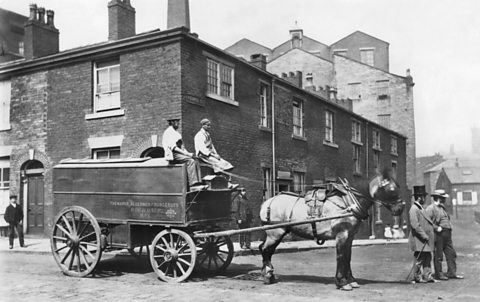
Smith’s Court in Bridge Street contained fourteen houses and one privy. The connected Laws Yard held more than 200 people. Twenty-nine families and the occupants of several smaller inner courts depended upon three taps. Water was available between seven and nine in the morning.
Source BBC
Privy boxes overflowed. Night soil ran down the channel and into the street. One household kept its privy box in an attic. Residents gathered around Lee to complain and told him that they wanted the yard made cleaner because they believed their health would improve. “Physic is very dear,” one of them remarked.
At Watson’s Yard, approximately fifty people shared two taps. Fish refuse, mussel shells, shrimp waste, and human excrement accumulated around the surface drain. In Paradise Lane, householders without privies carried boxes into the lane and emptied them there. Old George Yard in Norfolk Street had privies filled almost to their seats.
These were not remote districts separated from respectable Lynn. They stood behind some of its principal streets.
Illness in Linay’s Yard
Linay’s Yard in Church Street contained nine houses and three privies. The passage was narrow, and Lee noted the powerful stench.
Thomas Wigginton’s wife told him that the family had moved there shortly before Christmas 1850. Before their arrival, they had enjoyed good health. Since moving into the yard, they had lost two children. She was unwell, while her husband had suffered fever and now had problems with his lungs.
Next door, Mr Fielding and a child of about three were reportedly close to death from low fever. Another child had hydrocephalus.
Lee could not prove that the yard had caused each illness. His investigation nevertheless exposed a repeated pattern. Fever and prolonged sickness appeared in confined places where privies, stagnant drains, damp walls, stored water, and overcrowded rooms stood close together.
Poverty trapped families inside this environment. Illness deprived wage earners of income, while the costs of medicine and rent continued. Arrears prevented tenants from leaving unhealthy property. A household might then require parish relief, transferring part of the cost to the same ratepayers who resisted expenditure on drainage and water.
The fleets become sewers
Lynn’s fleets had once been working waterways. They carried small boats into the town, drained low ground, supplied water for trades, and marked the boundaries of successive medieval developments. By the nineteenth century, much of their commercial value had gone, but private access and navigation rights remained.
They had also become open sewers.
At low tide, the Purfleet exposed mud, decomposing fish, domestic refuse, and human waste. Drains entered it from several directions. Privies projected over the channel on timber supports and discharged directly onto the exposed banks. Lee called it “a most horrible place when without water”.
The Fisher Fleet received waste in much the same way. Privies entered it from one side, while people on the opposite bank threw in rubbish. Decaying cockles and shellfish collected in the channel.
Tidal water did not always reach the furthest portions of the fleets, especially during neap tides. Refuse remained until a spring tide or deliberate flushing carried some of it towards the Ouse.
Victorian doctors believed the vapours rising from this material caused cholera and fever. They were mistaken about cholera’s principal route of transmission. Yet an open watercourse receiving human waste beside densely occupied houses presented a genuine danger. The problem was not simply what residents breathed, but what might reach their hands, food, and drinking water.
The real burden of disease
Cholera attracted attention because its attack was sudden and visible. Lynn’s underlying mortality was more persistent.
William Lee calculated that the borough’s average annual death rate exceeded twenty-five per thousand. Comparing Lynn with sixty-one other registration districts, he estimated that the town had suffered 1,643 excess deaths during the previous eleven years. His method was shaped by the sanitary reform movement and should not be treated as a modern epidemiological calculation. His registration figures nevertheless demonstrate extensive premature mortality.
Deaths from what Victorians called zymotic diseases, including fevers, diarrhoeal illnesses, smallpox, measles, and scarlet fever, occurred at more than twice the rate recorded in Lee’s comparison districts. More than half of those who died in Lynn during the eleven-year period were under twenty.
Children were particularly vulnerable. They drank from the same stored water as adults, played in contaminated yards, and slept in crowded rooms. Diarrhoea, measles, scarlet fever, and respiratory infection could kill an undernourished child even when no recognised epidemic was present.
The Ormiston family’s destruction in 1832 was remembered because nine people died within ten days. In the courts and yards, smaller tragedies occurred without creating the same public alarm. A baby died in one room, a child from fever in another, and a labourer remained unable to work for weeks. The deaths were separated by time and recorded under different diseases, but many arose within the same landscape of poverty, contaminated waste, dampness, and insufficient water.
By the time William Lee walked through Lynn in 1852, the Blue Death had largely passed. The water taps still ran for only two hours a day, night soil still moved along open channels, and hundreds of people remained crowded into yards behind the town’s most prosperous streets.
© James Rye 2026
Book a Guided Tour with a Trained and Qualified King’s Lynn Guide Through Historic Lynn
References
General Board of Health. Public Health Act: Report to the General Board of Health on a Preliminary Inquiry into the Sewerage, Drainage, and Supply of Water, and the Sanitary Condition of the Inhabitants of the Borough of King’s Lynn. By William Lee. London: Eyre and Spottiswoode, 1853. https://play.google.com/store/books/details?id=DVYuJJeVPeQC.
Hillen, Henry J. History of the Borough of King’s Lynn. Vol. 2. Norwich: East of England Newspaper Company, 1907. https://archive.org/details/historyofborough02hill.
Norfolk Record Office. “King’s Lynn Borough Archives.” https://www.archives.norfolk.gov.uk/article/31098/Kings-Lynn-Borough-Archives.
Parliament of the United Kingdom. “1842 Report on the Sanitary Condition of the Labouring Population.” https://www.parliament.uk/about/living-heritage/transformingsociety/livinglearning/coll-9-health1/health-02/.
World Health Organization. “Cholera.” https://www.who.int/health-topics/cholera.