
A steel rack crowded with fish stands beside Marriott’s Warehouse. Farther north, a bronze column measures the river’s rise. At the end of the quay, a transparent screen breaks the familiar view into magnified fragments.
King’s Lynn’s three principal riverside artworks appeared between 2000 and 2014. They resulted from separate commissions, yet each draws its meaning from the Great Ouse. One recalls the cargoes once unloaded here. Another responds to the tide and the navigation of the Wash. The last turns the riverfront itself into a changing picture.
Fish from the north
The largest of the three works is Stock Fish Rack, the steel structure close to Marriott’s Warehouse. Two open frames are hung with scores of individually forged fish, together with shellfish, seaweed, a seagull, and a blacksmith’s version of a mermaid’s bra.
Art UK attributes the sculpture to Norfolk master blacksmith Nigel Barnett and dates it to 2009–10. Barnett led the project after being approached by Sheena Carman, King’s Lynn’s arts officer. Bethan Griffiths researched the town’s history and developed the design, while around 150 blacksmiths are reported to have contributed to its manufacture.
Much of the work took place in public during Lynn’s first Hanse Festival in 2009. Visitors watched the smiths working on South Quay and suggested objects for inclusion. Children were helped to make metal fish of their own. The sculpture was completed following further work at a meeting of the British Artist Blacksmiths Association at Blists Hill in Shropshire.
Sources differ over its precise contents. The association refers to about 160 fish, while other accounts give a total of 176 pieces. The larger figure probably includes the other marine objects, although the original inventory would be needed to confirm this.
The form of the sculpture refers to the wooden racks used in northern Norway to dry cod in the open air. The fish were gutted and hung outside during the cold, windy spring. Once dried, they became hard and light enough to withstand a long sea voyage without requiring salt.
This was stockfish, one of northern Europe’s most important medieval commodities. Large quantities were carried from the Norwegian fishing grounds to Bergen, where merchants collected and exported them. Customs accounts show German merchants handling much of the stockfish sent from Bergen to eastern England by the early fourteenth century.
King’s Lynn was one of the receiving ports. Ships crossed the North Sea and entered the Wash before travelling up the Great Ouse. Stockfish landed at Lynn could be sold locally or distributed far inland using the river system and the roads leading away from the town.
The sculpture does not suggest that cod were dried on South Quay. Its racks belong to the Norwegian end of the journey. By placing them beside the Ouse, the artist has brought the distant fishing grounds into the place where the finished product was unloaded and traded.
Its construction during the Hanse Festival adds to that meaning. Lynn joined the modern Hanse network in 2005, but its links with German merchants stretch back to the Middle Ages. The town was not itself a German member of the medieval Hansa. It was an English trading partner in which Hanseatic merchants enjoyed privileges and maintained property. The surviving Hanse House remains the clearest evidence of their presence.
Stock Fish Rack was made in much the same way that a cargo was assembled. Individual makers produced separate objects and brought them together on a common framework. The result is not simply a monument to trade. It is a product of shared labour, much like the commercial networks it commemorates.
Measuring the tide
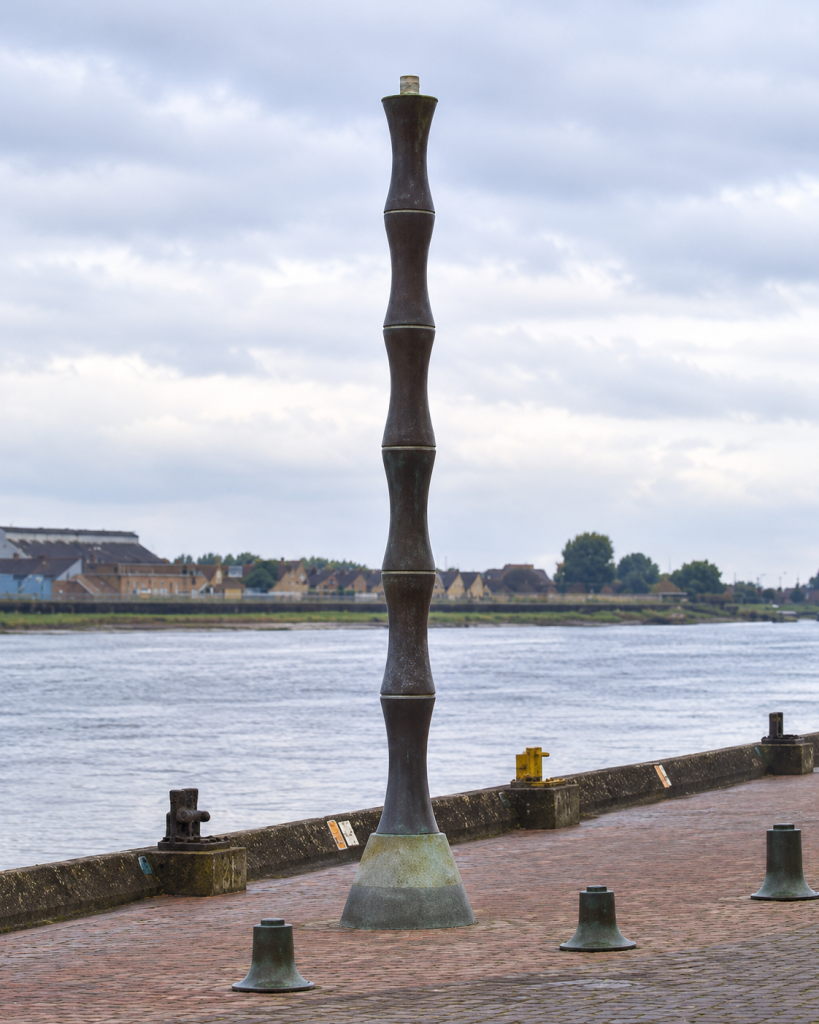
Opposite College Lane stands Andrew Schumann’s Half Fathom Column. Stacked bronze sections are separated by stainless steel spacers and mounted on a blue limestone base. At the top is a solar-powered light designed to flash after dark.
Source: Stephen Craven
The column was installed in 2000, when the borough was improving the South Quay promenade and King’s Staithe Square. Art UK records it as 6.2 metres high, with a stone plinth listed separately. Its repeated bronze sections resemble ripples travelling up the surface.
The accompanying inscription explains the design:
The Half Fathom Column
ripples like the river water
flashes at night like Wash buoys
climbs as high as the tidal rise
A fathom is six feet, or approximately 1.83 metres. The measurement developed from the span of a person’s outstretched arms and became a standard means of recording water depth. Half a fathom is three feet, just over 91 centimetres.
The sculpture resembles an enlarged sounding rod or tidal gauge. Its bronze surface refers to the moving Ouse, while the flashing light recalls the navigation buoys marking the route across the Wash. Although the column points upwards, its title belongs to the language of depth, channels, and safe passage.
Schumann had a personal reason for making it. After studying history of art at Cambridge, he entered industry and brought the Bespak manufacturing business to King’s Lynn in 1975. He later became a full-time artist, working with cast metal from a studio on Purfleet Quay.
In an interview, Schumann called the column his celebration of 25 years in King’s Lynn. The work was therefore both a contribution to the restored riverfront and a personal marker of the years since his arrival.
Some online accounts describe the column as Grade II listed. I have found no corresponding entry in the National Heritage List for England, and the borough’s conservation-area appraisal does not call it listed. Its position within a conservation area does not make the sculpture itself a listed structure.
The light was designed to flash like a buoy, but no current maintenance record has been found to establish whether it remains in regular operation.
Looking through Lynn
Source: Martin Pearman
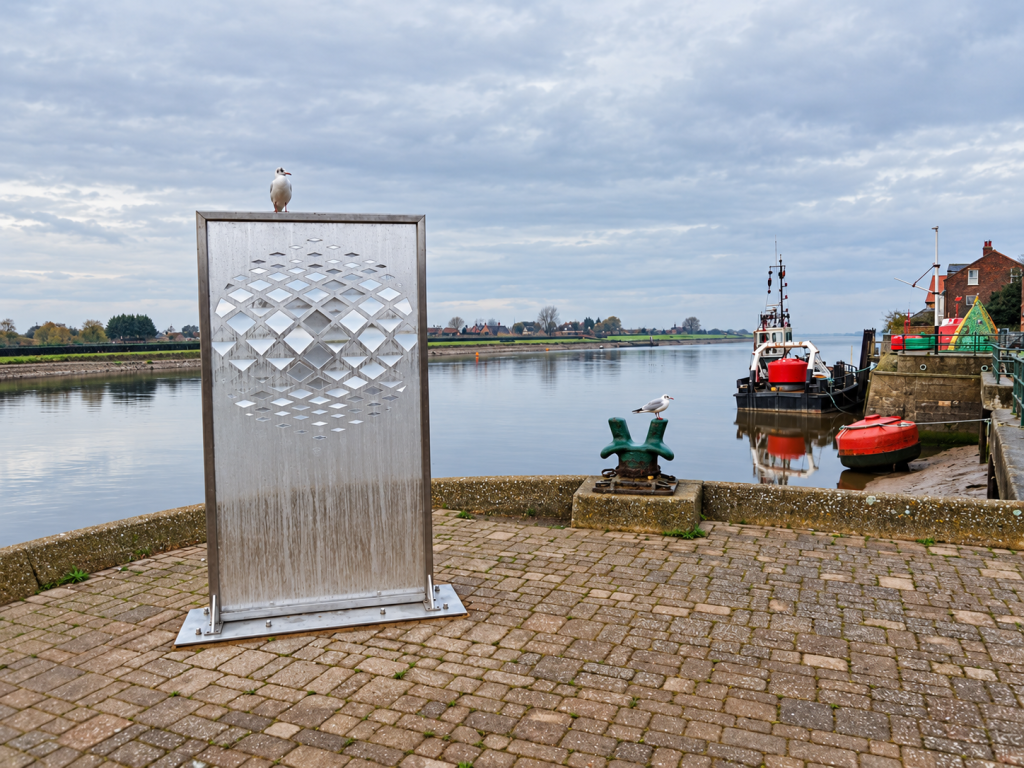
The third artwork stands at the northern end of South Quay, near King’s Staithe Square. It is easily overlooked because much of it is transparent. A clear plexiglass panel is held within a stainless steel frame and punctuated by circular magnifying lenses.
Art UK calls the sculpture Archilenses, while its French creator, Thibault Zambeaux, uses the singular title Archilense. There is also a difference in the recorded height. Art UK gives two metres, but the artist’s own project page records 2.2 metres.
The work was installed in 2014 through Art, Cities and Landscape, a partnership between the Borough Council and the Maison de la Culture d’Amiens. British and French artists were invited to respond to the landscapes and historic buildings of Lynn and Amiens. The programme received European funding through INTERREG IVA.
Zambeaux did not place a conventional picture of Lynn on the quay. He created an instrument through which the town could be viewed. Look through the plain panel and the scene remains recognisable. Look through a lens and part of the riverfront becomes enlarged, inverted or distorted. Moving a few inches produces another arrangement.
The Ouse and the surrounding buildings become part of the artwork. So do passing boats, pedestrians, reflections, and changes in the weather. Every view depends upon where the spectator is standing.
A large monument here might have competed with the Custom House and the surrounding historic buildings. Archilensedoes something quieter. It is almost empty until someone looks through it, at which point the familiar waterfront becomes strange again.
From iron to light
The three sculptures form an unintended progression along the quay. Stock Fish Rack is heavy with forged objects and the memory of cargo. Half Fathom Column replaces the cargo with the movement of water. Archilense is almost transparent, leaving only its frame and lenses between the spectator and the view.
The South Quay once existed chiefly as a place where goods moved between ships, warehouses, and markets. Its modern sculptures preserve that maritime identity without attempting to reconstruct the lost port. They allow the river to speak through trade, measurement, changing light, and the movement of the person looking.
© James Rye 2026
Book a Guided Tour with a Trained and Qualified King’s Lynn Guide Through Historic Lynn
References
- Art UK. “Archilenses.” https://artuk.org/artworks/312753.
- Art UK. “Half Fathom Column.” https://artuk.org/discover/artworks/half-fathom-column-312765.
- Art UK. “Stock Fish Rack.” https://artuk.org/discover/artworks/stock-fish-rack-312766.
- British Artist Blacksmiths Association. “Fish Racks.” https://baba.org.uk/post/Fish-Racks.
- Helle, Knut. “Bergen’s Role in the Medieval North Atlantic Trade.” https://journals.uis.no/index.php/AmS-Skrifter/article/download/254/218/455.
- Norfolk Record Office. “King’s Lynn’s Trading Links with Europe: King’s Lynn and the Hansa.” https://norfolkrecordofficeblog.org/2020/07/15/kings-lynns-trading-links-with-europe-kings-lynn-and-the-hansa/.
- Schumann, Andrew. “About.” https://andrewschumann.com/about.html.
- Society for the Protection of Ancient Buildings. “Building Focus: Hanse House, King’s Lynn.” https://www.spab.org.uk/news/building-focus-hanse-house-kings-lynn.
- West Norfolk Artists Association. “In Conversation with Andrew Schumann.” https://westnorfolkartists.org/blog/2017/07/in-conversation-with-andrew-schumann/.
- Zambeaux, Thibault. “Archilense.” https://www.thibaultzambeaux.com/portfolio/archilense/.