.jpg&f=1&nofb=1&ipt=800f623673fd8b86e0290cc8feee84cb05c095c90974251474235d6a2bb41f6c)
Source: George Bernard Mason
The iron numerals on the gable say 1635. Yet the little house beside St Nicholas’s Chapel is said to have belonged to a medieval exorcist. How could someone from medieval Lynn have lived in a house built after the Reformation?
Perhaps the name remembers an earlier dwelling on the site. The chapel certainly owned houses and accommodated its clergy. Its records even name the occupants of one clergy dwelling just before 1635. What they do not tell us is whether that dwelling stood where the Exorcist’s House stands today.
The house dated 1635
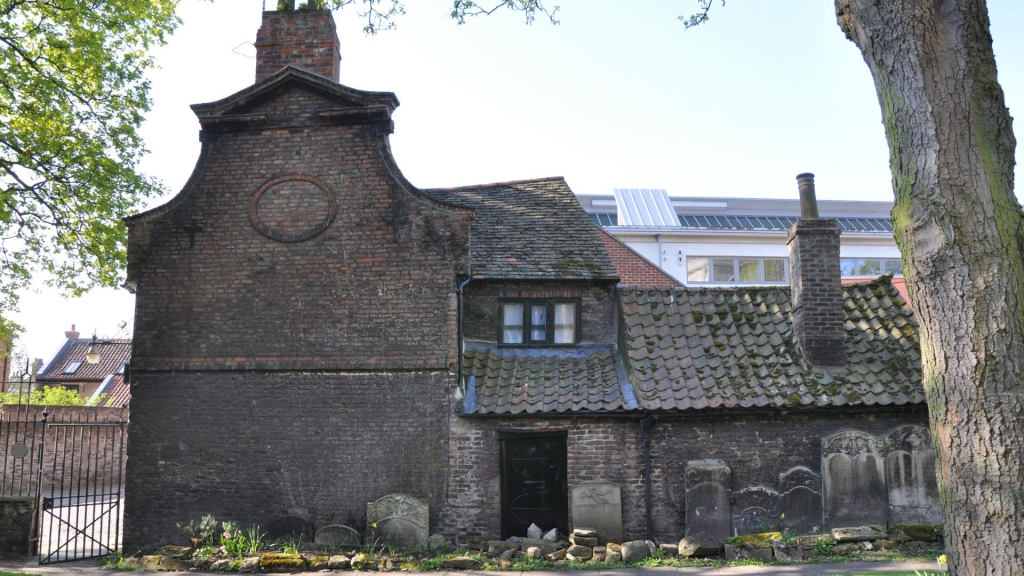
The Exorcist’s House stands at 7 Chapel Lane, against the southern edge of St Nicholas’s chapel yard. Older listings give its address as No. 8. The present building is Grade II listed and has two storeys, brickwork with some flint, and a plain-tiled roof. Its north end rises into a Dutch gable with sweeping curves, a blind oval opening, and the date 1635 in iron numerals. Historic England considers the design an early example of its type. The gable also recalls the architectural fashions crossing the North Sea during Lynn’s long relationship with the Netherlands, although no evidence identifies the person who chose it for this house.
The date makes the usual description of the cottage as a medieval exorcist’s home impossible. The more careful version of the tradition says that the 1635 house was built on the site of a medieval cleric’s dwelling. That is possible, but no deed or account examined so far identifies the earlier building or its occupant.
A clergy house in the chapel records
The chapel wardens’ accounts offer a more promising trail than the ghost stories. In 1616 they listed tenements associated with William Salter, the chapel clerk, and Richard Emmott, its curate. The editor of the published accounts noted that curates or ministers were allowed one of the chapel’s tenements without paying rent.
A later entry brings one dwelling into sharper focus. On 10 May 1634 the wardens agreed that Nicholas Toll, a chapel clerk, should have the messuage in which Emmott had formerly lived. Toll was also to instruct children in the catechism before Sunday evening prayer. Here, for once, we can follow a clergy residence from one named occupant to another. Unfortunately, the entry supplies no street or boundary description.
In 1636 the wardens bought 3,000 tiles for repairing “the houses”. The plural shows that more than one property needed attention. It does not show that the newly dated Exorcist’s House was among them. The published extracts contain no identifiable payment for building the cottage in 1635. We have evidence of chapel housing at exactly the right period, but still lack the link to this particular plot.
What did “exorcist” mean?
In the medieval Church, exorcist was one of the minor clerical orders through which a man might pass on his way to the priesthood. It did not necessarily mean that he spent his working life dealing with cases of possession.
Lynn supplies a striking example of the title’s older meaning. When the former Lynn priest William Sawtre was formally stripped of his clerical orders in 1401, the ceremony included taking away his book of conjurations as the emblem of the order of exorcist. Sawtre has no known connection with the Chapel Lane property. His case shows why the house’s name might once have referred to a clerical rank rather than to a succession of dramatic exorcisms.
We cannot yet tell when the name became attached to the house. A photograph taken in 1942 is catalogued under it, but the catalogue title might have been added later. The building’s 1951 listing is the earliest securely dated official use found in this research. A traditional name on a listing is evidence that people used the name, not proof of the story behind it.
The woman, the witchfinder, and the tunnel
Another story says that a woman was exorcised here, accused of witchcraft, and burned in Tuesday Market Place. No account of the supposed exorcism has been found. When the woman is named, she is usually Margaret Read.
Margaret’s story needs care. In 1738, the Lynn historian Benjamin Mackerell reported that a Margaret Read had been burned for witchcraft in 1590. He did not identify his source, and no surviving trial record has been found to confirm the execution or establish which, if either, of two women named in local parish registers was involved. Burning would also have been unusual for an English witchcraft felony, for which hanging was the customary punishment. Mackerell’s report cannot simply be dismissed, but it should not be presented as a fully documented trial.
The famous “Witch’s Heart” is a mark in the brickwork at 17 Tuesday Market Place. Legend says that Margaret’s heart flew from the flames and struck the wall. Historic England dates the surviving frontage to the mid eighteenth century, long after the alleged event. Nothing found in Margaret’s story connects her to St Nicholas’s Chapel or the Exorcist’s House.
Matthew Hopkins’s visit to Lynn rests on firmer ground. Borough records show that the corporation approached the witchfinder in May 1646 and agreed later that year to pay him £20 for his work. Records of the resulting proceedings include Grace Wright’s conviction and several acquittals. A much later tale gives Hopkins a secret passage between the Exorcist’s House and St Anne’s House. No contemporary document or archaeological survey found in this research establishes the passage or places him inside the cottage.
The man who really lived there
The house’s best documented connection with the occult belongs to the twentieth century. F. R. Buckley, a writer and broadcaster who lived there in his later years, appeared in a BBC Tonight report broadcast on 19 February 1964. He discussed objects found at Castle Rising, Bawsey Church, and Babingley Church, including effigies, sheep hearts, and black candles. The programme confirms that he took a public interest in the incidents. It does not establish the later stories that he could stop a camera working or advised the police on ritual magic.
After Buckley’s death in 1976, a story emerged about an elderly woman seen in a rocking chair inside the empty house. She was said to resemble Mrs Buckley. The published version supplies no named witnesses or contemporary statement, so it is best understood as a story passed down locally.
The Exorcist’s House is a private home. Its gable can be seen from public ground, but its most interesting unanswered question lies in the property records: where was the messuage passed from Richard Emmott to Nicholas Toll in 1634? A deed or rental placing it on this plot would bring the chapel’s documentary history much closer to the house we see today.
© James Rye 2026
Book a Guided Tour with a Trained and Qualified King’s Lynn Guide
References
- BBC Archive. “1964: A Curious Case of Black Magic in Norfolk.” Tonight, broadcast 19 February 1964. https://www.youtube.com/watch?v=QWTw3xoGhg4.
- Beloe, Edward Milligen, ed. Extracts from the Chapel Warden’s Accounts of St Nicholas, 1616–1660. King’s Lynn, 1926. https://www.stnicholaskingslynn.org.uk/wp-content/uploads/2019/01/Chapel-Wardens-Accounts.pdf.
- Historic England. “17, 17A, Tuesday Market Place.” National Heritage List for England, no. 1195407. https://historicengland.org.uk/listing/the-list/list-entry/1195407.
- Historic England. “The Exorcists House.” National Heritage List for England, no. 1298169. https://historicengland.org.uk/listing/the-list/list-entry/1298169.
- KL Magazine. “Delving into Norfolk’s Darker Past.” https://www.klmagazine.co.uk/articles/ghosts-of-norfolk.
- King’s Lynn Civic Society. A Pilgrimage Trail. https://www.visitwestnorfolk.com/wp-content/uploads/2023/01/1390-109-2-Pilgrimage-Trail-A5-booklet-WEB-1.pdf.
- Mackerell, Benjamin. The History and Antiquities of the Flourishing Corporation of King’s-Lynn in the County of Norfolk. London: E. Cave, 1738. https://archive.org/details/historyandantiq00mackgoog.
- Norfolk Record Office. “The Witches of Lynn.” 31 October 2018. https://norfolkrecordofficeblog.org/2018/10/31/the-witches-of-lynn/.