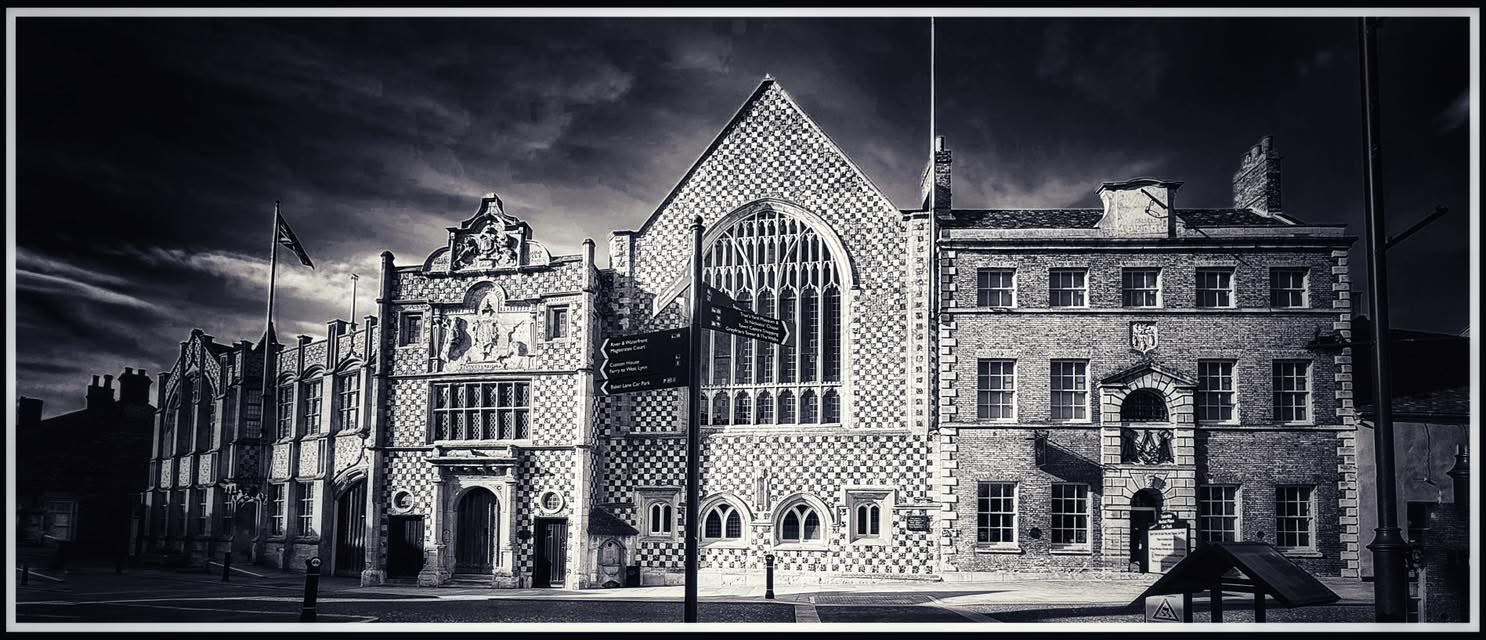

Source: King’s Lynn Civic Society
A King’s Lynn tradition says that Edward Everard built a private ballroom at his house opposite St Margaret’s Church because he did not want his daughters mixing with people in the new Assembly Room at the Town Hall.
It is a memorable story, but the familiar version cannot be correct. It confuses two men called Edward Everard, two generations of daughters, and separate alterations to the building now known as Hanse House. Behind the confusion, however, there may be a smaller and more credible story about wealth, marriage, and the careful control of social connections.
Edward Everard’s new house
Edward Everard senior, born in 1699, was a prosperous Lynn merchant and brewer. By 1732 he occupied the former Hanseatic complex then known as Allemayne Mansion or the Steelyard. Although German merchants had ceased operating from it long before, the buildings still belonged formally to the Hanseatic cities of Lübeck, Bremen, and Hamburg.
In February 1751, the three cities sold the property to Everard for £800. It included houses, warehouses, wharves, shops, cellars, yards, and gardens.
Everard then replaced the old street range facing St Margaret’s Church with the Georgian house that survives today. Historic England dates it broadly to the middle of the eighteenth century, while the local plaque gives a date of about 1755. Its nine-bay façade, sash windows, rusticated corners, central pediment, and formal doorway transformed the appearance of the property. Behind it, the medieval warehouse ranges remained in commercial use.
This rebuilding took place about twelve years before Lynn acquired its purpose-built Assembly Room. The Georgian front cannot, therefore, have been constructed in response to that room.
The family evidence creates another difficulty. Edward senior and his wife, Mary Holley, had three recorded daughters. Catherine was born and died in 1734. Mary was baptised in 1743. Alice died in infancy in 1746. By the time the Assembly Room opened, only Mary is known to have been alive. She would have been about twenty-four.
Edward senior died in 1769. He had lived long enough to see the new Assembly Room in use, but the tradition’s reference to his “daughters” does not fit his household.
Lynn enters the age of assemblies
Formal assemblies had taken place in Lynn before the new room was built. In 1757, Mrs Eastland held a Lynn Mart Assembly at the Town Hall. Such occasions brought dancing, cards, music, conversation, and courtship into a carefully regulated social setting.
During the 1760s, the Corporation provided something grander. A ballroom and adjoining Card Room were built behind the medieval Trinity Guildhall. Different accounts give dates between 1766 and 1768, apparently reflecting the stages of construction and fitting. The Town Hall’s chronology records that the rooms were built and the chandeliers purchased in 1767.
William Richards, writing in the early nineteenth century, described the ballroom as sixty feet long, twenty-seven feet wide, and twenty-two feet high. The Card Room was square and equally lofty. A musicians’ gallery provided for dances and concerts, while glass doors linked the suite of rooms.
This was the centre of fashionable public entertainment in Lynn. In November 1788, the Corporation held a ball and supper there to celebrate the centenary of the Glorious Revolution. Mr and Mrs Coke reportedly considered it as splendid as an entertainment at Holkham and more comfortable, although the sceptical Richards suspected that the occasion owed more to display than political gratitude.
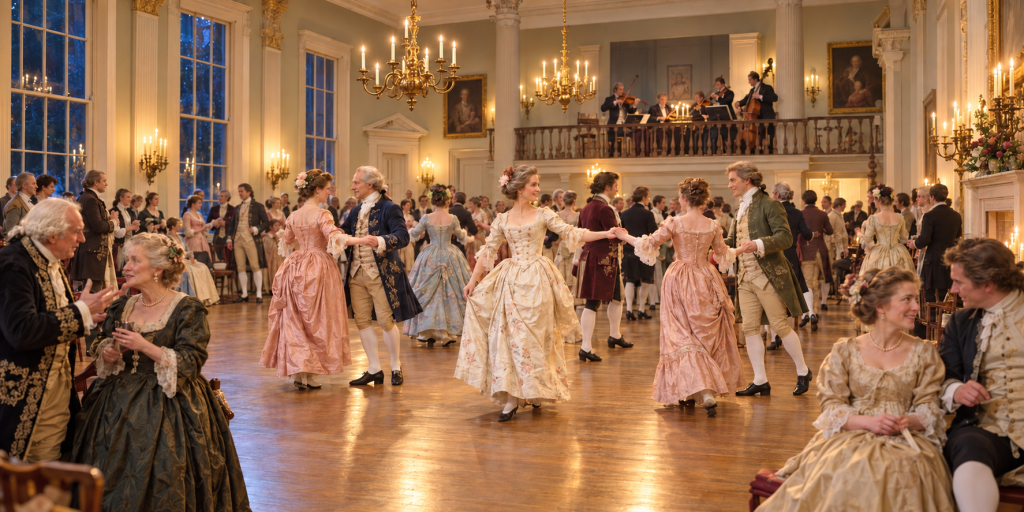
“Public” did not mean that everybody entered on equal terms. Provincial assemblies generally operated through subscriptions, tickets, invitations, or admission controlled by stewards. They were intended for the gentry, wealthy merchants, corporation families, military officers, and members of the professions. Attendance indicated that a person belonged, or claimed to belong, to polite society.
The boundaries were not immovable. Richards preserved a description of an election ball at which the wives and daughters of Lynn’s freemen were entertained. After the “better sort” of ladies had danced, prominent gentlemen took shopkeepers’ wives and daughters as partners. This was an election celebration rather than an ordinary assembly, but it shows how the Town Hall ballroom could occasionally bring together people from different levels of Lynn society.
The idea that a wealthy merchant might prefer to entertain at home is therefore plausible. The Assembly Room was selective, but it was not entirely controlled by one family.
The second Edward Everard
Edward Everard senior had a son, also called Edward, who was born in 1739. Edward junior became an alderman and a leading figure in Lynn’s mercantile establishment. During the French invasion scare of 1794, he commanded the newly formed Lynn Volunteers.
This second Edward fits the ballroom tradition much better.
Edward junior had six children, including two daughters, Elizabeth and Rebecca. His yachting log provides unusually direct evidence of the family together. In August 1795, those aboard one of his pleasure vessels included Edward, his married son and daughter-in-law, and “his two daughters Elizabeth and Rebecca”. Rebecca married Henry Prescott Blencowe in 1797.
The daughters were therefore living as part of Edward junior’s family during the period when the large Georgian Room behind the house appears to have been created. They were of an age when dances, dinners, and introductions formed an important part of family life. Marriage among prosperous mercantile families involved property, business connections, and social standing as well as personal attachment.
A private entertaining room allowed Edward to decide who entered his house and who met his daughters. It could be used to introduce suitable young men, strengthen family alliances, reward commercial associates, and cultivate political supporters. It offered something the Town Hall could not: complete control of the guest list.
That does not mean Edward wanted to prevent his daughters meeting anyone. Private entertainment was a means of selecting company rather than avoiding it.
Was it actually built as a ballroom?
The room associated with the tradition was not part of Edward senior’s Georgian frontage. It occupied the eastern end of the northern medieval warehouse range immediately behind the house.
Dr Paul Richards dates its creation to the 1790s and describes it as a Georgian drawing room adjoining a granary. The dining room, sitting room, and small study were on the ground floor of the street-front house. The large room behind was apparently created by adapting part of the old commercial range for domestic use.
“Ballroom” may therefore describe one use of the room rather than its original purpose. Large Georgian drawing rooms were used for receptions, music, cards, conversation, and dancing. Furniture could be removed when a larger space was needed. A room in which the Everards held dances could easily become known to later generations as the ballroom, even if no building account used that name.
This changes the story considerably. Edward junior may not have commissioned a purpose-built rival to the Town Hall Assembly Room. He may have created an impressive drawing room as part of a broader improvement of the family residence. Its suitability for dancing allowed the Everards to entertain on their own terms.
A tradition containing several truths
The story cannot be accepted literally. Edward Everard senior rebuilt the street house around 1755, before the Town Hall Assembly Room existed. He had only one daughter surviving infancy and died in 1769. The large room behind the house appears to have been created in the 1790s.
The tradition becomes possible when attached to Edward junior. He had two daughters, Elizabeth and Rebecca, and occupied the house when the Georgian Room was formed. A private room suitable for dancing would have served the family’s social ambitions and given Edward greater control over his daughters’ introductions.
No contemporary evidence has yet been found stating that he built it because he disapproved of the people attending the Town Hall assemblies. That explanation may have developed later. A family preference for private entertainment became a refusal to mix with the town. A drawing room in which dancing occurred became a specially constructed ballroom. Edward junior was confused with the better-known Edward senior who had purchased and rebuilt the former Hanseatic property.
What remains is a revealing glimpse of Georgian Lynn. The Corporation’s ballroom provided a setting in which merchants, professionals, corporation families, and visiting gentry could meet. The Everards’ private room offered a more carefully chosen society. Elizabeth and Rebecca were not being hidden from the social world. Their father may have been bringing a selected part of that world into his own house.
© James Rye 2026
Book a Guided Tour with a Trained and Qualified King’s Lynn Guide
References
- Historic England. “Hanse House.” National Heritage List for England, entry 1195393. https://historicengland.org.uk/listing/the-list/list-entry/1195393.
- King’s Lynn Town Hall. “History.” https://www.kingslynntownhall.com/townhall/history/.
- Norfolk Museums Service. “Civil War and Polite Society at Lynn Museum.” https://www.lynnmuseum.norfolk.gov.uk/article/30501/Civil-War-and-polite-society-at-Lynn-Museum.
- Richards, Paul. “Building in Focus: Hanse House, King’s Lynn.” Society for the Protection of Ancient Buildings, 19 August 2022. https://www.spab.org.uk/news/building-focus-hanse-house-kings-lynn.
- Richards, William. The History of Lynn. Vol. 2. Lynn: William G. Whittingham, 1812. https://www.gutenberg.org/ebooks/62372.
- Royal Museums Greenwich. “The Everard Family.” 25 July 2019. https://www.rmg.co.uk/stories/maritime-history/library-archive/everard-family.