

The house was locked. Emma de Beston was gone.
When the royal official arrived to place her in her uncle’s custody, he found neither the woman he had come to collect nor townspeople willing to disclose her whereabouts. He believed that Emma was being hidden. He also alleged that Henry Betle, the mayor of Bishop’s Lynn, had warned the man with whom she was staying, giving him time to conceal her.
Behind that closed door lay a troubling dispute. Emma’s ability to manage her affairs had been questioned, and the Crown had authorised arrangements for her guardianship. Yet a petition submitted on her behalf accused the proposed guardian of wanting her property to pay his own debts. The people resisting her removal maintained that the town had the right to arrange her care.
A measure intended to protect a vulnerable widow had become a struggle over who could be trusted with her future.
A widow with something to lose
In the early 1380s, King’s Lynn was still Bishop’s Lynn. Emma lived in a town whose legal privileges mattered to its civic leaders, and she possessed property whose management mattered to her relatives and potential guardians. Those two circumstances would shape the proceedings around her.
According to the historian and archivist Sean Cunningham, concerns arose when Emma began disposing of parts of her estate in ways considered erratic. An inquiry followed. The Norfolk escheator, an official responsible for administering certain rights of the Crown, examined her and concluded that she had lost her reason. His explanation invoked the “snares of evil spirits”.
Emma’s lands and goods were entrusted to her relative Philip Wyth. The arrangement was supposed to provide protection: someone would manage the resources on which she depended when she could no longer manage them herself.
The difficulty was that guardianship placed considerable power in another person’s hands. Managing an estate meant making decisions about its income, expenditure and preservation. It could safeguard its owner’s welfare, but it also created opportunities for someone more interested in the property than in the person it supported.
For Emma, ownership offered security and exposed her to interference. The same possessions that could pay for her care made control of her affairs worth pursuing.
The guardian she was said to fear
The petition submitted on Emma’s behalf challenged Philip’s motives. It alleged that his debts were beyond his means and that he sought her goods to settle them. More seriously, it accused him of promising the escheator a share in exchange for finding her incapable.
These were allegations made in a contested case. They do not establish that Philip bribed an official. They do, however, explain why an order placing Emma in his custody could be resisted by people claiming to protect her.
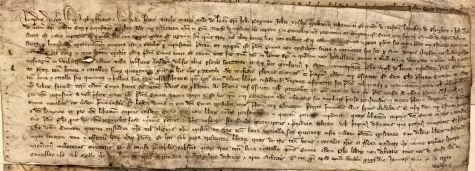
The dispute also reached beyond the family. Lynn’s authorities argued that the borough customarily provided for incapacitated burgesses and their families. They maintained that this responsibility belonged to the town, without royal intervention.
Emma’s whereabouts consequently became entangled with a dispute about civic independence. To the royal authorities, the failure to deliver her obstructed an authorised guardianship. To those resisting, intervention could threaten both a woman’s interests and the borough’s customary rights.
Neither position tells us everything about the people advancing it. Local officials could defend a neighbour while also defending their own authority. Royal officers could seek to safeguard property while enforcing an arrangement that others considered dangerous. The surviving documents preserve those competing claims more clearly than they preserve Emma’s private wishes.
Nevertheless, the resistance matters. Her removal was contested. People were prepared to obstruct the process, and arguments made on her behalf entered the official record.
Questions in a Lincoln church
On 31 July 1383, Emma appeared before commissioners at St Benedict’s Church in Lincoln for an examination of her mental capacity. A dispute rooted in Lynn had brought her before officials elsewhere, who were charged with deciding whether she could manage herself and her possessions.
The questions moved between her personal history, her understanding of time and her knowledge of money. Could she name her husbands? Did she know about her children? Could she identify the days of the week? How many shillings were there in forty pence? Would she prefer twenty groats or forty pence?
The account is arresting because it brings a medieval individual briefly into focus. Officials were asking Emma to retrieve the names and relationships that made up her life, then to perform calculations whose answers would help determine whether that life should be placed under someone else’s control.
We do not know how the questions were delivered, how long she was allowed to answer, or how she felt about the examination. The surviving report records what mattered to those conducting the inquiry. It gives us access to the proceedings, but not to the whole encounter.
Some questions seem readily understandable as attempts to explore memory and judgement. Others deserve closer scrutiny. An inability to calculate money could be relevant to managing property, but an examination of financial knowledge could not resolve every question about a person’s wishes or the trustworthiness of a proposed guardian.
The historian Eliza Buhrer questions the apparent neutrality of such tests, arguing that commercial knowledge could become a measure of mental competence. Her interpretation directs attention to the assumptions behind the examination as well as its findings.
Emma may have needed substantial assistance. That did not make the choice of assistant straightforward.
Care, property and divided responsibility
The commissioners concluded that Emma could not manage herself or her goods. The eventual arrangements, however, divided responsibility rather than concentrating it entirely in one person.
On 26 October 1384, Philip was entrusted with Emma’s personal custody, while four Lynn burgesses received responsibility for her property. They were to provide reasonable sums from its income for her maintenance.
This separation is an important part of the story. The person responsible for Emma’s daily care would not simply control all the resources that paid for it. The property managers, in turn, had an obligation to make money available for her support.
The settlement recognised practical needs. Emma required care, clothing and maintenance, and her possessions could help provide them. The proceedings had produced a framework through which those resources were to be administered.
What the settlement cannot reveal is how well that framework worked. An instruction to pay for maintenance says little about the patience, kindness or neglect a person might experience. Nor does the division of duties tell us whether Emma felt safer, whether her preferences were respected, or whether the earlier accusations continued to trouble those involved.

Legal arrangements can be precise while leaving everyday life almost invisible. Emma’s case is unusually detailed, but the detail is concentrated around decisions about her. Once those decisions were made, the woman at their centre becomes harder to see.
The woman behind the proceedings
Cunningham reports that Emma died on 30 December 1386 and that her estate passed to her niece, Isabel. The inheritance supplies an ending to the property dispute. The personal story closes with more questions unanswered.
We should resist giving Emma a modern diagnosis on the strength of these records. They preserve official classifications, reported answers and arguments advanced by interested parties. They do not provide the evidence needed to identify a particular illness confidently.
We should also resist turning the case into a simple contest between a wicked relative and heroic townspeople. Accusations require attribution, and claims to protect someone deserve examination. Emma’s story is compelling partly because care, financial interest and authority are so difficult to disentangle.
Yet there was more here than a struggle over possessions. The records show an attempt to provide support, a challenge to the person selected to provide it, and disagreement about who had the right to decide. They preserve resistance made on behalf of a woman whose ability to speak and act for herself was under scrutiny.
That gives Emma a place in Lynn’s history beyond the boundaries of a curious legal case. Her experience asks us to look beneath the town’s wealth and privileges at the security of an individual resident. Property could sustain her. Family could care for her. Civic government and royal law could intervene. Each source of protection also brought power over her life.
The locked house remains the story’s strongest image. The officer arrived with authority, but the door did not open and Emma could not be found. Whatever assistance she needed, someone had decided that delivering her to the appointed guardian was an unacceptable answer.
Before the examination and the eventual settlement, the dispute had already exposed its central difficulty: deciding that a person needs care is only the beginning. Someone must also decide whose care can be trusted.
Appendix: Summary of Richard II’s Letter in Latin (see above)
Richard, by the grace of God King of England and France and Lord of Ireland, to Henry Betle, mayor of Bishop’s Lynn, Lawrence de Elyngham, John Paxman and Robert Brisley, greeting.
It had previously been found by an inquiry held before John Rede, the king’s escheator in Norfolk, that Emma de Beston had not been incapable from birth, but that for about four years she had been deprived of her reason and understanding and had no lucid intervals.
Because of her condition, arrangements had been made for Emma and her property to be placed in the custody of her kinsman Philip Wyth.
The king therefore ordered Henry Betle, Lawrence de Elyngham, John Paxman and Robert Brisley to deliver Emma, together with her goods, to Philip Wyth without delay.
If they believed that there was good reason why they should not obey the order, they were to appear before the king’s Chancery and explain themselves on the Monday of the second week of Lent.
Failure to comply exposed them to a penalty of £300.
Given at Westminster, 31 January 1383.
© James Rye 2026
Book a Walk with a Trained and Qualified King’s Lynn Guide
References
Buhrer, Eliza. “Law and Mental Competency in Late Medieval England.” Reading Medieval Studies, 40 (2014), pp. 82–100. Especially useful for the allegations against Philip Wyth, resistance in Lynn and the interpretation of competency tests.
Cunningham, Sean. “Medieval Mental Illness and Care in the Community: Emma de Beston’s Case, 1383.” The National Archives, 28 November 2019. An accessible reproduction on Brewminate includes photographs of documents. The original article is identified as available under the Open Government Licence.
Roffe, David, and Christine Roffe. “Madness and Care in the Community: A Medieval Perspective.” British Medical Journal, 311 (1995), pp. 1708–1712. Discusses the examination and subsequent division of responsibilities.
Archival source: The National Archives, C 145/228/10, the principal file concerning Emma’s case.
Published calendar: Calendar of Inquisitions Miscellaneous (Chancery) Preserved in the Public Record Office, vol. IV, 1377–1388. London: HMSO, 1957, no. 227, pp. 125–128.
Source note: This article draws on published accounts of the proceedings. The original archival documents have not been inspected directly.