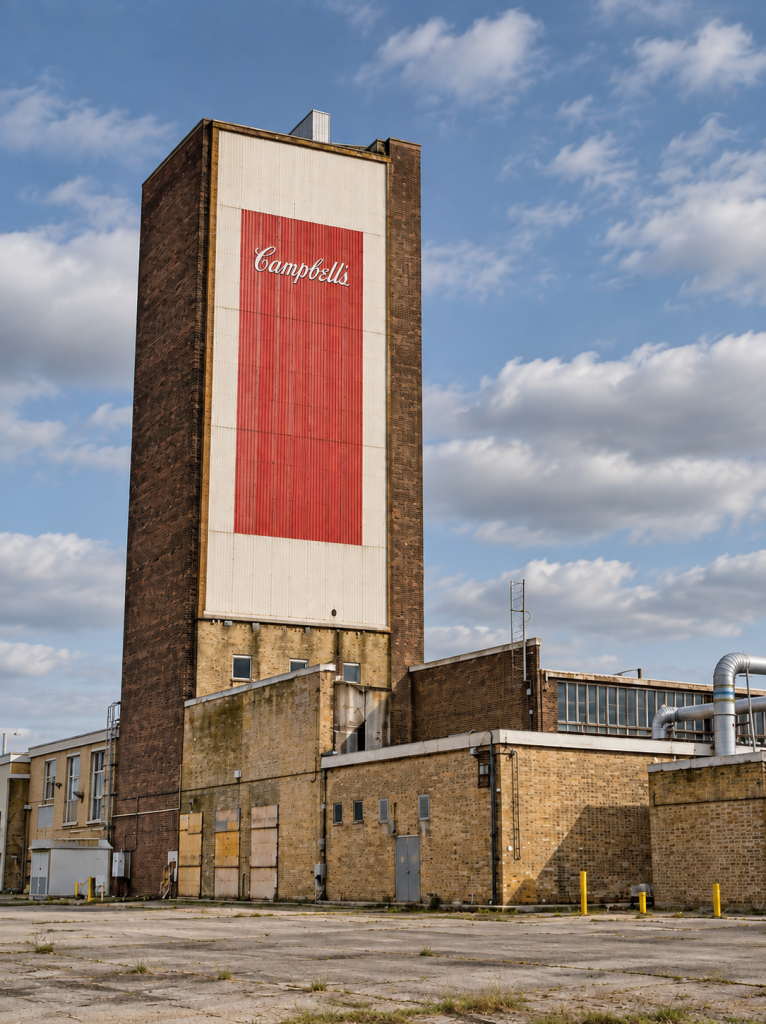
The red tower on Hardwick Road
Source: Unknown
For more than fifty years, Campbell’s was one of the landmarks by which King’s Lynn announced itself. The factory stood on Hardwick Road, on the site now remembered as Campbells Meadow. It was not picturesque, ancient, or decorative. It was brick, steel, concrete, steam, canning lines, warehouses, offices, and a red cooling tower that could be seen from the western approaches to the town.
It belonged to a different Lynn from the town of merchants, guildhalls, quays, and medieval churches. This was post-war industrial Lynn: practical, mechanised, and tied closely to the fields, roads, railway lines, and working households of west Norfolk.
The works was built by R. G. Carter in 1957 and opened in 1959. Norfolk Heritage Explorer describes it as Campbell’s first major plant constructed outside America. That wording matters. Campbell’s had earlier Canadian operations, including a Toronto plant opened in 1931, so it is best not to call King’s Lynn the company’s first factory outside the United States. Even so, the Lynn plant was a major statement. One of the world’s best-known food brands had chosen the edge of a Norfolk town for large-scale production.
Why Campbell’s came to Lynn
Campbell’s came because Lynn made sense. The Fens and west Norfolk could supply vegetables. The town offered labour, land, roads, and railway access. Finished goods could move from the rear warehouses onto rail connections joining the King’s Lynn to Ely line near Harbour Junction.
This was not romance. It was logistics. The factory sat where agriculture, transport, and industrial employment met.
The building itself was designed for modern food production. Later survey work recorded manufacturing areas, warehouses, offices, a boiler house, staff facilities, locker rooms, laundry arrangements, a canteen, and a medical department. It was a complete industrial world, not merely a shed with soup inside it.
The red cooling tower became the site’s public face. Norfolk Heritage Explorer records that it was once the tallest building in King’s Lynn. It had no great architectural beauty, but it had something stronger in local memory: constant visibility. People saw it from cars, buses, trains, work journeys, shopping trips, and school runs. Repetition made it familiar. Familiarity made it part of the town.
Soup, sauces, pies, and wages
Campbell’s is remembered as the soup factory, and rightly so, but by its final years the Lynn site made more than soup. Press reports in 2007 identified its products as Campbell’s tinned soups, Homepride canned sauces, and Fray Bentos pies.
The workforce was large, though the exact peak figure needs care. Some accounts say up to 500 people. Others give 700. The difference may reflect date, shift patterns, seasonal work, or how staff were counted. The safe conclusion is that Campbell’s employed several hundred people and became one of King’s Lynn’s major post-war workplaces.
For local families, that mattered more than corporate scale. Campbell’s meant wages, shifts, uniforms, canteen meals, overtime, friendships, skills, routines, and the ordinary discipline of factory life. Its history is not only a story of buildings and brands. It is also a story of pay packets carried home across Lynn and the surrounding villages.
The American name and the Norfolk factory
The Campbell’s brand began far from Norfolk. Joseph Campbell and Abraham Anderson founded Anderson & Campbell in Camden, New Jersey, in 1869. The condensed soup process followed in 1897 through Dr John T. Dorrance, and the red-and-white label appeared in 1898. The company became Campbell Soup Company in 1922.
By the time Campbell’s arrived in King’s Lynn, it was already a name with global recognition. That gave the Hardwick Road factory a double character. It was international in ownership and branding, but deeply local in labour, supply, and memory.
That double character also made its departure feel complicated. The company, the name, the products, the workforce, and the building did not all leave at once.
Sale, closure, and the last can
The corporate break came in 2006. On 12 July that year, Campbell Soup Company announced the sale of its UK and Irish businesses to Premier Foods. The deal included brands such as Homepride, OXO, Batchelors, Erin, and Fray Bentos. It was completed on 15 August 2006.
The legal papers tie the sale directly to King’s Lynn. Campbell’s UK Limited and Campbell Soup UK Limited both had registered offices at Hardwick Road, King’s Lynn, PE30 4HS. The sale agreement also listed freehold land at Hardwick Road under title numbers NK99709 and NK194486.
Then came the blow. In January 2007, Premier Foods proposed closing the King’s Lynn factory, with production due to end in December. Press coverage reported that 245 Lynn staff would be offered jobs elsewhere in East Anglia, while production was concentrated at other sites including Wisbech, Worksop, and Long Sutton.
Production stopped in December 2007. Machinery began to be stripped out. The Lynn News marked the moment with the headline “Last can off the line at Campbell’s”. It was a plain phrase, but a sharp one. A factory that had run for nearly half a century had ceased to do the thing it was built to do.
The empty factory and the falling tower
After closure, the Hardwick Road works stood empty while redevelopment plans gathered pace. A desk-based assessment was made in 2009. A further building survey recorded the site in August 2011, by which time much of the equipment had already gone.
The final act came on 15 January 2012, when the red tower was brought down by controlled explosion. The demolition was not just spectacle. The button was pressed by Sarah Griffiths, whose father, Mick Locke, had died in 1995 after being severely scalded by steam while working at the factory.
Crowds gathered to watch. Exact estimates differ, but the size of the audience tells its own story. People do not gather in large numbers to watch an anonymous structure disappear. They came because the tower had become part of Lynn’s mental map.
In seconds, the last great vertical sign of Campbell’s vanished from the skyline.
Campbells Meadow
The site did not remain empty. It became Campbells Meadow, a commercial and retail landscape with Tesco, Dobbies, a petrol station, business units, offices, and other development. R. G. Carter, the firm that built the original factory, was also involved in the redevelopment of the former Campbell’s site.
There is a hard neatness in that. The same company was linked to both the arrival of industrial food production and the later retail reshaping of the land.
The factory has gone, but the name remains. That is often how local memory works. Buildings disappear first. Place-names linger. Campbells Meadow is now a clue to an earlier Lynn: a town of steam, cans, vegetables, shifts, rail sidings, and a red tower at Hardwick Road.
Campbell’s came to King’s Lynn because the town was useful. It left because ownership changed and production was moved elsewhere. Between those two facts lay nearly fifty years of work, wages, noise, and soup. For a generation and more, the factory was part of how Lynn looked, worked, and remembered itself.
© James Rye 2026
Book a Walk with a Trained and Qualified King’s Lynn Guide
References
Brown & Co. “Industrial Unit, Campbells Business Park, King’s Lynn, PE30.” Accessed June 2026. https://www.brown-co.com/services/commercial/property/industrial-kings-lynn-pe30-ap444956
Campbell Soup Company. “Campbell Agrees to Sell U.K. and Irish Businesses to Premier Foods PLC.” 12 July 2006. https://www.thecampbellscompany.com/newsroom/press-releases/campbell-agrees-to-sell-u-k-and-irish-businesses-to-premier-foods-plc/
Campbell Soup Company. “Campbell Completes Sale of UK and Irish Businesses to Premier Foods PLC; Majority of Proceeds to Be Used to Fund New Share Repurchase Plan.” 15 August 2006. https://www.thecampbellscompany.com/newsroom/press-releases/campbell-completes-sale-of-uk-and-irish-businesses-to-premier-foods-plc-majority-of-proceeds-to-be-used-to-fund-new-share-repurchase-plan/
The Campbell’s Company. “Campbell History.” Accessed June 2026. https://www.thecampbellscompany.com/about-us/our-story/campbell-history/
Great Northern. “Soup-inspired symbol of town’s identity warms King’s Lynn station.” 25 October 2021. https://www.mynewsdesk.com/uk/gtr/pressreleases/soup-inspired-symbol-of-towns-identity-warms-kings-lynn-station-3141292
The Guardian. “Daughter blows up building where father was killed.” 15 January 2012. https://www.theguardian.com/uk/2012/jan/15/blow-up-building-father-killed
The Independent. “Daughter demolishes the soup factory where her father lost his life.” 16 January 2012. https://www.independent.co.uk/news/people/news/daughter-demolishes-the-soup-factory-where-her-father-lost-his-life-6290236.html
The Independent. “Premier Foods to close two factories with loss of 450 jobs.” 15 January 2007. https://www.independent.co.uk/news/business/news/premier-foods-to-close-two-factories-with-loss-of-450-jobs-432936.html
Norfolk Heritage Explorer. “Campbell’s Factory, King’s Lynn.” NHER 52755. Accessed June 2026. https://www.heritage.norfolk.gov.uk/record-details?MNF57846-Campbell%27s-Factory-Kings-Lynn=
R. G. Carter. “Tesco Dobbies, King’s Lynn.” Accessed June 2026. https://www.rgcarter-construction.co.uk/project/tesco-dobbies-kings-lynn/
United States Securities and Exchange Commission. “Stock and Share Sale Agreement by and among Campbell Soup Company, Premier Foods plc, and Premier Foods Investments No. 2 Limited.” Filed 2006. https://www.sec.gov/Archives/edgar/data/16732/000089322006001597/w23181exv2w1.htm