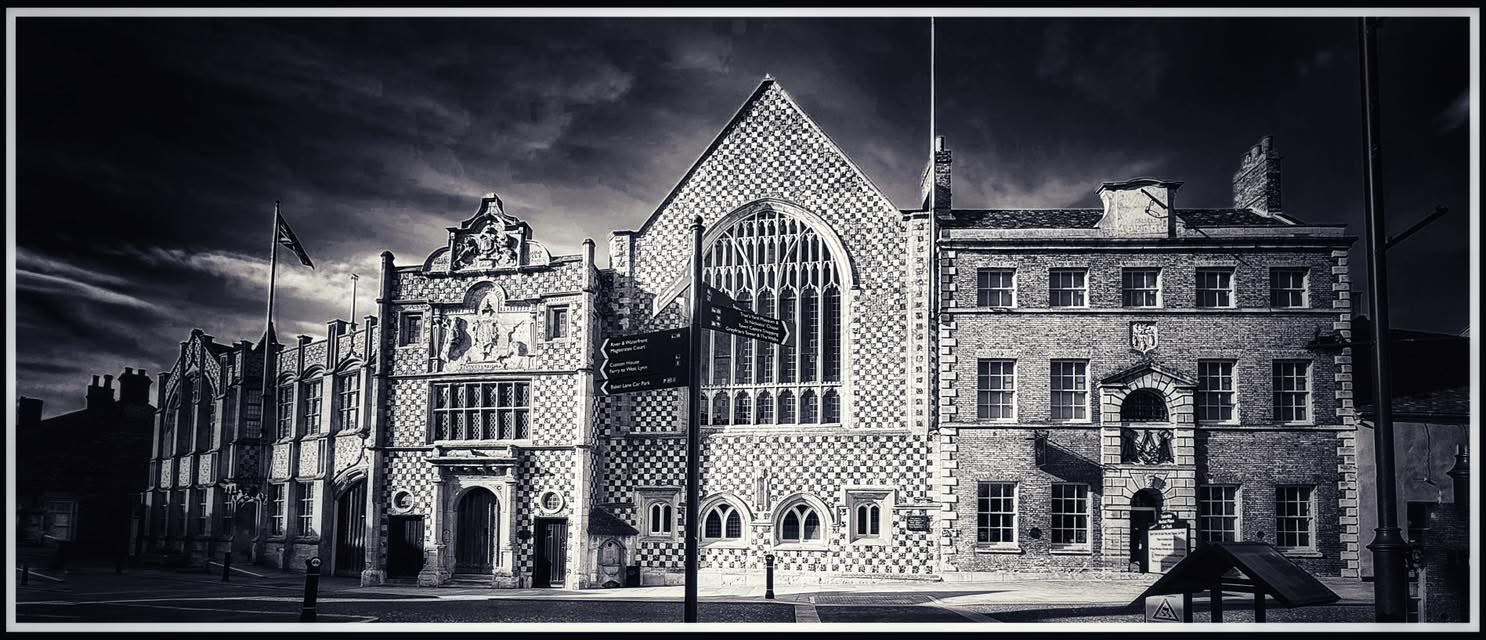
By the end of the nineteenth century, King’s Lynn could manufacture a locomotive, a steam traction engine, a fairground galloper, a marine boiler, and agricultural machinery. This was an extraordinary change for a town still usually described in terms of its medieval merchants and its declining importance as a port.
Lynn had not ceased to be a port. Instead, a second industrial economy was developing alongside the old commercial one. The railway arrived in 1844, Alexandra Dock opened in 1869, and Bentinck Dock followed in 1883. Reclaimed land provided room for larger factories, while rail and river gave manufacturers access to raw materials and distant customers. By the later nineteenth century, King’s Lynn was not simply receiving and forwarding goods made elsewhere. It was making increasingly sophisticated products of its own. The borough’s archaeological survey describes the town at this period as a centre for engineering, particularly agricultural and fairground machinery.
Four firms help tell that story. John Aickman represents its early foundry tradition. Frederick Savage turned agricultural engineering into a large manufacturing enterprise and became internationally famous for fairground machinery. Alfred Dodman developed heavy steam engineering at Highgate. Thomas Cooper, arriving towards the century’s end, began the move towards highly specialised engineering.
Aickman: iron for mills, farms, and the waterfront
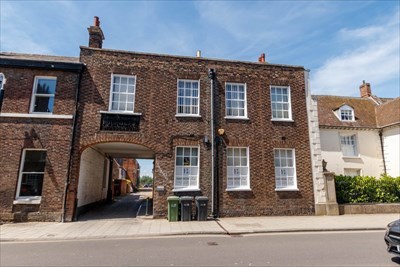
John Aickman’s foundry takes the story back well before the great Victorian factories. Its presence is still announced above the carriage entrance at No. 19 King Street by the cast-iron inscription “John Aickman’s Foundry MDCCCXXVII”. Historic England confirms that the entrance led into the yard occupied by the foundry.
Aickman was an ironfounder and millwright rather than simply the proprietor of a small local blacksmith’s shop. The business supplied practical ironwork for an agricultural and maritime district, including farm implements and ship-related work, while carrying out the repairs that were a large part of any nineteenth-century foundry’s trade. By the later century the firm was being described as a maker of ship and agricultural instruments.
One remarkable product has actually survived. In 1832 Aickman supplied the cast-iron windshaft for Thelnetham windmill in Suffolk. It weighed about 1¾ tons and formed the central shaft carrying the sails and transmitting their power into the mill machinery. Aickman was therefore capable of casting large, technically demanding components for working machinery, not merely gates, railings, and miscellaneous iron goods. The same firm is also associated with millwrighting work elsewhere in East Anglia.
The setting was very different from the later factory landscape. Aickman’s Yard ran back from King Street towards the river, embedded within the old mercantile town. Manufacturing, warehousing, houses, workshops, and the waterfront stood close together. The later workshops in the yard, including buildings of 1891 and 1904, show how long industrial activity survived on the site.
Aickman therefore belongs at the beginning of Lynn’s engineering revival rather than on its margins. When Savage and Dodman later built much larger works, they were entering a town in which ironfounding, machinery repair, and skilled metalworking were already established.
Savage: from agricultural machinery to mechanical spectacle
Frederick Savage arrived in King’s Lynn in 1848 and established his own business two years later. His later fame can obscure how conventional his beginnings were. He entered engineering through agriculture.
The company described itself as a manufacturer of ploughing, winding, traction, and portable engines, boilers, and agricultural implements, and as an iron and brass founder. Surviving catalogues advertise traction and portable engines, agricultural equipment, and even brickmaking machinery.
Among Savage’s early products were carts, hoes, threshing machinery, and steam engines for agricultural work. One ambitious machine was the Juggernaut traction engine of about 1856. Savage later produced the Agriculturalist ploughing engine, designed to haul a plough across a field by cable. Another remarkable experiment was the Darby Digger, an enormous twenty-ton machine intended to reproduce mechanically the action of men digging with spades.
Not every Savage invention became commercially successful. What the machines reveal is the willingness of the firm to experiment. The rapidly changing agriculture of the Fens provided a market for mechanical power, and Savage learned how to manufacture engines, gear systems, boilers, castings, and machinery on a substantial scale.
The business expanded through several sites before moving in the 1870s to the St Nicholas Ironworks on reclaimed land near the river. At its height the works employed about 400 people. Inside were foundrymen, machinists, fitters, pattern makers, carpenters, carvers, painters, and other craftsmen. Lynn Museum preserves thousands of wooden patterns and engineering drawings from the works.
Then Savage discovered the fairground.
From steam engines to gallopers
Steam power was already beginning to transform fairground rides when Savage entered the market. Historic England records that by 1870 he was manufacturing a steam-powered Velocipede in which riders sat on early bicycles arranged around a revolving platform. He did not invent the steam roundabout, but he became one of the manufacturers who developed the technology on an unprecedented scale.
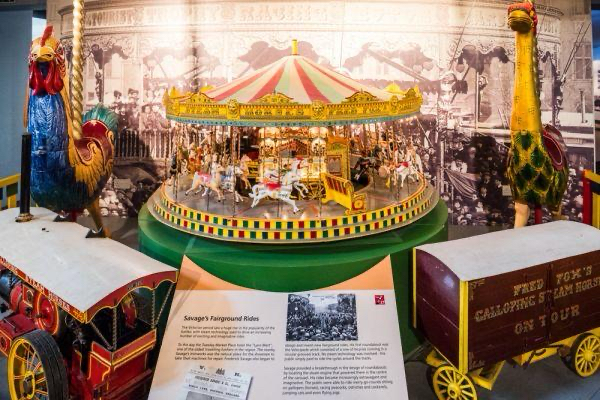
The resulting catalogue reads like a Victorian imagination let loose in an engineering works. Savage produced Dobby Horses, Platform Gallopers, Racing Peacocks, Jumping Cats, Flying Pigs, Switchbacks, Steam Yachts, Sea-on-Land rides, Tunnel Railways, Cakewalks, Razzle Dazzles, and other mechanical attractions.
The names sound whimsical. The engineering was not. Savage’s patented switchback used cars travelling around an undulating track with an additional rail arrangement intended to reduce the danger of overturning. Large gallopers could carry scores of carved horses arranged several abreast. As the platform accelerated, the mechanism created the rising, falling, and outward-swinging movement that gave riders the sensation of galloping at speed.
The firm manufactured much of what was required in Lynn. Castings came from the foundry, wooden components from the pattern and woodworking shops, and skilled carvers produced the horses and other animals. Some were extraordinarily elaborate. Decoration was applied after the engineering had been completed, turning machinery into theatre.
Savage also supplied the power that made the show possible. Its showmen’s engines could drive rides, while steam-powered generating sets, marketed as Savage Sparklers, helped illuminate them after dark. Later products included steam road wagons. In the twentieth century the firm’s remarkable adaptability even took it into aircraft manufacture during the First World War. (King’s Lynn & West Norfolk)
Savage’s achievement was therefore much larger than the manufacture of merry-go-rounds. The same works could build agricultural machinery, boilers, traction and portable engines, sophisticated fairground rides, and road vehicles. Few Lynn businesses have ever combined heavy engineering and popular entertainment so successfully.
Dodman: King’s Lynn goes into heavy engineering
Alfred Dodman’s Highgate Works had a rather different character. If Savage’s engineering could end beneath carved horses and electric lights, Dodman’s usually ended beneath rivets, boiler plate, pipes, and machinery.
Dodman began engineering in Lynn in the 1850s and moved to a purpose-built ironworks on Highgate Field in 1875. The position beside the railway branch serving the docks was particularly useful. Coal, iron, steel plate, and other heavy materials could reach the works by rail, while completed machinery could be sent away without negotiating the narrow streets of the town centre.
The borough archaeological survey identifies the principal products as boilers, traction engines, and steam locomotives. A contemporary engineering listing from around 1900 describes Alfred Dodman Ltd as a manufacturer of steam boilers, marine steam engines, and stationary steam engines.
Boiler-making lay near the heart of the business. Dodman manufactured substantial industrial boilers of the kinds used to raise steam for factories, mills, pumping installations, ships, and engines. A surviving company catalogue in the collection of Museum Wales runs to fifty-five pages and contains numerous illustrated examples of boilers made at Highgate Works. That is evidence of a firm marketing a considerable product range rather than simply undertaking occasional repairs for local customers. (Museum Wales)
The works produced Cornish and Lancashire-type boilers, along with boilers for portable and traction engines and marine use. Such products demanded large sheets of iron or steel to be cut, rolled into cylindrical form, riveted, fitted with furnaces and tubes, and tested to withstand substantial internal pressure.
Dodman also built traction and portable engines, agricultural machinery, and marine machinery. By the beginning of the twentieth century the range had widened further to include items such as pumps, cranes, mill machinery, and oil engines.
Gazelle: Lynn’s extraordinary little locomotive
Dodman’s most famous surviving product is much smaller than its great boilers.
In 1893 the Highgate Works completed Gazelle, a tiny standard-gauge steam locomotive commissioned by the Lynn corn merchant William Burkitt. Originally built as a 2-2-2 well-tank locomotive, it combined conventional railway engineering with components and ideas derived from traction-engine practice.
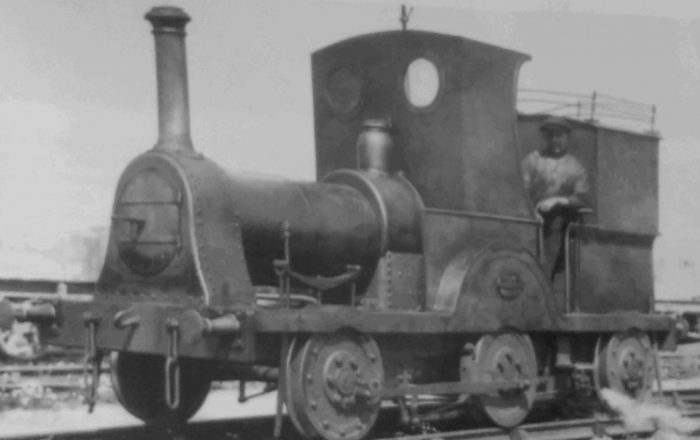
Gazelle had a steel boiler, copper firebox, inside cylinders, and a water tank carried low within the locomotive. After completion it was tested on the railway between King’s Lynn and Downham Market. The little engine later had an extraordinarily long life, was rebuilt, worked on the Shropshire and Montgomeryshire Railway, and eventually survived into preservation.
Gazelle appears to have been an exceptional commission rather than evidence of a large locomotive production line. That makes it more interesting rather than less. A Lynn firm primarily known for boilers and heavy engineering possessed the skills to construct a complete railway locomotive when a customer asked for one.
The difference between Savage and Dodman is revealing. Savage’s products ranged from farm engines to spectacular pleasure machinery. Dodman concentrated more heavily upon boilers, engines, marine equipment, and substantial industrial plant. Between them, they demonstrate how varied engineering in late Victorian Lynn had become.
Cooper: from steam digging to precision bearings
Thomas Cooper entered this world in the final years of the nineteenth century. Cooper was established in King’s Lynn in 1894, and the company’s own history identifies his first major invention not as a bearing but as a steam digger intended for arable farming.
That provides a useful connection with Savage. Agricultural mechanisation was still generating engineering ideas in Lynn half a century after Savage entered the same market.
Cooper’s lasting breakthrough came in 1907 with his split roller bearing. The principle was deceptively simple. Conventional bearings could be awkward to replace where shafts were difficult to dismantle. A bearing divided into sections could instead be fitted around the shaft. For machinery in ships, factories, mines, and other large installations, this could greatly simplify maintenance. Cooper roller bearings are in use in the Jodrell Bank Radio Telescope and in the Middlesborough Lift Bridge.
The company subsequently specialised in split cylindrical roller bearings and related bearing units and housings. Here Lynn engineering had entered another phase. Aickman produced ironwork and mill machinery. Savage and Dodman built complete engines and large machines. Cooper increasingly concentrated upon a precision component hidden inside other machinery.
That specialist approach gave the business remarkable longevity. While Aickman’s foundry disappeared and the great Savage and Dodman works eventually closed, Cooper continued manufacturing in King’s Lynn.
An engineering town
Seen through its products, the scale of King’s Lynn’s nineteenth-century engineering revival becomes much easier to appreciate.
Aickman could cast a 1¾-ton windmill shaft as well as manufacture agricultural and maritime ironwork. Savage made agricultural equipment, boilers, traction engines, giant digging machines, fairground rides, and road vehicles. Dodman built industrial and marine boilers, traction engines, stationary engines, marine machinery, and an extraordinary little locomotive. Cooper began with agricultural invention before moving towards the precision split bearings that would make its name.
These firms did more than add a few factories to the edge of an old port. They changed the nature of work in the town. Foundrymen, pattern makers, boilermakers, machinists, draughtsmen, fitters, woodworkers, and other skilled workers became part of Lynn’s economy. The railway and new docks helped manufacturers reach larger markets, while the agricultural hinterland and working harbour supplied problems for engineers to solve.
Medieval Lynn had prospered largely by buying, selling, storing, and transporting other people’s goods. Victorian Lynn increasingly added another activity to that list. It learned how to make difficult things.
© James Rye 2026
Book a Walk with a Trained and Qualified King’s Lynn Guide
References
- Aickman, Dorothy Jean. John Aickman’s Foundery MDCCCXXVII, King’s Lynn: A Fragment of Lynn History. Wisbech: Daedalus Press, 1980.
- Borough Council of King’s Lynn and West Norfolk. King’s Lynn Urban Archaeological Database Project Report. 2022. https://www.west-norfolk.gov.uk/download/downloads/id/7178/kings_lynn_urban_archaeological_database_project_report_-_march_2022.pdf
- Braithwaite, David. Savage of King’s Lynn. Cambridge: Patrick Stephens, 1975.
- Caspall, M. (2026) Private correspondence with SKF’s Product Engineering Manager
- Clark, Ronald. Savages Limited: A Short History 1850–1964. Norwich: Modern Press, 1964.
- Clark, Ronald. The Development of the English Traction Engine. Norwich: Goose and Son, 1960.
- Cooper Roller Bearings. “About Cooper.” https://cooperbearings.com/about-us.asp
- Historic England. “19, King Street, King’s Lynn.” National Heritage List for England, List Entry 1298220. https://historicengland.org.uk/listing/the-list/list-entry/1298220
- Historic England. “Thelnetham Windmill.” National Heritage List for England, List Entry 1031207. https://historicengland.org.uk/listing/the-list/list-entry/1031207
- Museum Wales. “Alfred Dodman & Co. Ltd., Boiler Catalogue.” Collections Online. https://museum.wales/collections/online/object/9a1c8b45-a3bf-3cf0-b1e6-11a3aedd66c7/Alfred-Dodman–Co-Ltd-boiler-catalogue/
- Norfolk Museums Service. Frederick Savage, Victorian Fairground Manufacturer of King’s Lynn. Lynn Museum, 1989. https://www.lynnmuseum.norfolk.gov.uk/media/14481/A-history-of-savages/pdf/p6a-history-of-savages.pdf
- National Fairground and Circus Archive, University of Sheffield. “Savage Ltd (1850–1973).” https://archives.shef.ac.uk/agents/corporate_entities/93