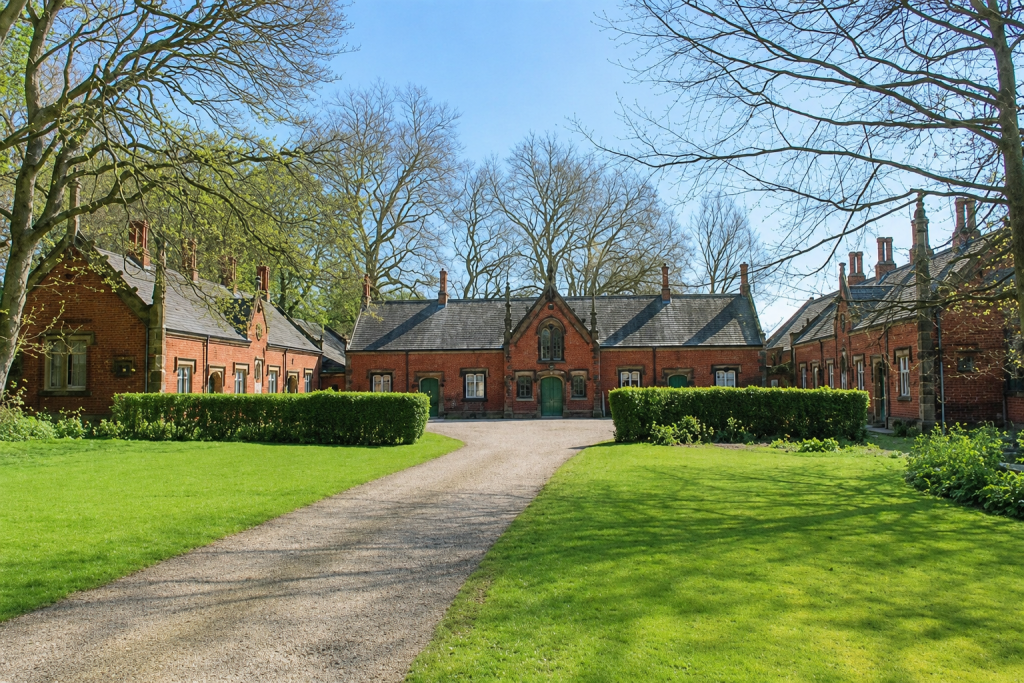
Framingham’s Almshouses in King’s Lynn stand beside The Walks, near the meeting of London Road and St James’s Road. Their quiet nineteenth-century buildings conceal a history that began almost two centuries earlier – and the familiar name tells only half the story.
A beginning in Paradise
The first Framingham’s Hospital stood in a field called Paradise, east of Broad Street. This attractive name gave the institution its earliest alternative titles: Paradise Hospital and the Broad Street Almshouse.
According to William Richards’s History of Lynn, the project was begun in 1676 by John Heathcote, whose surname also appears in older records as Helcote. Heathcote died before he could finish the work. Henry Framingham, a wealthy Lynn alderman, then acquired the property and completed the hospital, apparently during the following year.
So who was the founder?
The fairest answer is that Framingham’s had two. Heathcote conceived and began the almshouse; Framingham completed it and secured its future. The institution bears Framingham’s name because his contribution proved decisive, but Heathcote’s part should not be forgotten.
The original hospital was arranged around a quadrangular courtyard. It contained a chapel and twelve small dwellings, each with an adjoining garden. Twelve elderly men lived there, one of whom served as the reader or chaplain and received an additional allowance for carrying out his duties.
Framingham appears to have endowed eleven places. The twelfth was supported later by another Lynn alderman, John Goodwyn. Like many historic almshouses, the hospital was therefore not the product of one gift made on a single date. It grew through several acts of generosity.
More than one foundation date
Different histories attach different dates to Framingham’s. The buildings were begun in 1676 and probably completed in 1677, but Framingham’s will belongs to 1704. A later indenture is dated 1714.
These dates are not necessarily contradictory. They seem to represent different stages in the charity’s development: the construction of the hospital, Framingham’s testamentary gift and its subsequent legal or administrative settlement.
This distinction matters. Historic charities were rarely created as neatly as a modern organisation might be. A benefactor could erect a building during his lifetime, provide for it in his will and leave trustees or the Corporation to formalise its management years later.
Framingham’s also received support from later donors. Thomas Cooke of Pentonville, who had previously lived in Lynn, left £2,100 in three per cent stock to the hospital. He also made substantial bequests to St James’s and Valinger’s almshouses, linking three of the town’s otherwise separate charitable foundations.
Twelve men, twelve rooms and a reader
When Richards described the Broad Street hospital in 1812, it still contained twelve apartments and a chapel. The dwellings opened into the central court, while their small gardens lay beside the entrance from Broad Street.
The residents received weekly allowances from the charity’s investments. The reader occupied one of the apartments but was paid more than the other men in return for leading the institution’s religious observances.
Life there was modest, but an almshouse offered something of considerable value: a secure home outside the ordinary system of parish relief. Admission was nevertheless selective. Age and poverty alone were not always sufficient; character, local connection and respectability could all influence whether somebody was accepted.
The institution was both compassionate and paternalistic. It provided security, but within rules established by benefactors and civic governors.
A new home beside The Walks
The almshouses we see today are not the seventeenth-century buildings.
During the 1840s, the old Broad Street hospital was replaced by a new complex beside The Walks. Construction took place between approximately 1846 and 1848, with the old buildings reportedly demolished in 1848.
The relocation placed Framingham’s beside one of Lynn’s most important public landscapes. The Walks had developed from promenades laid out near the former town walls. John Rastrick’s map of 1725 showed a straight walk running eastwards from the neighbouring St James’s Almshouses; by the middle of the nineteenth century, the area was being transformed into an increasingly formal and attractive public space.
The new Framingham’s retained the traditional complement of twelve residents. White’s 1864 directory described them as men aged sixty or over, of good character, who had “seen better days”.
That revealing phrase captures the Victorian ideal of the “deserving” recipient. The almshouses were intended not simply for those who lacked money, but for respectable older people thought worthy of assistance. Charity offered protection, but it also passed judgement.
Substantial sums quoted in connection with Framingham’s sometimes create further confusion. The larger costs belong to this nineteenth-century relocation and rebuilding, not to Heathcote’s original foundation in the 1670s.
A charity repeatedly renewed
The present Framingham’s Almshouses are Grade II listed and remain part of King’s Lynn’s remarkable tradition of charitable housing. They are administered within King’s Lynn General Charities, which continues to provide almshouse accommodation for older residents of the borough.
Their survival creates an impression of unbroken permanence, but the real history is richer. Framingham’s has occupied two sites. It has been rebuilt, re-endowed and placed under changing legal arrangements. Its residents’ living conditions and qualifications have evolved alongside wider attitudes towards age, poverty and welfare.
Even its name simplifies the past.
Framingham’s began with John Heathcote’s unfinished project. Henry Framingham completed and endowed it. John Goodwyn supported its twelfth place. Thomas Cooke and other benefactors strengthened its finances. The Corporation gave it a new home beside The Walks.
What survives is therefore more than a monument to one man. It is the result of successive generations choosing to preserve the same charitable purpose: providing older people in King’s Lynn with a secure place to call home.
© James Rye 2026
Book a Walk with a Trained and Qualified King’s Lynn Guide
References
William Richards, The History of Lynn, volume II, 1812:
https://www.gutenberg.org/cache/epub/62372/pg62372-images.html
Henry J. Hillen, History of the Borough of King’s Lynn, volume II, 1907:
https://archive.org/stream/historyofborough02hill/historyofborough02hill_djvu.txt
White’s History, Gazetteer and Directory of Norfolk, 1864:
https://archive.org/stream/historygazetteer00whit/historygazetteer00whit_djvu.txt
Charles Mackie, Norfolk Annals:
https://www.gutenberg.org/files/34439/34439-h/34439-h.htm
Historic England, The Walks:
https://historicengland.org.uk/listing/the-list/list-entry/1001374
Historic England archive record for Framingham’s Hospital:
https://historicengland.org.uk/images-books/photos/item/IOE01/00201/29
King’s Lynn Civic Society:
https://www.kingslynncivicsociety.co.uk/pilgrimage/framingham-almshouses/
King’s Lynn General Charities:
https://register-of-charities.charitycommission.gov.uk/en/charity-search/-/charity-details/233003