

Photo © James Rye 2023
In Georgian King’s Lynn, the hardest wealth to tax was the wealth that moved.
A house stood still. A field could be measured. Rent could be estimated, even if old valuations often lagged behind real market rents. But Lynn was a port. Its wealth moved through ships, cargoes, warehouses, credit, partnerships, and promises written in ledgers. Coal might arrive from the north-east and be sold inland almost at once. Timber could be imported, stored, and resold. A merchant’s capital might be tied up in vessels, goods at sea, debts owed by customers, or payments due to suppliers.
So the town faced a practical problem. If much of Lynn’s prosperity came from trade, how could the poor rate and land tax make that trade pay?
That is the sharp question behind John M. Barney’s article, “Local taxes as a measure of commerce in the eighteenth century: the cases of Poole, Dorset and King’s Lynn, Norfolk”, published in The Local Historian in May 1998. Barney was not interested in tax records because they were tidy. They were not. He was interested in them because, in rare cases, they can reveal the commercial structure of a town.
King’s Lynn was one of those rare cases.
What did “stock” mean?
The key word is “stock”.
Today, stock usually means goods held for sale. In the eighteenth century it could mean something wider: the capital used in trade. That might include goods in a warehouse, cargoes on the move, money advanced in business, debts owed by customers, shares in ships, or other trading assets.
In Lynn, part of the poor rate and land tax was assessed on stock. In plain English, the town was trying to tax business wealth as well as land and buildings.
That sounds simple until we ask how anyone could value it. Parish officers had no income tax returns. They could not demand modern balance sheets. They did not have clean annual accounts from every trader on the quayside. They had local knowledge, reputation, custom, pressure, and dispute.
A stock assessment was therefore not an exact statement of wealth. It was a local taxable estimate. It was partly a calculation and partly a judgement. That makes the records dangerous if read too literally. It also makes them fascinating.
The figures: what was actually paid?
The easiest mistake is to think that an assessment was the tax bill.
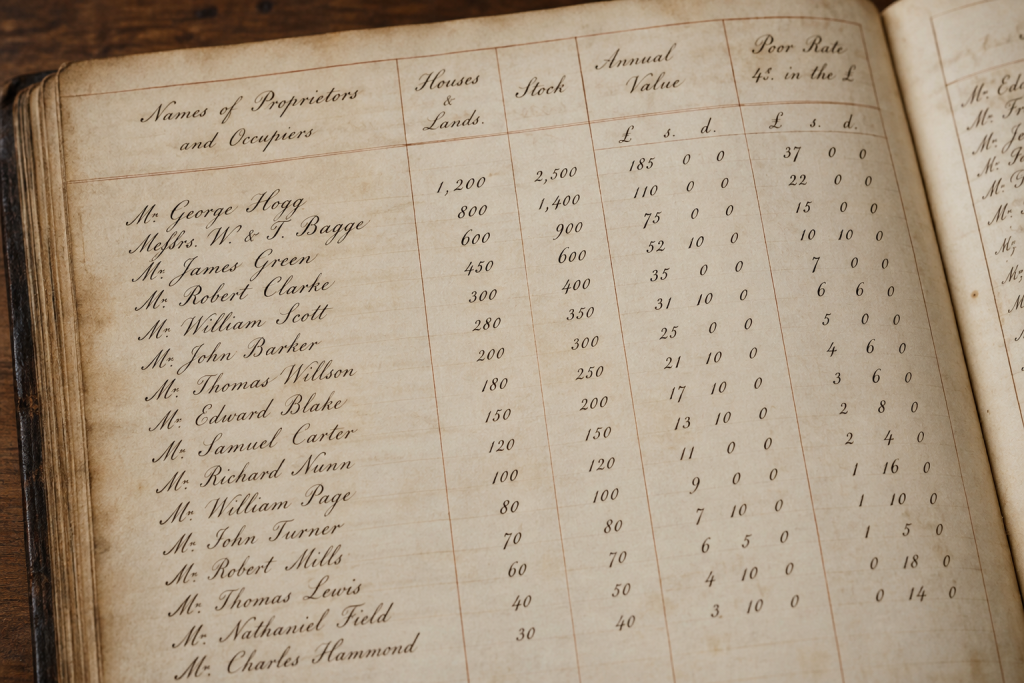
It was not. If a merchant was assessed on £1,400 of stock, he did not pay £1,400 in tax. Nor does the figure prove that his whole business was worth only £1,400. The figure was first turned into an assumed annual return. Barney explains that Lynn commonly treated stock as producing 5 per cent a year.
So £1,400 of stock was treated as producing £70 of annual value.
The poor rate was then charged on that annual value.
In 1771, the rate was 4s. in the pound. There were 20 shillings in a pound, so 4s. meant 20 per cent. W. & T. Bagge’s 1771 stock assessment can therefore be read like this:
| Stage of calculation | Figure |
|---|---|
| Assessed stock | £1,400 |
| Assumed return at 5 per cent | £70 |
| Poor rate at 4s. in the pound | 20 per cent of £70 |
| Actual poor rate paid on stock | £14 |
That £14 was the tax paid on the assessed stock. The £1,400 was not the amount paid.
George Hogg’s firm was assessed in 1771 on £2,500 of stock, the highest figure in that year’s list. At 5 per cent, £2,500 became £125 of annual value. At 4s. in the pound, the payment would be £25. That does not mean Hogg’s business was worth only £2,500. It means that, for rating purposes, he stood at or near the top of Lynn’s commercial hierarchy.
This is the point. The figures are poor evidence for exact wealth, but useful evidence for relative standing.
The other percentages
Barney also gives percentages showing how much of the whole rate came from stock. These figures measure something different. When stock produced 33 per cent of the poor rate in St Margaret’s parish in 1771, that does not mean merchants paid 33 per cent tax on their stock. It means that one third of all the money raised by the rate came from assessments on stock rather than from land and buildings. The distinction matters.
One percentage tells us the rate charged on assessed annual value. Another tells us how much of the total burden came from commercial stock. They answer different questions.
The figures below bring the main points together:
| Year | Rate in the pound | What the rate meant | Approximate payment on £100 of assessed stock, assuming a 5 per cent return | Share of the total rate raised from stock, or stock and ships | What the figure suggests |
|---|---|---|---|---|---|
| 1771 | 4s. | 20 per cent of assessed annual value | £1 | 33 per cent from stock | Stock was a major part of the poor rate in St Margaret’s parish |
| 1791 | Not the key figure here | Not the key figure here | Not calculated here | 15 per cent from stock | The commercial share had fallen sharply |
| 1795 | 14s. | 70 per cent of assessed annual value | £3 10s. | Not given as a comparable share | The rate itself had become heavy, sharpening arguments about fairness |
| 1797 | After reform | Not directly comparable | Not directly comparable | 27 per cent from stock and ships | Reform brought more commercial wealth, especially shipping, into the assessment |
The 1795 figure looks startling, and it was certainly heavy. But it does not mean that a trader paid 70 per cent of the total value of his stock. If £100 of stock was treated as producing £5 a year, a 14s. rate took 70 per cent of that £5. The payment was £3 10s. on £100 of assessed stock.
Still, the rise was severe enough to make people argue. A tax system that might be tolerated at 4s. in the pound could look very different at 14s.
Why Lynn quarrelled
The dispute was not simply a row between small merchants and larger merchants. Barney’s summary describes the Lynn conflict more precisely as one between “the merchants and the general tradespeople”. That wording matters.
The challengers were the wider body of shopkeepers, tradespeople, and ratepayers who had to contribute to poor relief. Their complaint was not necessarily that every leading merchant was escaping tax. The problem was that merchant wealth was hard to see, while shops, houses, and workshops were much easier to rate.
A shopkeeper’s premises could be valued. A tradesman’s yard was visible. But a merchant’s wealth might be spread across cargoes, credit, and shipping. If stock was under-assessed, and if ships were not properly brought into the calculation, then more of the burden fell on rents, buildings, and smaller visible businesses.
That was the grievance. Who should pay for poverty in a trading port? Should the burden fall mainly on fixed property, or should Lynn’s maritime wealth be made more taxable?
Ships sharpened the problem
Ships were awkward because they were valuable, mobile, and central to the port’s economy. Before the 1790s reform, ship ownership does not seem to have been fully reflected in Lynn’s stock assessments. This mattered. A merchant who owned ships held a major business asset, but that asset did not fit neatly into a system designed around land, houses, and local premises.
The legal advice obtained during the dispute helped clarify the position. Ships were to be rated where they were registered. For Lynn, that pointed to St Margaret’s parish, because the Custom House lay there. A vessel might be built, moored, or associated with South Lynn, but its registration could still bring it into the St Margaret’s assessment.
The new arrangement valued ships at £4 per registered ton. This was still a formula, not a market valuation. Yet it made shipping more visible within the rating system.
That helps explain why the share of the rate coming from stock and ships rose from 15 per cent in 1791 to 27 per cent in 1797. Reform did not restore the 1771 figure of 33 per cent, but it did bring a larger share of commercial wealth back into view.
A town governed by men of trade
The quarrel also tells us something about power in Georgian Lynn. The town’s government was closely linked to its mercantile elite. Merchants were present among the corporation, magistrates, and Guardians of the Poor. They did not simply avoid taxation. They paid. But they also belonged to the class of men who helped manage the system that decided how much people should pay. That made the rating of stock politically sensitive.
If the system was too aggressive, merchants could complain that trade was being punished. If it was too gentle, shopkeepers and tradespeople could suspect that powerful men were protecting one another. Lynn’s poor rate books therefore record more than finance. They record trust, suspicion, and local authority.
The figures are not neutral. They were produced inside a town where the people being assessed often knew one another, traded with one another, and sat in judgement on one another.
What the records can prove
Barney is careful about the value of this evidence, and that caution is useful. The stock assessments do not tell us exactly how rich Lynn’s merchants were. They were too rough for that. They were shaped by custom, legal uncertainty, local bargaining, and incomplete knowledge. Some assessments were probably well below real commercial value. But they are not useless.
If one firm was assessed on £2,500 and another on £50, that gap is unlikely to be accidental. In a compact commercial town, a wildly wrong ranking would have been difficult to sustain. The leading traders knew who had ships, who handled cargoes, who had credit, and who mattered on the quay.
The records give us a rough map of commercial reputation. They show who stood high, who sat in the middle, and who belonged to the smaller world of visible shops and premises. They do not provide a full balance sheet. They provide a social and commercial ranking drawn in tax figures.
The value of a difficult source
At first sight, poor rate and land tax records look dry. They are lists of names, properties, assessments, and payments. Yet Barney shows how much they can reveal when read carefully.
For Lynn, they open a window onto the port’s eighteenth-century economy. They show trade wealth being pulled, reluctantly and imperfectly, into local taxation. They show ships becoming part of the argument. They show general tradespeople challenging a system strongly influenced by merchants. They show a town trying to decide which forms of wealth should count.
The argument over stock was really an argument over visibility. Land could be seen. Houses could be inspected. Shops had doors, counters, and windows. Merchant wealth was different. It moved with the tide.
© James Rye 2026
Book a Guided Tour with a Trained and Qualified King’s Lynn Guide Through Historic Lynn
References
- Barney, John M. “Local Taxes as a Measure of Commerce in the Eighteenth Century: The Cases of Poole, Dorset and King’s Lynn, Norfolk.” The Local Historian 28, no. 2 (May 1998): 66–77. British Association for Local History. https://www.balh.org.uk/publication-tlh-the-local-historian-volume-28-number-2-may-1998
- British Association for Local History. “The Local Historian Volume 28, Number 2, May 1998.” Accessed 11 August 2026. https://www.balh.org.uk/publication-tlh-the-local-historian-volume-28-number-2-may-1998
- British Agricultural History Society. “Annual List of Articles on Agrarian History, 1998.” Agricultural History Review 48 (2000): annual bibliography section. https://www.bahs.org.uk/AGHR/VOLUMES/AGHR48.pdf