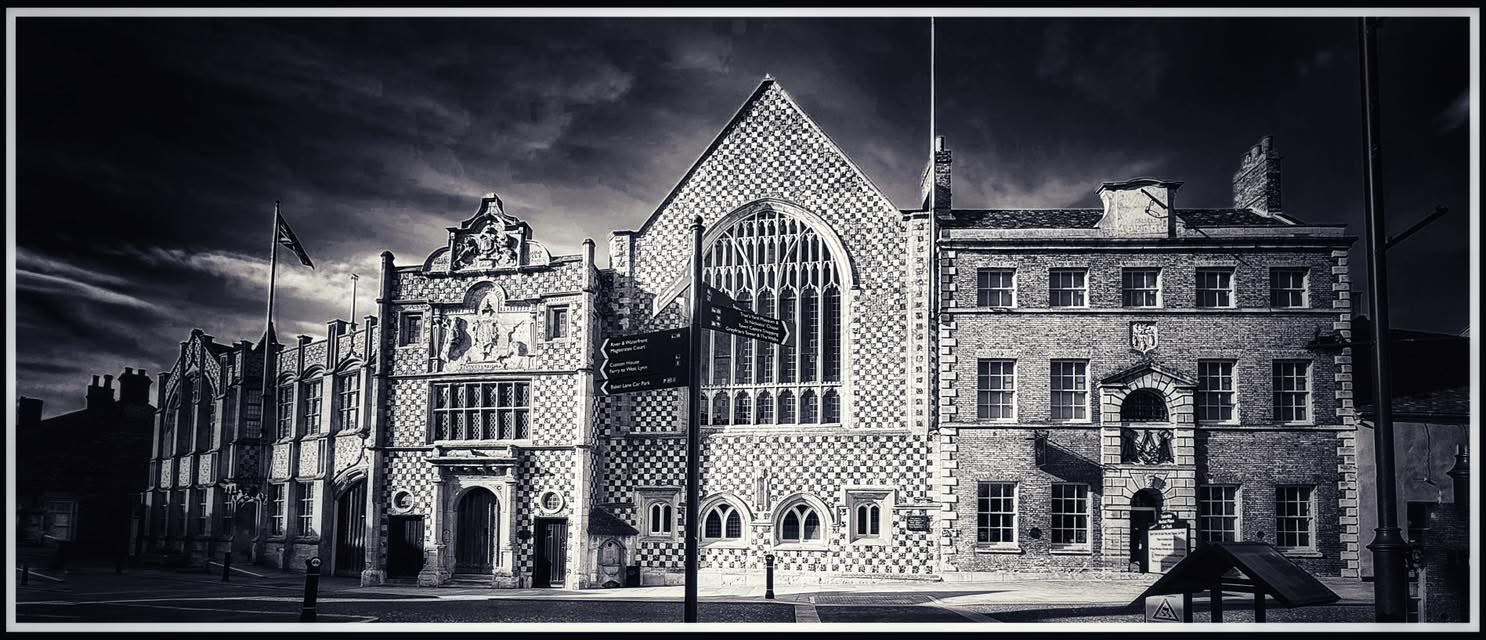
Queen Street is one of the finest historic streets in King’s Lynn. Walk its length and almost every building hints at a different chapter in the town’s past. Medieval merchants once lived and traded here. Georgian rebuilding reshaped older properties. Victorian prosperity introduced new commercial premises, while twentieth-century conservation ensured much of the street survived into modern times.
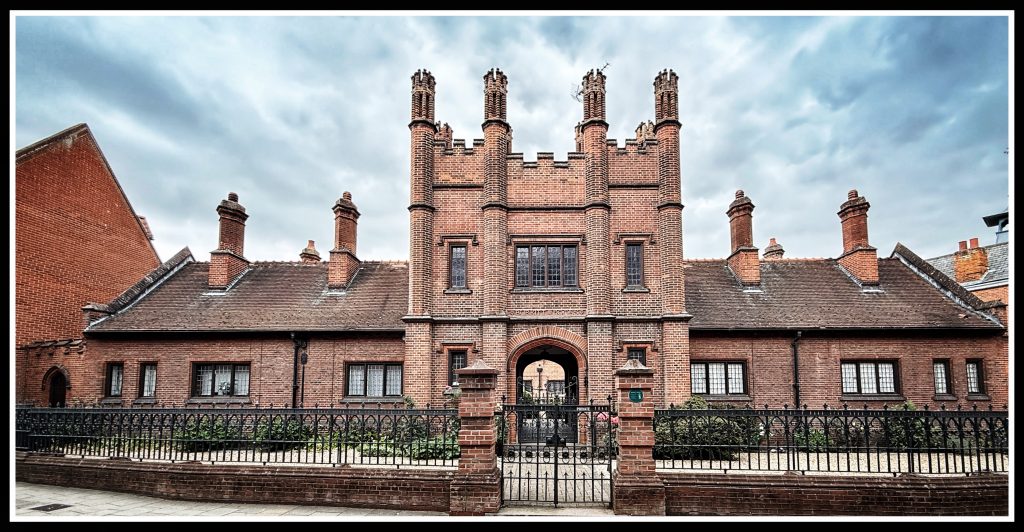
Photo © James Rye 2026
Among these buildings stands one that is easy to admire without fully understanding. Behind an imposing gatehouse, with its battlements, turrets, and mullioned windows, lies Burkitt Homes. It is one of King’s Lynn’s youngest historic almshouse foundations, yet it belongs to a charitable tradition that stretches back many centuries.
Unlike many historic buildings, Burkitt Homes has never become merely a monument. More than a century after it was founded, it still provides homes for older people, fulfilling almost exactly the purpose its benefactor intended.
Charity has long shaped King’s Lynn
King’s Lynn owes much of its historic character to trade. For centuries ships entered the Great Ouse carrying grain, timber, wine, coal, iron, and countless other commodities. Successful merchants accumulated considerable wealth, and some chose to invest part of that wealth in the town itself.
That generosity took many forms. Churches were enlarged or rebuilt. Schools were endowed. Hospitals received gifts. Public buildings were improved. Charitable trusts provided relief for widows, apprentices, the poor, and elderly townspeople. Almshouses formed an important part of this tradition.
Their purpose was practical rather than grand. They offered modest but secure accommodation for people who had reached old age without the resources to support themselves comfortably. Long before pensions or the welfare state, they provided stability, independence, and dignity.
King’s Lynn possesses several examples from different periods, each reflecting the charitable ideas of its own age. Burkitt Homes belongs to the final great wave of almshouse building that flourished during the late Victorian and Edwardian years.
A family memorial
The story begins with two men who shared exactly the same name. Burkitt Homes was founded in 1909 by William Burkitt in memory of his uncle, also William Burkitt. Historic England records this directly from the commemorative inscription beneath the entrance arch. That shared name has caused confusion ever since.
The elder William Burkitt was a prominent figure in nineteenth-century King’s Lynn. Contemporary borough records identify him as a maltster and corn merchant, occupations closely tied to the prosperity of the port. Grain from East Anglia passed through King’s Lynn in enormous quantities, and merchants such as Burkitt formed an important part of the town’s commercial life.
His business success was accompanied by civic service. He was elected Mayor of King’s Lynn twice, in 1863 and again in 1886.
Some modern publications have accidentally substituted 1883 for his first mayoralty, while others blur the careers of uncle and nephew together. The surviving documentary evidence leaves little doubt that the older William Burkitt was the man honoured by the memorial, while the younger William Burkitt created and endowed it.
The younger man’s own life remains surprisingly elusive. Later writers have associated him with Derbyshire, but readily accessible evidence does not yet establish his biography with confidence. That gap reminds us that local history is often incomplete rather than finished.
Building for permanence
The choice of design was anything but accidental. Many Edwardian charitable institutions resembled ordinary terraces or institutional buildings. Burkitt Homes took a different approach. The architect, whose identity unfortunately remains unknown, created a compact quadrangle enclosed behind a ceremonial entrance. Visitors pass beneath a broad four-centred arch framed by polygonal turrets before entering a peaceful courtyard surrounded by modest dwellings.
The materials are straightforward: red brick walls beneath tiled roofs. The details, however, deliberately recall an earlier England. Mullioned windows, crenellated parapets, gables, and projecting towers borrow freely from late medieval and Tudor architecture.
This was not an attempt to deceive anyone into believing the buildings were ancient. Instead, the design connected a modern charitable foundation with England’s long tradition of philanthropy.It was architecture carrying a message. Charity, permanence, and civic responsibility were intended to endure.
Twelve homes around a shared garden
Behind the gatehouse stood twelve small dwellings arranged around a central courtyard.
By modern standards the accommodation was modest, but it represented security at a time when many older people had few alternatives. Shared washing facilities and bath houses reflected contemporary expectations while making amenities available that many working-class households still lacked.
Life inside the walls would have been quiet. Residents retained their independence while benefiting from accommodation maintained through the charitable trust.
Later improvements altered the internal arrangement. Several of the smallest dwellings were combined to create larger apartments better suited to modern expectations. Today the complex contains ten homes, but externally it remains remarkably close to its original appearance.
At the centre of the courtyard stands a stone sundial dating from 1909, itself separately protected as a listed structure. It is an easily overlooked feature, yet it forms an integral part of the original design.
Who could live there?
The original trust deed reveals much about Edwardian ideas of charity. Admission was not simply a matter of financial need. Applicants had to have been born in the parish of King’s Lynn, reached the age of sixty, be of good character, lack sufficient means of support, be incapable of earning their living, and have attended a Protestant place of worship for at least two years. To modern readers these conditions may seem restrictive, yet they reflected widely held assumptions of the period.
Most benefactors expected their charity to assist people they regarded as members of their own community. Birth within the parish ensured a local connection. Religious observance reflected the moral outlook of many nineteenth-century charitable foundations. The requirement that applicants should be incapable of supporting themselves distinguished permanent need from temporary hardship.
Over time these conditions have changed. Today’s admission arrangements are considerably broader, reflecting changing society, housing policy, and charity law. The precise legal process by which those original qualifications were modified remains a subject for further archival research.
Queen Street before Burkitt Homes
The story of Burkitt Homes is also the story of a changing street. The buildings stand on the site formerly occupied by No. 34 Queen Street, demolished in 1909 to make way for the new development.
Archaeological records suggest that the site contains evidence associated with a presumed twelfth-century building, demonstrating that this part of King’s Lynn had already been occupied for many centuries before Burkitt Homes appeared.
Queen Street illustrates one of the defining characteristics of King’s Lynn. Buildings rarely stand in isolation from the past. Instead, successive generations have rebuilt, adapted, demolished, and renewed while leaving traces of earlier occupation beneath their work.
A charity that never stood still
Although its outward appearance has changed remarkably little, Burkitt Homes has never been frozen in time. The charity has adapted to modern expectations by improving accommodation, combining some of the original dwellings into larger apartments, and continuing to provide independent housing rather than institutional care. This flexibility explains its longevity.
Many Edwardian institutions gradually disappeared because they failed to adapt. Burkitt Homes survived because it balanced respect for its original purpose with practical changes that allowed the buildings to remain useful.
More than a century after the first residents arrived, the charity still fulfils its founding aim of providing secure homes for older people connected with King’s Lynn.
Looking through the gate
Every historic building tells more than one story. Burkitt Homes is an architectural landmark. It is also a family memorial, an expression of civic pride, an Edwardian charitable foundation, and a continuing home for local residents.
Perhaps that explains why it remains so appealing. It has never become simply a relic of the past. The gatehouse still welcomes residents rather than visitors, the courtyard still serves the purpose for which it was designed, and the charity continues to support the community that inspired its creation.
Many people pause outside the entrance to admire its handsome brickwork and battlements. Fewer realise that behind those walls survives one of King’s Lynn’s most successful acts of private philanthropy, quietly continuing its work more than a century after William Burkitt chose to honour his uncle with something far more lasting than a monument.
© James Rye 2026
Book a Guided Tour with a Trained and Qualified King’s Lynn Guide Through Historic Lynn
References
Almshouse Association. Case Study: Burkitt Homes, King’s Lynn. https://www.almshouses.org/news/case-study-burkitt-homes-kings-lynn/
Borough Council of King’s Lynn and West Norfolk. List of Mayors of King’s Lynn, 1248 to 2025. https://www.west-norfolk.gov.uk/download/downloads/id/5646/list_of_mayors_of_kings_lynn_1248_to_2025.pdf
Charity Commission for England and Wales. The Burkitt Homes. https://register-of-charities.charitycommission.gov.uk/en/charity-search/-/charity-details/234467
Charity Commission for England and Wales. The Burkitt Homes: Governing Document. https://register-of-charities.charitycommission.gov.uk/en/about-the-register-of-charities/-/charity-details/234467/governing-document
Historic England. Burkitt Homes, Queen Street, King’s Lynn. https://historicengland.org.uk/listing/the-list/list-entry/1210433
Historic England. Educational Image: Burkitt Homes, Queen Street, King’s Lynn.https://historicengland.org.uk/education/schools-resources/educational-images/burkitt-homes-queen-street-kings-lynn-norfolk-ioe01-14154-23
Hillen, Henry J. History of the Borough of King’s Lynn. Vol. II. London: East of England Newspaper Company, 1907. https://archive.org/details/historyofborough02hill
Lynn Museum. Deal Justly with All: A History of Poverty and Charity in King’s Lynn.https://artsandculture.google.com/story/deal-justly-with-all-a-history-of-poverty-and-charity-in-king-39-s-lynn-lynn-museum/HQXR_1UrpDbKKw?hl=en
Norfolk Heritage Explorer. Record MNF12052. https://www.heritage.norfolk.gov.uk/record-details?MNF12052=
Norfolk Record Office. “King’s Lynn Golden Jubilee Procession: Identity Parade.” https://norfolkrecordofficeblog.org/2022/06/03/kings-lynn-golden-jubilee-procession-identity-parade/
The National Archives. Norfolk Record Office Accessions.https://www.nationalarchives.gov.uk/accessions/2002/02returns/02ac153.htm