AI altered image from an original by https://www.boutiquehotelier.com/
The statue of Charles I above Bank House may be older than the building supporting it. The vaults beneath the garden were discovered, forgotten, and then discovered again. Even the familiar claim that the house was built in 1682 proves difficult to support. Bank House has no single foundation story. It developed from a merchant’s riverside property into one of King’s Lynn’s finest houses, later becoming a bank, offices, and finally the hotel we see today.
A house without a firm building date
Bank House stands on the south side of King’s Staithe Square, beside one of the places where ships unloaded their cargoes and merchants conducted business. Coal, timber, and wine entered Lynn through the port, while grain from Norfolk and the Fens travelled in the opposite direction. Goods landed at the staithe were assessed, stored, and trans
ferred to smaller vessels or road transport. A large merchant’s house in this position placed its owner close to the centre of Lynn’s commercial life.
The exact age of Bank House remains uncertain. Historic England dates the surviving building to the early eighteenth century. Henry Bell’s plan of Lynn, drawn around 1680, appears to show the site without the present house, while Rastrick’s map of 1725 shows a building there. This suggests that the main house was constructed between those dates.
The Norfolk Historic Environment Record complicates matters by associating a mariner named Thomas Lemon with Bank House in 1689. That reference may concern an earlier house on the property. It is also possible that the name Bank House was applied retrospectively when the document was examined. No dated foundation stone, building account, or contemporary deed has yet been found to support the precise construction date of 1682.
The safest conclusion is that a house may have existed on the site by the late seventeenth century, but that most of the surviving building belongs to the eighteenth century and later. Ownership between about 1700 and 1745 has not been established, so the person who commissioned the main house cannot presently be identified. Its size and position indicate a prosperous merchant, but claims that it was built for one of Lynn’s richest merchants go beyond the available evidence.
The house continued to change. The Norfolk record suggests that the west wing was added around 1750 and bay windows appeared around 1765. Historic England dates the present full-height bays and the remodelling of the north façade to the early nineteenth century. Earlier projections may have been rebuilt during that later work, although the surviving evidence does not provide a definite sequence.
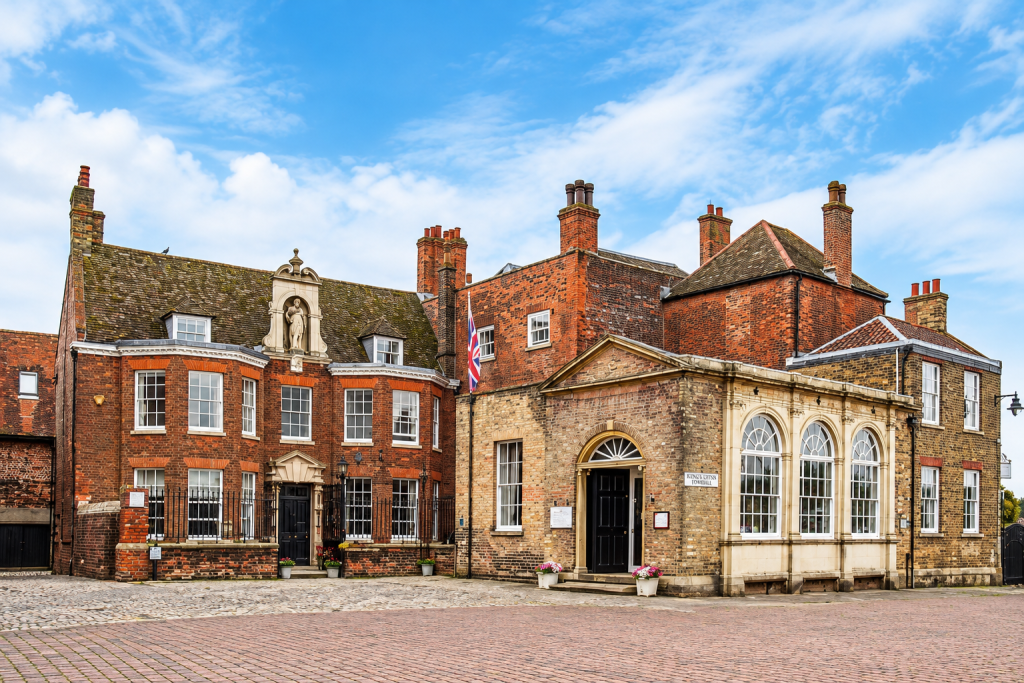
The resulting north front is built of red brick and rises through two storeys to a dormered attic. A central panelled doorway sits within a heavy rusticated surround, with tall canted window bays on either side. The west wing reaches three storeys and contains patches of older English-bond brickwork. Inside are eighteenth-century panelling, decorated ceilings, an elaborate overmantel, and an early nineteenth-century staircase. Bank House was listed Grade II* in 1951.
James Fysh and the wine vaults
The first well-documented eighteenth-century occupant was James Fysh, who lived at Bank House between about 1745 and 1769. Fysh was a Lynn merchant, freeman of the borough, churchwarden of St Margaret’s, and wine importer. He died in January 1781, aged about 66.
Fysh’s occupation gives substance to the tradition that Bank House was a wine merchant’s home. It also coincides with the suggested construction of the west wing and the first bay windows. This does not prove that he commissioned the work, but he was living in the house during the period when it is thought to have taken place.
The great brick vaults beneath and behind Bank House fit naturally into this history. Lynn imported large quantities of wine from continental Europe. It arrived in barrels and needed cool, secure storage near the quayside. The cellars beneath Bank House provided precisely those conditions.
Local accounts say that wine stored there was sent onwards to Cambridge colleges, Ely, and northern England. The claim is plausible because water transport connected Lynn with the Fenland waterways, while coastal shipping linked it to ports such as Newcastle. No surviving account book has yet been found, however, that identifies Fysh’s customers or confirms those particular destinations.
Henry Hillen recorded a curious episode involving the vaults. In October 1870 workmen repairing a drain uncovered large cellars behind Bank House. The discovery was reported in the local press, but later tenants apparently remained unaware of them. They were found again in January 1904 when an opening was being dug for a rainwater pipe.
Hillen described three parallel brick vaults running east to west beneath the garden and former stables. Each was approximately 18 feet wide, with arched openings connecting them. Together they covered about 284 square yards. Historic England also records extensive barrel-vaulted cellars entered from a ground-floor room beneath a heavy timber beam. These were substantial commercial storage spaces rather than ordinary domestic cellars. Stories about secret tunnels are less convincing. The evidence supports connected vaults extending beneath the property, but not mysterious passages leading elsewhere in Lynn.
The king above the roof
The statue in the elaborate niche above the façade represents Charles I. Historic England says that it came from Lynn’s former Custom House of about 1630 and was moved to King’s Staithe Square in 1685. A description written in 1737 certainly records a statue of Charles I among the buildings surrounding the square.
The chronology presents a problem. If the present Bank House is mainly early eighteenth-century, the statue cannot have been placed on its current façade in 1685. It may first have been attached to an earlier building on the property and incorporated into the later house. Alternatively, the accepted date of its transfer may be wrong. The statue’s origin is reasonably well supported, but the stages of its journey have not been traced through contemporary records.
The story that it arrived in a wheelbarrow is local folklore. It may preserve a memory of the figure being moved a short distance through Lynn, although no documentary evidence for the wheelbarrow has been found. An early nineteenth-century history mistakenly identified the statue as King John, perhaps because of John’s long association with the town. Its costume and the heritage records identify it as Charles I.
What happened to the tollbooth?
Historic England’s older listing states that Bank House was built on the site of a sixteenth-century port tollbooth. The more recent Norfolk archaeological record gives a different account. It says that the tollbooth survived until 1788, when the bank leased and demolished it before constructing a Counting House. Both statements cannot describe exactly the same footprint.
The later account offers a more convincing sequence. Bank House was already standing when banking began there in 1782. Six years later, the neighbouring tollbooth was removed and its site incorporated into the property. This preserves the genuine connection between Bank House and the port tollbooth without requiring the main house to have replaced a structure that survived into the 1780s.

Photo: Lynn News
The Counting House is separately listed Grade II. It is a single-storey brick building with a pedimented entrance, double doors beneath a fanlight, Ionic pilasters, and three tall round-headed windows facing the square. Historic England dates it to 1782, while the Norfolk record favours 1788. Banking probably began inside the house in 1782 and expanded into the purpose-built Counting House after the tollbooth was demolished. The late eighteenth-century gates and iron railings connecting the two buildings have their own Grade II listing.
How Bank House acquired its name
The Lynn Bank opened in John Birkbeck’s house on 1 January 1782 as part of the Gurney banking network. It remained there for 87 years, with the building serving both as a residence and place of business. The bank moved to larger premises in the Market Place in 1869 and eventually became part of Barclay & Company in 1896.
The Cresswell banking family were among the later residents. Samuel Gurney Cresswell, born at Bank House in 1827, became a Royal Navy officer, Arctic explorer, and artist. He was one of the first naval officers to cross the Northwest Passage, completing the route through sea voyages and long overland journeys.
From offices to hotel
The history after 1869 is less complete. Historic England summarises the building’s successive uses as house, hotel, and offices. Local accounts identify tax inspectors, solicitors, and shipbrokers among its occupants, but a properly dated sequence has not yet been reconstructed from directories, rate books, census returns, and title deeds. The forgotten cellars suggest that the property had been divided between tenants who knew only the rooms they occupied.
By the early twenty-first century, the main house provided limited guest accommodation while other areas remained residential or were used as offices. The Counting House was occupied by solicitors. Anthony and Jeannette Goodrich acquired the property in 2007 or 2008 and converted it into a twelve-bedroom hotel with a bar and restaurant. Later partitions were removed, while the panelling, staircase, façade, vaults, and associated banking structures were retained. Bank House reopened as a boutique hotel in 2008.
The waterfront surroundings have also attracted filmmakers. King’s Lynn represented eighteenth-century New York in the 1985 film Revolution, starring Al Pacino. In 2018 King’s Staithe Square and the Purfleet became a Victorian fish market for The Personal History of David Copperfield. Boats, barrels, market stalls, and temporary shopfronts briefly returned commercial activity to the square outside the merchant’s house.
© James Rye 2026
Book a Guided Tour with a Trained and Qualified King’s Lynn Guide Through Historic Lynn
References
- Art UK. “Charles I (1600–1649).” https://artuk.org/discover/artworks/charles-i-16001649-312758
- Bidwell, W. H. Annals of an East Anglian Bank. London, 1900. https://archive.org/download/annalsofeastangl00bidwrich/annalsofeastangl00bidwrich.pdf
- Hillen, Henry J. History of the Borough of King’s Lynn, vol. 2. https://archive.org/stream/historyofborough02hill/historyofborough02hill_djvu.txt
- Historic England. “Bank House.” List Entry 1220654. https://historicengland.org.uk/listing/the-list/list-entry/1220654
- Historic England. “The Bank.” List Entry 1290849. https://historicengland.org.uk/listing/the-list/list-entry/1290849
- Historic England. “Railings, Wall and Lamp Standard in Front of Bank House.” List Entry 1195296. https://historicengland.org.uk/listing/the-list/list-entry/1195296
- Norfolk Heritage Explorer. “Bank House, King’s Staithe Square.” NHER 22427. https://www.heritage.norfolk.gov.uk/record-details?MNF22427=
- Norfolk Heritage Explorer. “The Bank, King’s Staithe Square.” NHER 75576. https://www.heritage.norfolk.gov.uk/record-details?Index=62667&MNF75576-The-Bank-King%27s-Staithe-Square=