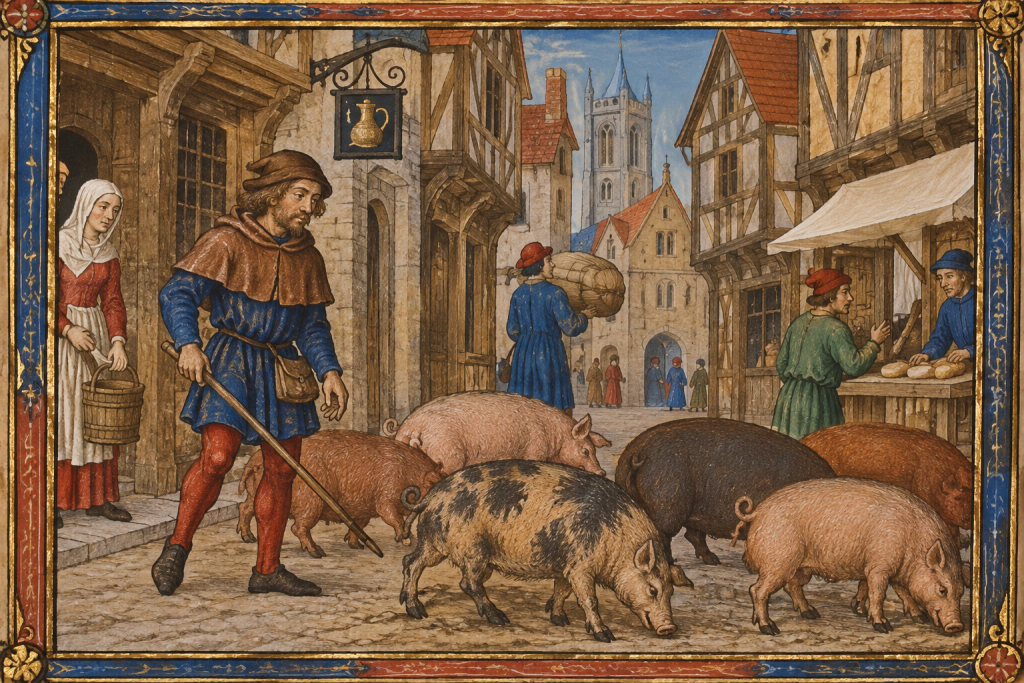
In September 1331, the authorities in Bishop’s Lynn decided that something had to be done about the pigs. Too many were wandering through the streets, rooting through rubbish and making nuisances of themselves. The town’s rulers responded with an ordinance requiring owners to keep their animals confined. There was, however, one remarkable exception. On Saturday afternoons, the pigs could be released while their owners cleaned out their sties.
It is an entertaining glimpse of everyday life in medieval Lynn. We tend to imagine the town as a prosperous international port, its quays crowded with ships and its merchants trading across northern Europe. But behind the impressive houses and warehouses were yards, gardens, workshops, and pigsties. The inhabitants of this wealthy trading town shared their streets with animals that were not always inclined to obey the rules.
And keeping the pigs under control proved remarkably difficult.
Why were there pigs in the streets?
Medieval towns were not entirely separate from the countryside. Many households kept animals, even in busy commercial centres such as Lynn. A pig was particularly useful because it required relatively little space and could be fed on household scraps and other waste. When fattened, it provided meat that could be salted for winter, while its fat was valuable for cooking. For a family of modest means, a pig represented a considerable investment.
The trouble was that pigs were enthusiastic scavengers. Left to themselves, they would root through rubbish, investigate market stalls, and wander into neighbouring gardens. A hungry pig could cause considerable damage, and a large animal loose in a narrow street was potentially dangerous. What its owner regarded as a valuable source of food might be viewed rather differently by a neighbour whose vegetables had just been eaten.
Lynn’s authorities therefore faced a familiar problem: how to balance the interests of individual householders against those of the wider community. They could hardly prohibit pig keeping altogether, but neither could they allow animals to wander wherever they pleased.
Saturday afternoon was pig day
The ordinance of 1331 was a practical compromise. Pigs were to be confined, except on Saturdays, when owners could release them while cleaning their accommodation. The regulation is recorded in Lynn’s medieval Red Register and discussed by historian Carole Rawcliffe in Urban Bodies: Communal Health in Late Medieval English Towns and Cities.
The Saturday exception tells us something about domestic life that rarely appears in conventional histories. Pigsties needed regular cleaning, and the authorities recognised that owners had to put their animals somewhere while the work was done. The solution was to allow a limited period of freedom rather than insist upon a rule that might have been impossible to observe.
We can imagine the scene. Behind a house in one of Lynn’s crowded streets, a family drives its pigs out of their enclosure and begins removing the accumulated dung and dirty bedding. One animal investigates a pile of vegetable refuse, while another wanders towards the street. Someone shouts for it to be brought back before it disappears around the corner. Meanwhile, neighbours are engaged in much the same activity.
This is an imagined reconstruction, not a recorded incident, but it gives some idea of the practical problem the ordinance was intended to address.
An account of the regulation states that owners of wandering pigs faced a fine of fourpence and the confiscation of their animals, although these particular penalties still require confirmation from the original document. Even a relatively small fine could be troublesome for a household of modest means, while losing a pig might represent a serious financial setback.
Yet the regulations apparently did not put an end to the problem.
The pigs refused to behave
A striking claim concerning the year 1372–73 suggests that Lynn’s authorities recorded 675 offences involving 86 pig owners. If accurate, that would represent an average of nearly eight offences per owner in a single year. Unfortunately, the original source of these figures has not yet been identified, so they must be treated with caution.
Nevertheless, the surviving records of Lynn’s leet courts demonstrate how closely the authorities supervised everyday behaviour. The town was divided into administrative districts called constabularies, whose officials helped maintain order and report infringements of local regulations. The courts dealt with the ordinary disputes and misdemeanours of urban life, including matters that brought neighbours into conflict.
Historian Susan Maddock has shown how valuable these records are for reconstructing the lives of Lynn’s inhabitants. The surviving leet rolls, extending with gaps from 1309 to 1434, name hundreds of people who would otherwise have left little trace in history. Their offences might appear trivial, but they reveal the difficulties of living in a crowded town where one person’s activities could easily inconvenience another.
The problem of wandering animals was certainly not confined to Lynn. In Leicester during the 1350s, a goldsmith and his son assaulted an official who had confiscated their pigs. They were subsequently required to provide substantial financial guarantees for their behaviour. The incident demonstrates how seriously some householders regarded interference with their livestock.
In Lynn, the authorities were still struggling with the problem almost a century after the original ordinance. In 1425, they threatened imprisonment for anyone who obstructed the official responsible for removing wandering animals. Whether this warning followed a particular confrontation is unclear, but the severity of the threatened punishment suggests that enforcing the regulations was not always straightforward.
A town struggling to keep itself clean
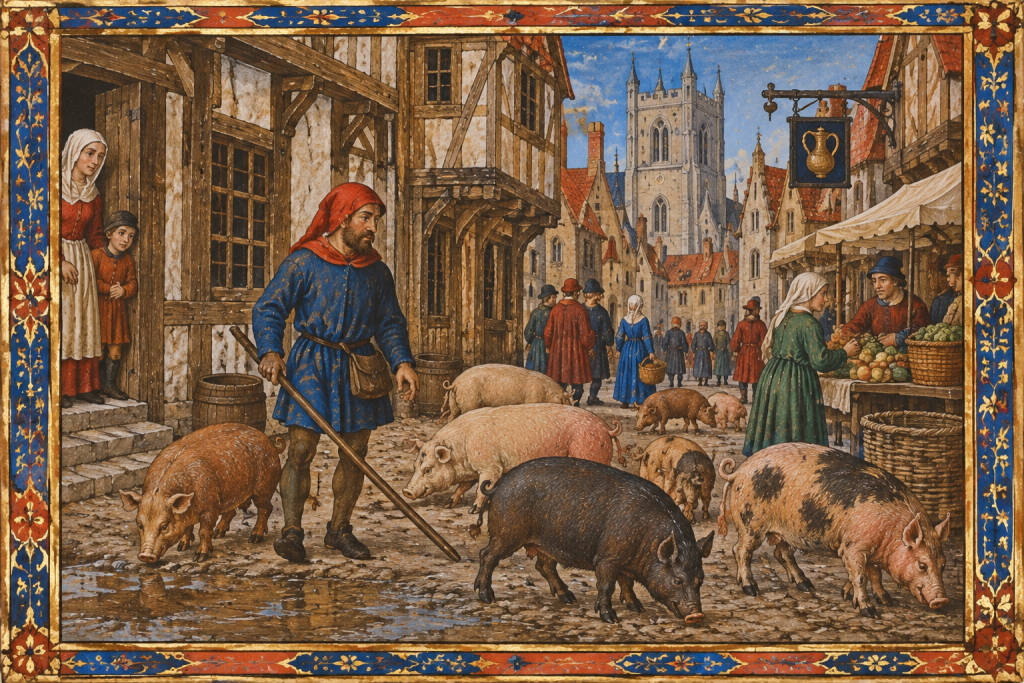
The wandering pigs belonged to a much larger problem. Medieval Lynn was a busy working town, and its streets had to accommodate people carrying goods, carts moving between warehouses and quays, and animals being driven to market. Households generated rubbish, workshops produced waste, and livestock contributed substantial quantities of dung. In wet weather, the accumulation of refuse and mud could make the streets particularly unpleasant.
The authorities were not indifferent to these conditions. In December 1343, Lynn’s aldermen were instructed to investigate whether streets were being properly maintained and whether rubbish and dung were being removed. The mayor warned that ward sergeants who neglected their responsibilities could face imprisonment.
The regulations became increasingly detailed. In 1422, eighteen butchers were presented for slaughtering animals in the streets, while another 34 were accused of fouling the town’s water gates with offal. Four years later, 22 householders living beside one of Lynn’s tidal waterways were fined for dumping offensive material into it. The authorities associated the resulting pollution with foul air and sickness.
These incidents challenge the familiar assumption that medieval people simply accepted filthy surroundings. They certainly did not understand the transmission of disease as we do today, but they recognised that rotting waste, offensive smells, and polluted water threatened the wellbeing of the community. Their explanations often involved the corruption of the air, yet many of the practical measures they adopted were sensible attempts to improve their environment.
By 1436, Lynn’s corporation was paying an annual sum of 26s. 8d. to employ a street cleaner, known as a raker, whose responsibilities included the water gates and the town’s two principal markets. The appointment marked a development in the town’s approach to cleanliness. Rather than relying entirely upon householders and neighbourhood officials, the corporation was now employing someone to undertake regular cleaning in important public spaces.
The pigs had helped expose a problem that required more than occasional fines and warnings.
Lynn was not alone
Other medieval towns faced similar difficulties, sometimes adopting considerably harsher solutions.
In London, wandering pigs became a particular nuisance when they entered churchyards and disturbed burial grounds. The situation was complicated by the privileges enjoyed by St Anthony’s Hospital, whose pigs were traditionally permitted to roam through the city. Some wore bells identifying their association with the hospital. In 1311, the authorities intervened to restrict the hospital’s claims to animals that had actually been donated to it.
Sandwich, another important medieval port, took a more uncompromising approach. An official was authorised to kill pigs and other animals found wandering through the town or polluting its water supply. Some of the meat was then distributed to patients at St John’s Hospital.
Compared with such measures, Lynn’s Saturday afternoon arrangement seems remarkably accommodating. Its authorities accepted that pigs were part of urban life and attempted to control their movements rather than eliminate them altogether.
The other side of the argument
It is easy to sympathise with the officials trying to keep Lynn’s streets clean, but the pig owners had interests of their own. For a prosperous merchant, a wandering pig might be an irritating obstruction. For a poorer household, that same animal could represent months of careful feeding and the prospect of meat for the winter.
Keeping pigs confined also required space and suitable accommodation. An enclosure had to be maintained, and an animal that could no longer scavenge freely needed feeding. Some owners may have struggled to meet these demands, while others might simply have been careless.
The regulations therefore reveal a tension between private needs and public convenience. Lynn’s authorities wanted orderly streets, but many inhabitants depended upon activities that made those streets difficult to manage. The town’s government had to find ways of accommodating both.
This is what makes the ordinance of 1331 so revealing. It shows medieval government dealing not with grand questions of royal authority or international trade, but with the ordinary complications of living alongside other people.
The merchants of Lynn might conduct business with the great trading cities of northern Europe, but their neighbours still had to clean out the pigsties.
And on Saturday afternoons, at least for a little while, the pigs could enjoy their freedom.
© James Rye 2026
Book a Guided Tour with a Trained and Qualified King’s Lynn Guide Through Historic Lynn
References
Alsford, Stephen. History of Medieval Lynn. The ORB: Online Reference Book for Medieval Studies. History of Medieval Lynn.
Maddock, Susan. ‘Society, Status and the Leet Court in Margery Kempe’s Lynn.’ In Town Courts and Urban Society in Late Medieval England, 1250–1500, edited by Richard Goddard and Teresa Phipps. Woodbridge: Boydell Press, 2019. Cambridge University Press.
Rawcliffe, Carole. Urban Bodies: Communal Health in Late Medieval English Towns and Cities. Woodbridge: Boydell Press, 2013. The discussion of Lynn’s 1331 pig ordinance cites the Red Register of King’s Lynn, vol. I, p. 203.
Rawcliffe, Carole, and Claire Weeda, eds. Policing the Urban Environment in Premodern Europe. Amsterdam: Amsterdam University Press, 2019. Publisher’s website.
Stories of Lynn. ‘King’s Lynn Borough Archives‘. Information about the surviving borough records.