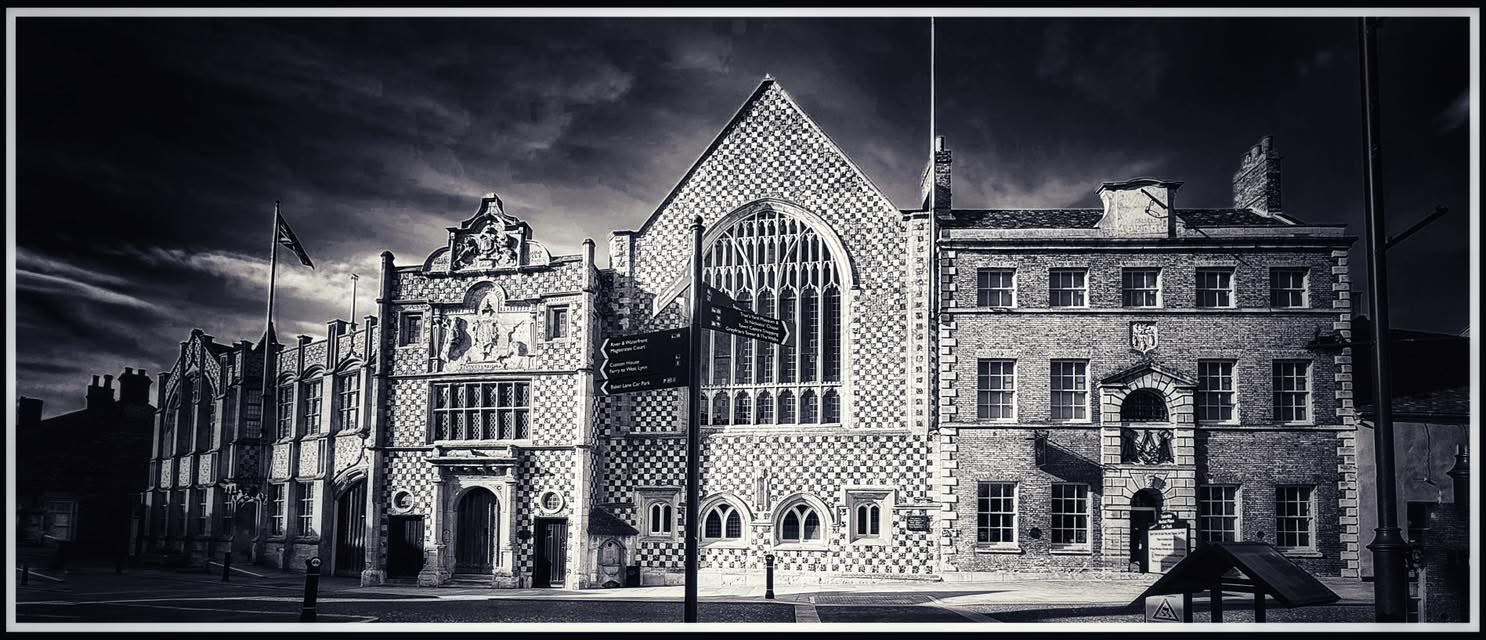
Some buildings in King’s Lynn reward a second look. The Corn Exchange grabs you at once. Its front rises above Tuesday Market Place with columns, carved corn, civic heraldry and, at the top, Ceres (the goddess of corn) herself, looking out over the old commercial heart of the town. It is bold, slightly swaggering and impossible to mistake. That was no accident. When the Corn Exchange was erected in 1854, it was meant to give public form to trade. Grain dealing was practical business, but in Victorian Lynn it was also something the town wished to display with confidence.
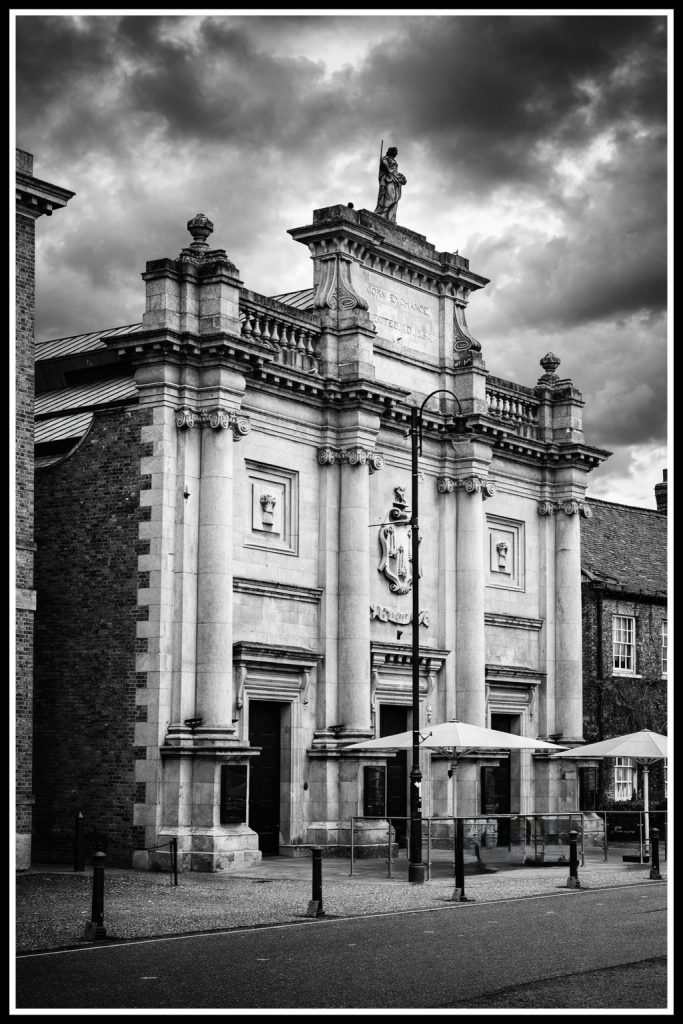
Photo © James Rye 2026
Yet the Corn Exchange is not only a story about architecture. It is a story about adaptation. It began as a formal home for the corn trade, widened into a hall for preaching, meetings and entertainment, and survived the decline of its original purpose by becoming a theatre and cinema. If you want one building that shows how King’s Lynn has repeatedly altered old spaces rather than abandoning them, this is a strong contender.
Before there was a Corn Exchange
The site already had a history before the present building appeared. In the eighteenth century there had been the Angel Inn. In the early nineteenth century that gave way to the Market House, begun in 1830 and in corporate hands by 1832. Henry J. Hillen describes it as a substantial building stretching back towards the Common Staith, with butchers’ stalls below and an elegantly furnished concert room above. It had replaced the old Market Cross and the surrounding shambles. The Corn Exchange therefore took over ground already bound up with trade and public life in the centre of town.
That setting mattered. Historic England notes that Lynn’s prosperity rested heavily on trade, and that cereal exports became especially important after drainage and agricultural improvement in the Fens, notably from the sixteenth century onward and with great force in the eighteenth. A purpose-built corn exchange was therefore not some decorative municipal whim. It answered the needs of a port town closely linked to an agricultural hinterland.
Building it
The move towards a new exchange gathered strength in the early 1850s. Hillen records that on 10 November 1851 the mayor, Walter Moyse, called a meeting of farmers and merchants to consider the idea. There were delays and disagreements. One proposal would have adapted part of the existing Market House, but that met opposition. In September 1853 the Corporation asked the local architects Cruso and Maberley to prepare fresh plans for a separate building. On 30 January 1854 the tender of Mr P. Edmunds was accepted, and the Corn Exchange opened on 9 January 1855.
The cost is one of those details that repays notice. Charles Mackie’s Norfolk Annals gave the figure as £2,450. Hillen, looking more closely, explained that once extras, architects’ commission and the value of the old Market House were included, the fuller figure was £2,986 13s. He also gave the dimensions as 170 feet by 51 feet. That suggests a building of real scale, designed not merely to shelter traders but to make a statement.
A front designed to impress
The façade is the part everyone remembers, and with reason. Historic England describes it as Baroque in style, arranged in three bays with engaged Ionic columns and pilasters, an entablature, bracketed cornice and balustraded parapet. In the centre is the attic panel with the inscription “CORN EXCHANGE / ERECTED AD 1854”, crowned by the statue of Ceres, goddess of agriculture and grain. Over the central entrance sit the borough arms and a pelican; over the side doors are carved sheaves of corn.
It is a splendidly unapologetic design. The building does not merely accommodate commerce. It stages it. Behind the stone screen stood a more functional hall, a long brick structure with a glazed roof carried on wrought-iron trusses. The official venue history still points to that contrast between the showy front and the working body behind. Pevsner’s famous description of it as “jolly and vulgar”, preserved by Historic England, was barbed but accurate enough. The Corn Exchange enjoys effect, and was meant to.
The building quickly outgrew its name
One of the most revealing things about the Corn Exchange is how quickly it served more than one purpose. Hillen notes that in June 1857 C. H. Spurgeon preached there in aid of the Baptist chapel repair fund, with 2,600 tickets issued. A hall built for grain dealing was already proving itself a venue for mass public gathering.
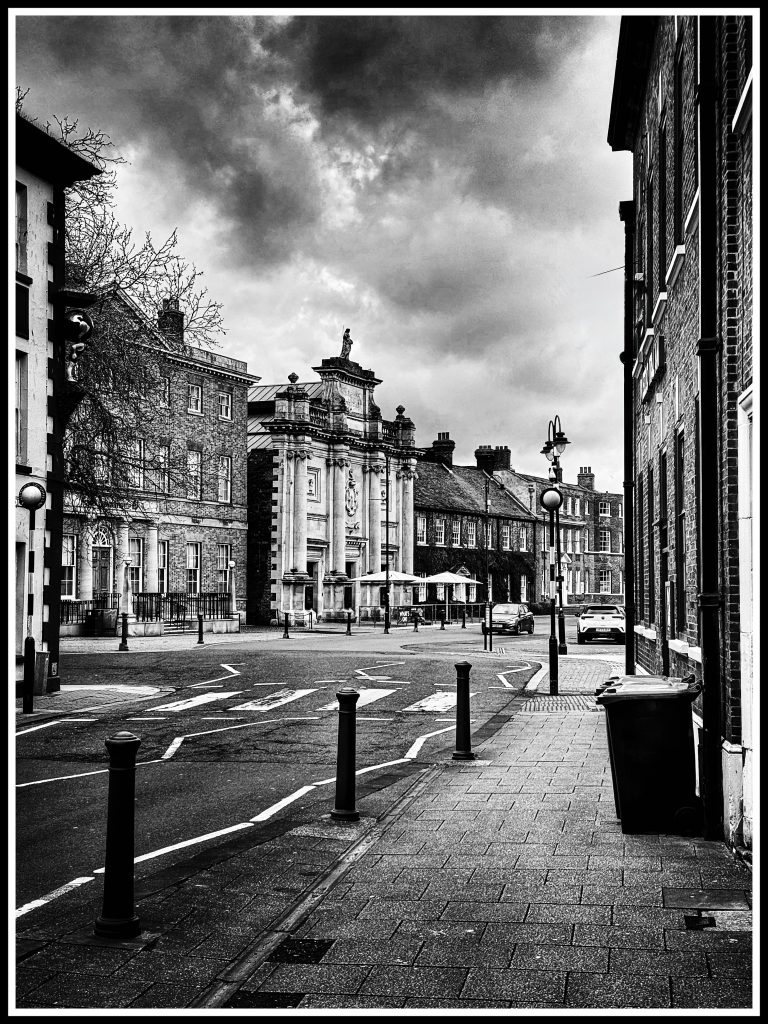
Photo © James Rye 2026
That pattern continued. Historic England records later use as a concert, exhibition and sports hall. The King’s Lynn Civic Society adds Queen Victoria Jubilee celebrations, election counts, preaching and, by 1909, roller skating. Hillen also records that the building produced income for the borough, with a surplus of £151 11s. 2d. going into the borough fund in 1901. The Corn Exchange was handsome, but it was also useful, and that helps explain why it lasted.
There were improvements too. In 1877 the roof was reconstructed and reglazed using more than 9,000 square feet of patent glazing supplied by W. E. Rendle of London. Hillen says the result was a much lighter and brighter interior, with a claimed increase in light of 50 per cent. It is a neat glimpse of Victorian confidence in improvement and modernisation.
When the old purpose faded
Like many corn exchanges, Lynn’s eventually outlived the precise conditions that had created it. Trade patterns changed, transport changed, and the older world of formal grain exchanges shrank. But the building did not simply become irrelevant. It kept finding new uses because it was well placed, spacious and already woven into public life.
By the mid 1990s, however, its position was precarious. The official venue history says that it had become dilapidated, though still used for community events. Many towns would have lost a building in that state. King’s Lynn instead backed a major transformation. Between 1995 and 1996 the Corn Exchange was remodelled by Levitt Bernstein Associates as a concert and community hall, reopening after a £4.4 million rebuild. Historic England notes the extension of the main hall for a stage area and the addition of a three-storey rear range for backstage and administrative use.
This was not a timid exercise. The building was altered decisively so that it could live. Historic England records artistic features from the redevelopment, including John Mills’s balustrade of 400 clapping hands and Sharon Ting’s blinds drawing on Lynn’s history. The venue history also notes Julie Graves’s textile work. The Victorian façade stayed, but the building behind it was turned into something fit for modern performance and public use.
Older Lynn beneath it
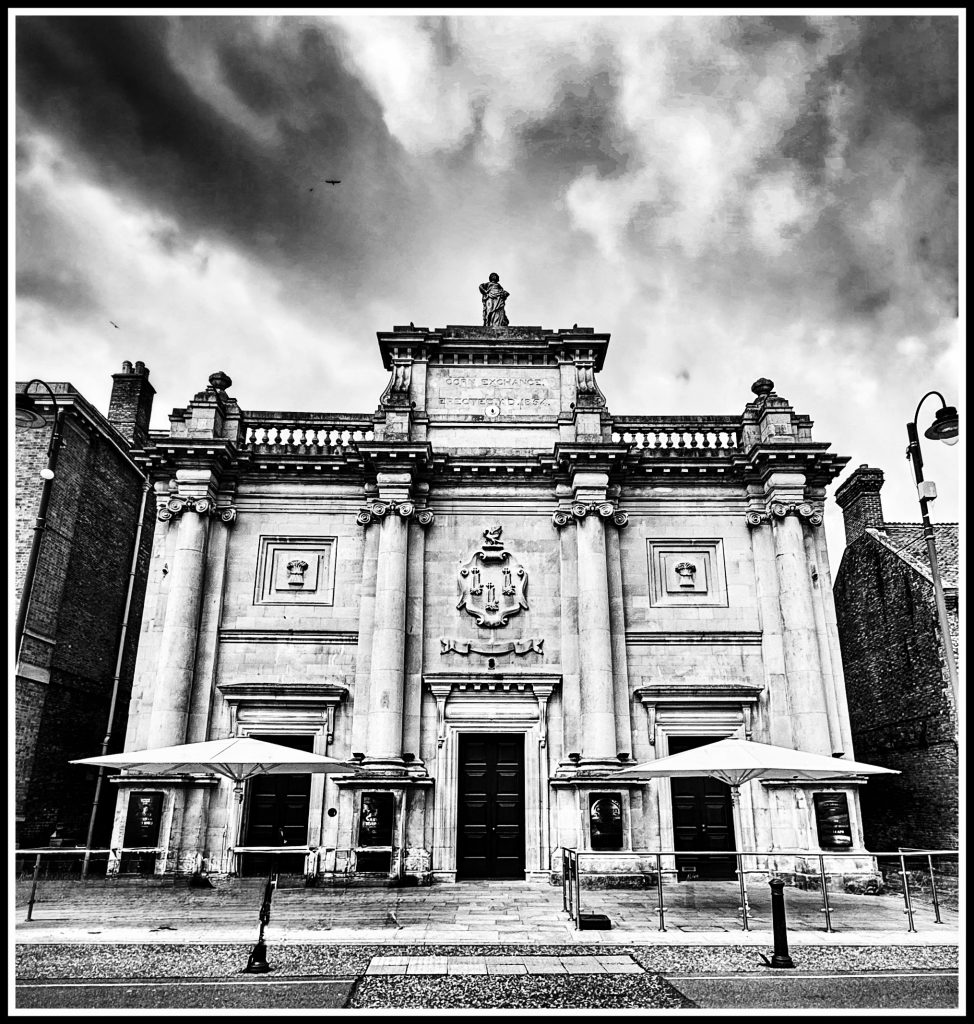
Photo © James Rye 2026
Redevelopment also revealed traces of earlier centuries. Historic England records deep backfill above older riverbank deposits, a bell-casting pit thought to match the size of the bell cast in 1611 by James Edberry for St Nicholas’ Chapel, a possible medieval wall, and pottery from late medieval and post-medieval levels. The Corn Exchange may present itself as a confident Victorian building, but below it lies a much older town.
The latest phase
The story did not end with the 1990s rescue. In 2020 the upstairs foyer was converted into a two-screen cinema after a £1.6 million investment. The official venue history says this work also included reroofing the front, replacing leadwork and guttering, refreshing the façade and lighting, and adding a specially designed lift for disabled access. The new cinema screens seat 58 and 52.
That latest change continues, rather than breaks, the building’s history. The Corn Exchange still does what this site has done for generations: it draws people into the centre of town for a shared public purpose. The nature of that purpose has altered dramatically, but the civic role has not vanished. It remains one of the buildings that gives Tuesday Market Place its sense of theatre and consequence.
Now
The Corn Exchange survives because it has never stayed still for long. It replaced older market buildings on a long-established trading site. It gave Lynn’s grain trade a façade full of pomp and confidence. It broadened into a venue for sermons, meetings, exhibitions and entertainment. It survived the fading of its original role by being remade for performance, and then remade again for film.
That is why it feels so central to King’s Lynn. Not simply because it is handsome, though it certainly is, and not simply because it occupies a commanding position, though it does. It feels central because the building has kept earning its place. Ceres still looks over Tuesday Market Place, but what she now presides over is no longer the grain trade alone. She presides over one of Lynn’s best examples of practical reinvention.
© James Rye 2026
Book a Guided Tour with a Trained and Qualified King’s Lynn Guide Through Historic Lynn
References
- Hillen, Henry J. History of the Borough of King’s Lynn. Vol. 2. Norwich: East of England Newspaper Co., 1907. https://archive.org/details/historyofborough02hill
- Hillen, Henry J. History of the Borough of King’s Lynn. Vol. 2, full text. Norwich: East of England Newspaper Co., 1907. https://archive.org/stream/historyofborough02hill/historyofborough02hill_djvu.txt
- Historic England. “Corn Exchange, Non Civil Parish, List Entry No. 1212488.” National Heritage List for England. https://historicengland.org.uk/listing/the-list/list-entry/1212488
- King’s Lynn Civic Society. “The Corn Exchange.” https://www.kingslynncivicsociety.co.uk/heritage/the-corn-exchange/
- King’s Lynn Corn Exchange. “History and Heritage.” https://kingslynncornexchange.co.uk/about-us/history-and-heritage/
- Mackie, Charles, comp. Norfolk Annals, a Chronological Record of Remarkable Events in the Nineteenth Century. Vol. 2. Norwich: Norfolk Chronicle, 1901. https://www.gutenberg.org/files/36206/36206-h/36206-h.htm
- Norfolk Heritage Explorer. “Corn Exchange, Tuesday Market Place.” https://www.heritage.norfolk.gov.uk/record-details?Index=60718&MNF71913-Corn-Exchange-Tuesday-Market-Place=&RecordCount=64187&SessionID=69341ae0-dd49-4adc-9e24-263dbe4cde35