An Election with Two Meanings
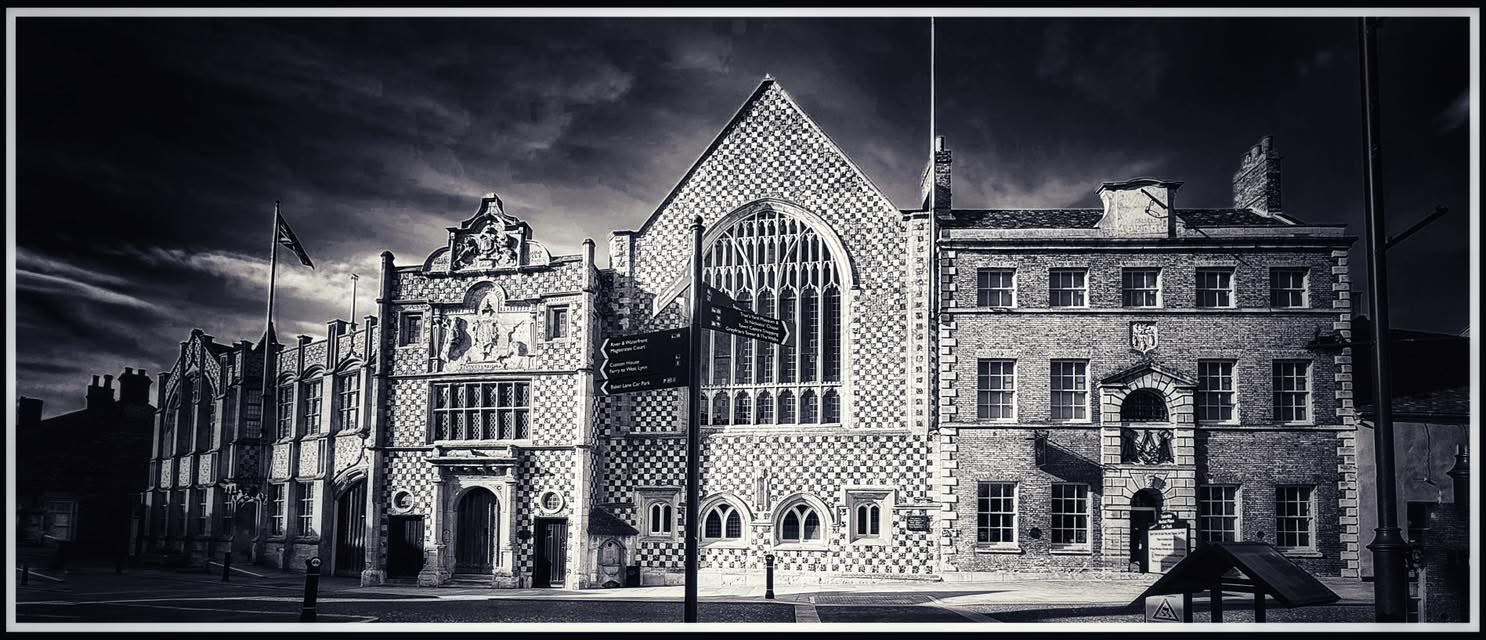
The King’s Lynn riot of June 1822 was an election riot, but it was never only about one vacant seat. It exposed a deeper quarrel over who controlled the borough: the old Walpole interest, long embedded in Lynn’s parliamentary life, or a local challenge presented in the language of independence.
The vacancy followed the death of Horatio Walpole, 2nd Earl of Orford, on 14 June 1822. His son, then one of Lynn’s MPs, inherited the peerage and left the Commons. The Walpole candidate was Lieutenant-Colonel the Hon. John Walpole, brother of the former MP. His opponent was Sir William Browne Ffolkes of Hillington, a local gentleman whose supporters argued that Lynn should no longer return a member simply because he bore the Walpole name.
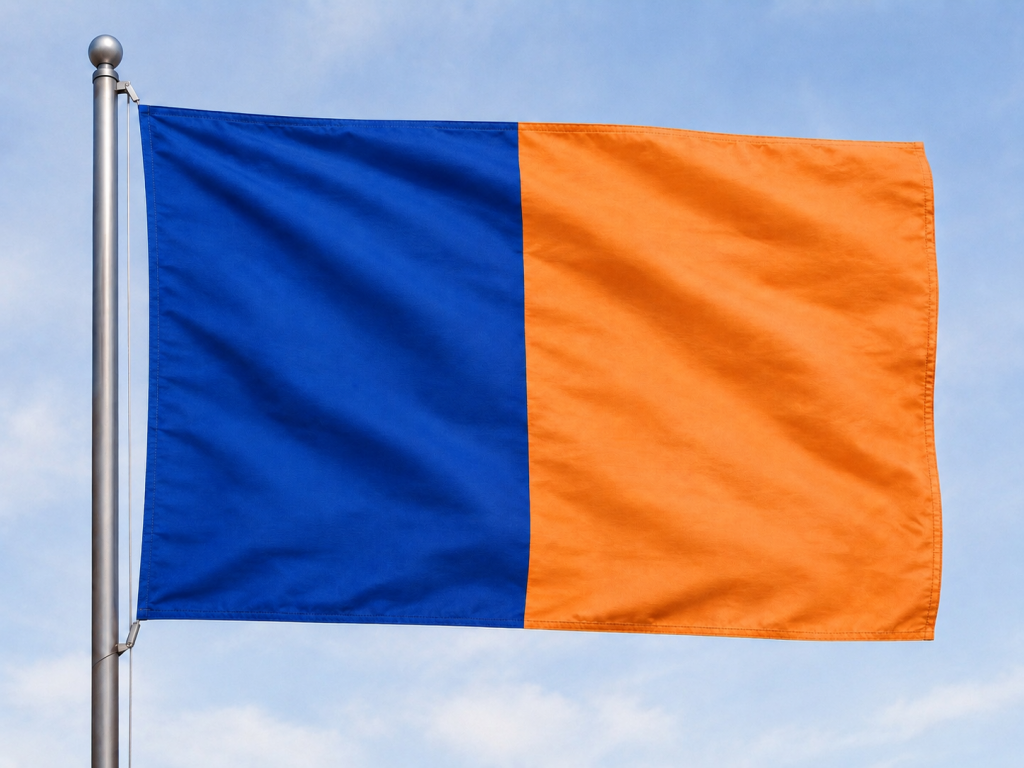
The result was a fierce contest between orange and blue.
The Orange Side: Walpole and the Old Interest
John Walpole’s supporters wore orange. In party terms, he is best described as Tory, or ministerial and establishment-aligned, although parties in 1822 were not disciplined modern organisations. Locally, his strength rested on continuity, family connection, and the long habit of Walpole representation.
To supporters, that meant stability, influence, rank, and access. To opponents, it meant dependence, patronage, and aristocratic control. Walpole’s headquarters were at the Duke’s Head, and this became important when the crowd later attacked both the inn and the corporation flag displayed there. In popular eyes, Walpole, the Corporation, and the civic establishment were closely linked.
The Blue Side: Ffolkes and Independence
Sir William Browne Ffolkes’s supporters wore blue. He is best described as an independent, Whig-leaning, reform-minded candidate rather than a Liberal in the later Victorian sense. His campaign stood against the Walpole family interest and presented itself as the cause of local independence.
The Blue headquarters were at the Crown Tavern in Church Street. Their address to the freemen attacked the Walpoles as a family tied to office, public money, rank, and influence. The message was direct: could a man from such a network truly be an independent representative for King’s Lynn?
That language sharpened the contest. Hillen later judged that the Blue address “aggravated if not engendered” the riot. That is suggestive, but not proof that Ffolkes or his committee ordered violence.
A Peep at the Peers
One of the Blue side’s weapons was a radical pamphlet called A Peep at the Peers. Published in 1820, it listed aristocratic families, offices, pensions, salaries, church livings, and other public rewards. It belonged to the print culture of reform and anti-corruption politics, and it was designed to make privilege visible in names and figures.
The pamphlet was not a neutral reference work. Its figures could be disputed, and contemporaries complained that some were inflated or false. That did not prevent it from being politically useful. In Lynn, the Blue address drew on A Peep at the Peers to present the Walpoles as beneficiaries of public office and family advantage. It turned the by-election into a sharper question: was Lynn choosing a representative, or merely confirming the power of a great family?
The Crowd Was Not the Same as the Campaign
The worst violence was anti-Walpole, but the crowd should not simply be treated as the official Blue party. Hillen identifies the main attackers as navvies employed on the Eau Brink Drainage works. These were labouring men connected with the major works around the lower Great Ouse, and not necessarily freemen or voters.
A contemporary writer called the men who destroyed the booth people “without interest” and strangers to the town. That may be partly true, although such language often shifted blame away from respectable local voters. What can be said safely is that some of the violence came from men at the edge of formal politics. They may not have been able to decide the election by voting, but they could still interrupt it by force.
From Procession to Violence
Ffolkes entered Lynn in theatrical style. His supporters met him at Gaywood. At the East Gates, they removed the horses from his carriage and drew him through the streets with a band and cavalcade. It was a public claim that he was the people’s candidate, not a family nominee.
The first disorder came at the nomination in the Town Hall. Walpole’s orange supporters had taken the most prominent position. The Blues, unable to make the display they wanted, jumped onto the council table. Fighting followed. Rails were broken, the council table was demolished, and the town clerk, Robert Whincop, had his gown torn from his back.
The struggle then moved to the Tuesday Market Place, where the hustings had been set up before the Market Cross. The poll opened on 27 June 1822. When about forty votes had been recorded for each candidate, a group of navvies attacked the Walpole side of the booth with a flagstaff. The Walpole compartment was destroyed, constables were driven back, the wreckage was set on fire, and stones were thrown at the clerks and officials, who took refuge in the Market Cross.
The target was plain. The crowd did not wreck the whole election structure equally. It struck at the orange side.
The Duke’s Head and the Corporation Flag
The mob then turned on the Duke’s Head, Walpole’s headquarters. Windows were smashed, further damage was done, and the corporation flag was pulled down and torn.
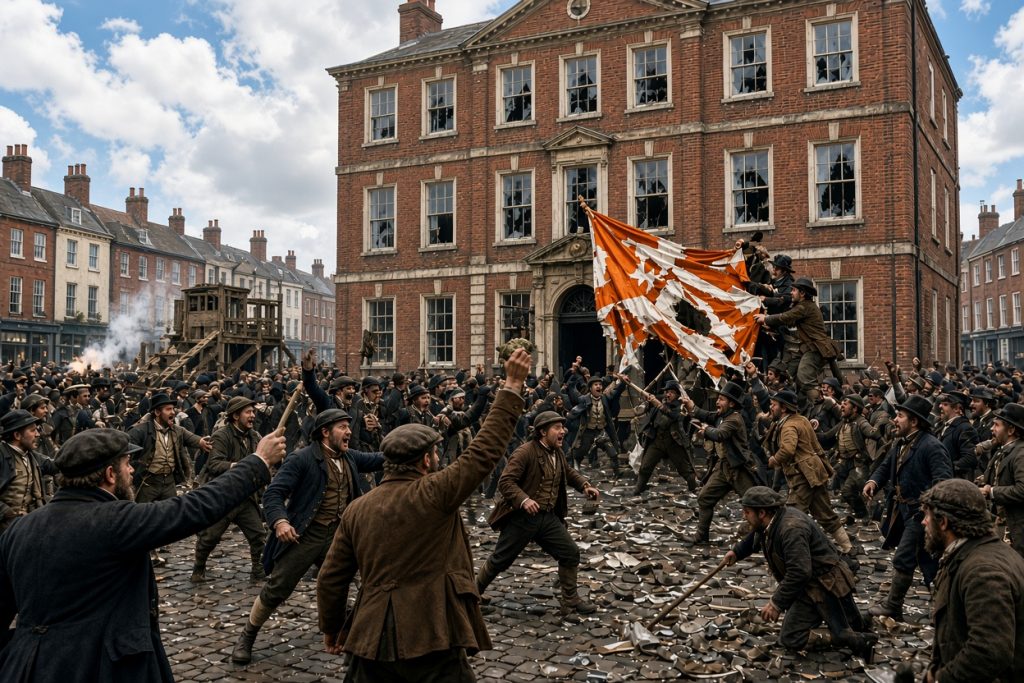
That act gave the riot its clearest political meaning. The Duke’s Head stood for Walpole’s campaign. The flag stood for civic authority. To the crowd, the two belonged together. The attack was therefore aimed not just at a candidate, but at the local order thought to sustain him.
Mayor John Maxey Allen suspended the poll. When disorder resumed the next day, more constables were sworn in and armed with bludgeons. Military help was called from Norwich.
On 28 June, a troop of the 7th Dragoon Guards arrived under Lieutenant Everard. The Riot Act was read, and one alleged ringleader was sent under guard to Swaffham Bridewell. By then Walpole was already well ahead.
Result and Aftermath
The poll resumed, and ffolkes withdrew. The final result was decisive:
| Candidate | Votes |
|---|---|
| John Walpole | 156 |
| Sir William Browne Ffolkes | 92 |
Walpole won the seat. The old interest had survived the challenge, at least at the poll.
The legal aftermath was not small. William Chandler was indicted at the Norwich Assizes on 31 July 1822 for a prominent part in the disturbance. At the Thetford Lent Assizes in March 1823, Thomas Johnson and others received prison sentences. There was also litigation over the damaged hustings. In Allen v. Ayre, the mayor initially obtained a verdict, but the King’s Bench later held that the hustings were not a building under the relevant Act, and that the mayor lacked the necessary legal interest to sue.
The riot left costs, prosecutions, and a bruised civic memory.
What Each Side Stood For
The orange side stood for Walpole, Tory politics, family influence, continuity, and the established civic order. Its friends saw stability. Its enemies saw control.
The blue side stood for Ffolkes, independence, anti-Walpole feeling, and a challenge to borough management. Its friends saw local freedom. Its enemies saw dangerous agitation.
The crowd was anti-Walpole and anti-corporation in action, but not simply the same thing as ffolkes’s campaign. Some of its force came from labouring men outside the formal electorate.
The civic authorities stood for order, legality, and the completion of the poll. Yet because the Corporation was associated with the established interest, even lawful action looked partisan to its opponents.
That is why the riot matters as more than a violent election day. Walpole won the seat, but the events of June 1822 showed that unreformed Lynn was under strain. The old borough interest could still command votes. It could not command the streets.
© James Rye 2026
Book a Guided Tour with a Trained and Qualified King’s Lynn Guide Through Historic Lynn
References
British History Online. “King’s Lynn.” In The History of Parliament: The House of Commons, 1820–1832. Accessed May 2026. https://www.historyofparliamentonline.org/
Google Books. A Correct Copy of the Poll, as Taken at an Election, for a Burgess, to Serve in Parliament, for the Borough of King’s Lynn … on … June 27th, 1822, and Two Following Days. King’s Lynn: E. Mugridge, 1822. https://books.google.com/books/about/A_correct_copy_of_the_poll_as_taken_at_a.html?id=IlJiAAAAcAAJ
Hillen, Henry J. History of the Borough of King’s Lynn. Vol. 2. Norwich: East of England Newspaper Co., 1907. https://archive.org/stream/historyofborough02hill/historyofborough02hill_djvu.txt
“Lynn Hustings.” In Fenland Notes and Queries. https://archive.org/stream/fenlandnotesand00unkngoog/fenlandnotesand00unkngoog_djvu.txt
Mackie, Charles. Norfolk Annals: A Chronological Record of Remarkable Events in the Nineteenth Century. Vol. 1. Norwich: Norfolk Chronicle Office, 1901. https://www.gutenberg.org/files/34439/34439-h/34439-h.htm
Pentland, Gordon. “Viral Text, Political Disinformation, and Parliamentary Reform in 1830.” The Historical Journal. Cambridge University Press. https://www.cambridge.org/core/journals/historical-journal/article/viral-text-political-disinformation-and-parliamentary-reform-in-1830/CC4B2F5E789A886CC67549A529726921