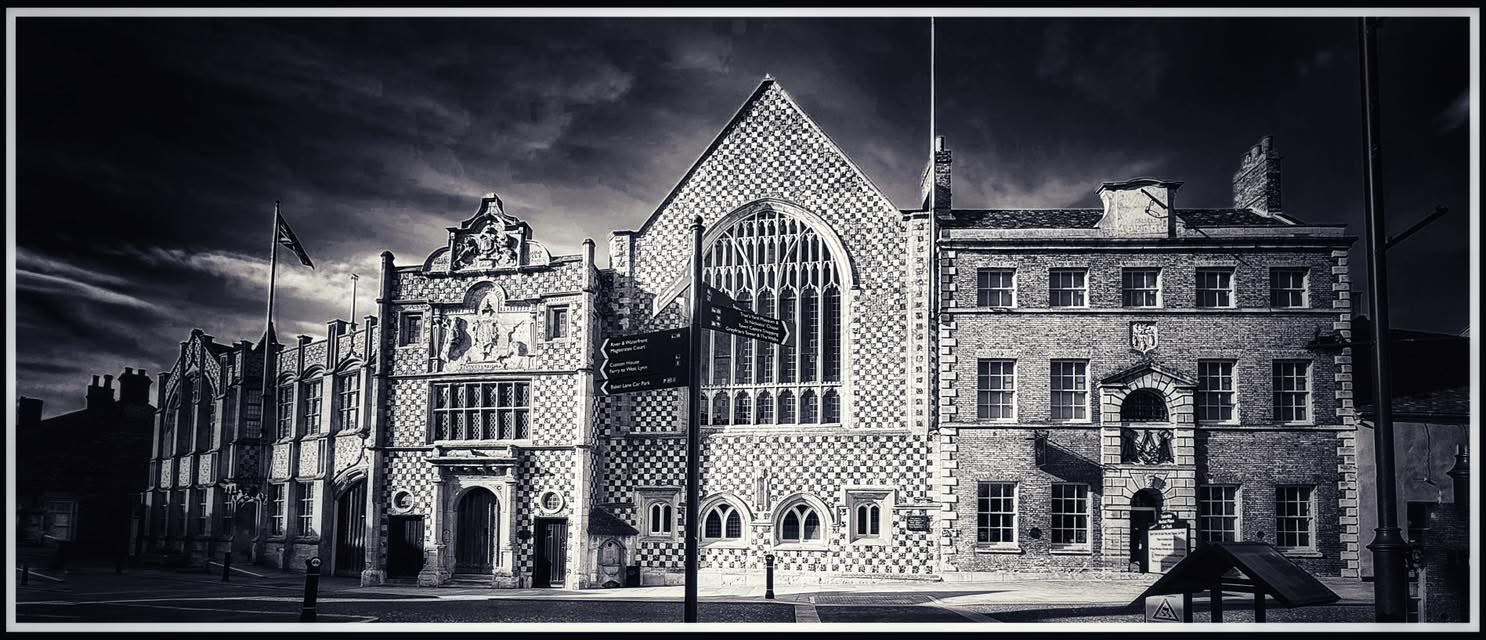
Richard the Lionheart never needed to come to Bishop’s Lynn for his foreign policy to cause trouble there.
By the later 1190s, Lynn was already a port with commercial connections extending across the North Sea. Grain from the Great Ouse basin, the Fens, and eastern England could move down the river system to the Wash and then overseas. Flanders lay across the water, within reach of English ships and English produce. Then politics intervened.
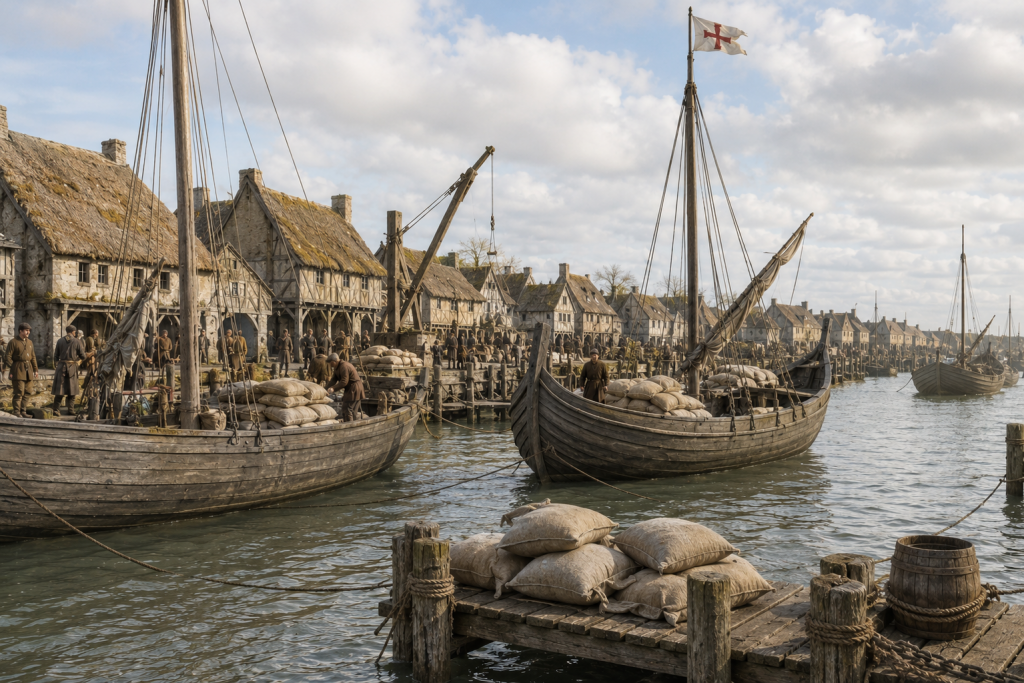
Richard I was fighting Philip II of France, and his struggle extended beyond castles and armies. The king attempted to restrict trade with Philip’s continental allies. That put ports such as Lynn in an awkward position. Political alliances could change quickly. Commercial relationships, markets, debts, and shipping routes were harder to switch off. The surviving financial records suggest that some merchants carried on regardless.
Lynn and the North Sea
The distance between the Wash and the Flemish coast was considerable, but travelling by sea could make the two regions commercially closer than places separated by much shorter distances overland.
Historian Eljas Oksanen has shown the importance of East Anglia in trade with the southern Low Countries during the Anglo-Norman period. Lynn’s position was particularly useful. Its river connections allowed agricultural produce from a large hinterland to reach the port, while the Wash opened onto the North Sea.
By Richard’s reign, Lynn was therefore tied into commercial networks over which the king had only limited control. That became a problem when Flanders found itself on the wrong side of Richard’s war.
Flemish merchants arrested at Lynn Fair
The first sign of trouble came in 1197. According to the Pipe Roll for the eighth year of Richard’s reign, Flemish merchants were imprisoned at Lynn’s fair.
The surviving entry does not provide enough information to reconstruct the arrests in detail. We do not know how many merchants were detained, how long they remained in custody, what goods they had brought, or how Lynn’s own merchants regarded the action. Even so, the incident is revealing.
Lynn’s fair was part of a commercial system that brought foreign merchants into the town. Now Richard’s foreign policy had reached directly into that marketplace. Men who had arrived to trade found themselves prisoners instead. But the arrests did not end Lynn’s problems with Flanders.
A 1,000-mark penalty
The following financial year produced much stronger evidence. The Pipe Roll for 1197–98 records penalties against people who had sold grain to the king’s enemies in Flanders. Thirty-three individuals in Norfolk and Suffolk and another nineteen in Essex were penalised. Most of the individual sums were between half a mark and five marks.
Several coastal communities faced much larger assessments.
Dunwich was assessed at 1,060 marks. Lynn came next at 1,000 marks. Ipswich and Great Yarmouth were each assessed at 200 marks, Beccles at 60, and Orford at 15. Dover, Hythe, Rye, and Winchelsea were also penalised. The comparison is striking. Lynn’s assessment was five times that imposed upon Great Yarmouth or Ipswich. And 1,000 marks was an enormous sum.
A mark was a unit of account worth 13s. 4d., or two-thirds of a pound. Lynn’s 1,000 marks therefore represented £666 13s. 4d.
Converting that into twenty-first-century money would give a false impression of precision. There is no satisfactory exchange rate between a medieval economy and our own. A better indication comes from the scale of royal finance itself. Historian Nick Barratt’s work on Richard’s English revenues shows just how limited the king’s annual resources were by modern governmental standards. Against that background, a liability of £666 imposed upon one town was formidable.
There is another important qualification. An assessment entered in a Pipe Roll does not necessarily mean that the whole amount was immediately collected in cash. Medieval Exchequer accounts could carry debts forward, record partial payments, and preserve liabilities for years. Establishing precisely how much Lynn eventually paid would require following the debt through subsequent rolls.
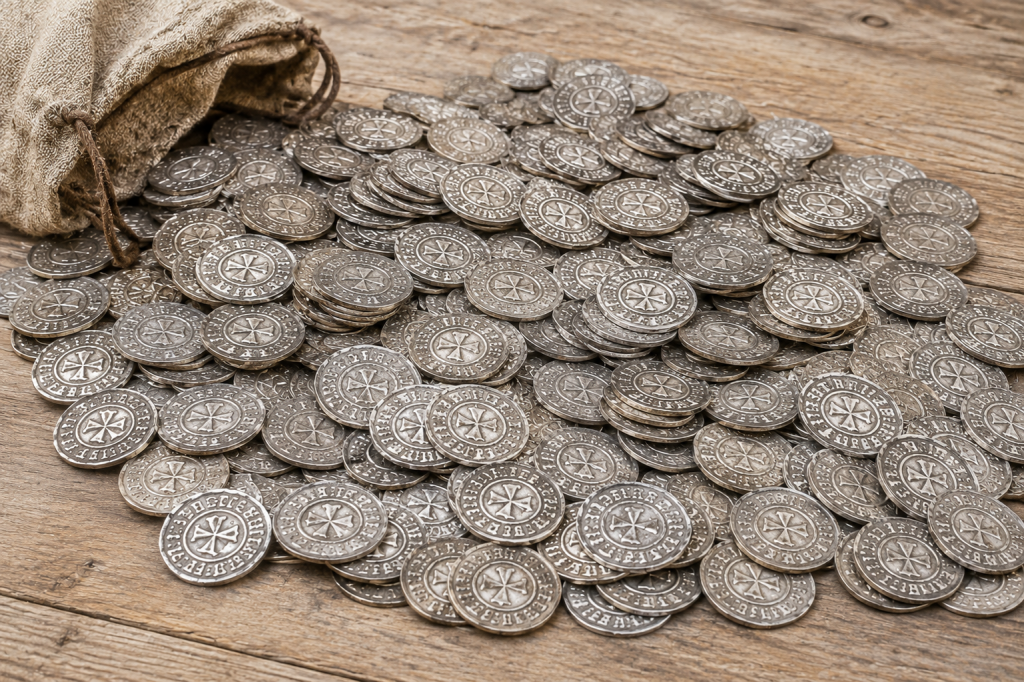
What the record establishes beyond doubt is the size of the liability placed against Lynn.
Medieval sanctions busting?
Calling Lynn a “sanctions busting” port uses modern language for a medieval situation, so the comparison should not be pushed too far.
Richard possessed nothing resembling a modern international sanctions regime. Yet the underlying principle is recognisable. His government sought to restrict trade with a hostile power as part of a wider political and military strategy. Merchants continued to supply that market, and the Crown penalised them for doing so.
The commodity concerned makes the episode more significant. It was grain.
Flanders contained large urban populations that depended in part upon food brought from elsewhere. East Anglia possessed agricultural surpluses and ports capable of exporting them. Lynn stood at the seaward end of one of the river systems that connected those two economies. Richard was therefore trying to prevent a strategically useful commodity from reaching his enemies.
Lynn appears to have been doing a substantial trade in precisely that commodity.
Why did the merchants carry on?
The Pipe Rolls tell us what the Crown punished. They do not tell us what individual Lynn merchants thought they were doing.
Profit is an obvious explanation, but it need not have been the only one. Medieval international commerce rested upon continuing relationships between merchants, customers, creditors, carriers, and shipowners. Cargoes had to find buyers. Credit had to be settled. Ships followed established routes. Political orders issued by a king did not instantly dissolve those arrangements.
Nor should the 1,000-mark assessment be taken to mean that every merchant in Lynn participated or that the town met collectively and decided to defy Richard.
The evidence supports a narrower conclusion: prohibited commerce associated with Lynn was extensive enough for the royal government to impose one of the largest penalties recorded against the English ports involved.
That alone tells us something important about the scale of Lynn’s overseas trade before the better-documented commercial expansion of the thirteenth century.
Grain, diplomacy, and a change of sides
There was another twist. Baldwin IX, count of Flanders, reached an agreement with Richard in 1197 and joined the coalition against Philip II. Historians have long considered economic pressure among the factors that encouraged this change of alignment. Oksanen has drawn particular attention to the implications of restricting English food exports if Flanders had become partly dependent upon imported supplies.
Lynn did not force Baldwin to change sides. The political relationship between England, France, and Flanders involved far more than the grain ships of the Wash.
But Lynn belonged to the commercial network upon which Richard’s policy operated. Grain leaving its port for Flemish buyers mattered enough for the Crown to try to stop it, and breaches of that prohibition mattered enough to produce a 1,000-mark assessment.
For the merchants of Lynn, a European war had become a local business problem.
A darker connection with Richard’s reign
This was not Lynn’s only encounter with the forces unleashed during Richard’s reign.
In January 1190, amid the anti-Jewish violence associated with Richard’s accession and mobilisation for the Third Crusade, Lynn’s Jewish community was attacked. The chronicler William of Newburgh records the violence, while an Exchequer record independently confirms that a Jewish financier associated with Rising died in the fire at Lynn. No reliable death toll survives, and there is no evidence that Richard ordered the attack. The Jewish community at Lynn appears not to have recovered.
It was a grim opening to a reign that would later affect the town for very different reasons.
When Richard’s war reached Lynn
There is no known evidence that Richard I ever visited Bishop’s Lynn. There is no firm evidence that he sailed from its port for the Third Crusade, and the town’s important early royal charter belongs to his brother John. Yet the surviving records reveal a more interesting connection than a fleeting royal visit. Richard’s war reached Lynn through its trade.
Flemish merchants were arrested at the town’s fair. Grain continued to move towards a prohibited market. The Exchequer responded by recording a liability of 1,000 marks against Lynn, five times the amount imposed upon either Ipswich or Great Yarmouth.
Behind those terse entries lies a recognisable conflict. Kings made foreign policy, but merchants had markets to serve, cargoes to sell, and commercial relationships that crossed political boundaries.
In the late 1190s, those two worlds collided at Bishop’s Lynn. Richard wanted trade with his enemies stopped. The merchants of Lynn seem to have had other ideas.
© James Rye 2026
Book a Guided Tour with a Trained and Qualified King’s Lynn Guide Through Historic Lynn
References
Barratt, Nick. “The English Revenue of Richard I.” The English Historical Review 116, no. 467 (June 2001): 635–656. https://doi.org/10.1093/ehr/116.467.635
https://academic.oup.com/ehr/article/116/467/635/364562
Gillingham, John. Richard I. New Haven and London: Yale University Press, 1999. https://yalebooks.yale.edu/book/9780300094046/richard-i/
Howlett, Richard, ed. Chronicles of the Reigns of Stephen, Henry II, and Richard I. Rolls Series 82. Vol. 1. London: Longman, 1884. https://upload.wikimedia.org/wikipedia/commons/c/c1/Chronicles_of_the_reigns_of_Stephen%2C_Henry_II.%2C_and_Richard_I_%28IA_chroniclesofreig03howl%29.pdf
Oksanen, Eljas. “Economic Relations between East Anglia and Flanders in the Anglo-Norman Period.” In East Anglia and Its North Sea World in the Middle Ages, edited by David Bates and Robert Liddiard, 174–187. Woodbridge: Boydell Press, 2013. https://www.researchgate.net/publication/385508320_Economic_Relations_between_East_Anglia_and_Flanders_in_the_Anglo-Norman_Period
Oksanen, Eljas. Flanders and the Anglo-Norman World, 1066–1216. Cambridge Studies in Medieval Life and Thought, Fourth Series 88. Cambridge: Cambridge University Press, 2012. https://doi.org/10.1017/CBO9781139207324
Olszowy-Schlanger, Judith, and Sian Collins. “Samuel of Norwich in the Marshlands of King’s Lynn: Economic Tribulations Reconstructed from a Newly Discovered Thirteenth Century Hebrew Starr in Cambridge University Library.” Jewish Historical Studies 50 (2018): 14–44. https://discovery.ucl.ac.uk/id/eprint/10071614/1/article%203.pdf
Owen, Dorothy M., ed. The Making of King’s Lynn: A Documentary Survey. Records of Social and Economic History, new series 9. London: Oxford University Press for the British Academy, 1984. https://openlibrary.org/books/OL2576050M/The_Making_of_King%27s_Lynn
Pipe Roll Society. The Great Roll of the Pipe for the Eighth Year of the Reign of King Richard the First, Michaelmas 1196. Pipe Roll Society. The reference to Flemish merchants imprisoned at Lynn fair is cited by Oksanen at p. 226. https://piperollsociety.co.uk/full-list-of-publications
Pipe Roll Society. The Great Roll of the Pipe for the Ninth Year of the Reign of King Richard the First, Michaelmas 1197. Pipe Roll Society. The penalties for trade with Flanders are cited by Oksanen at pp. 92–93, 137–38, and 209–10. https://piperollsociety.co.uk/full-list-of-publications