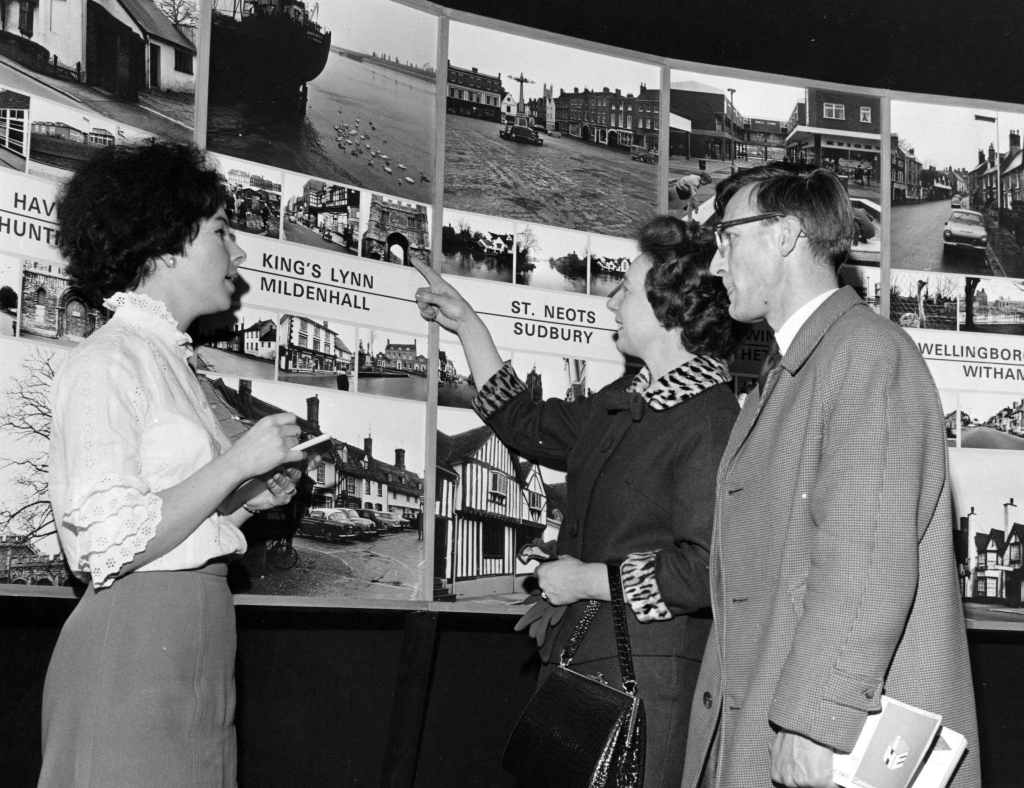
Photo by Fox Photos/Getty Images
For Lynn people who remembered the town before the Second World War, its expansion during the 1960s must have been astonishing. Streets and houses spread across former fields, factories appeared at Hardwick, and unfamiliar accents were heard in new schools, shops and workplaces.
This transformation is usually attributed to the “London overspill”. That is only partly correct. King’s Lynn had been building council houses for local families for decades before Londoners began arriving. The overspill scheme did not start municipal housing in Lynn. It greatly enlarged it and tied the building of homes to an ambitious plan for industrial growth.
Council houses before the Londoners
Lynn’s original housing problem was entirely local. During the nineteenth and early twentieth centuries, nearly a third of the town’s population lived in about 160 yards, courts and alleys behind its principal streets. Some contained respectable homes, but many properties were overcrowded, badly ventilated and poorly supplied with sanitation.
After the First World War, the corporation began providing houses beyond the congested centre. Homes around Holcombe Avenue were among those associated with the national “Homes for Heroes” programme. They were built in a garden suburb style, with more space and light than could be found in the old yards, although some were later sold because their intended tenants struggled to afford the rents. [1]
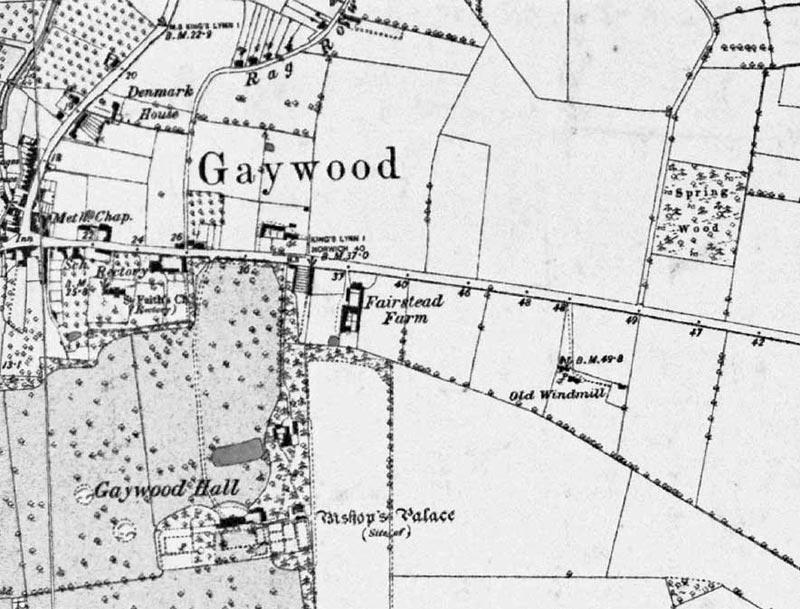
Slum clearance gathered pace during the 1920s and 1930s. New council housing appeared in North Lynn, South Lynn and Gaywood. The expansion of the borough boundary in 1935, when Gaywood and North Lynn were incorporated into King’s Lynn, gave the corporation more land on which to build. The council also acquired the Gaywood Hall estate. [2]
Council housing was therefore well established before anyone proposed sending London families to Lynn. Its first purpose was to replace poor local housing and accommodate the town’s own population.
A plan to double the town
The change began in 1961, when King’s Lynn was selected as a London overspill town. A formal town development scheme followed in April 1962 under the Town Development Act 1952. That legislation allowed a crowded authority such as London to reach an agreement with a smaller “receiving town”, where homes and employment could be provided for people willing to move. [3]
King’s Lynn was not made a New Town like Harlow or Stevenage. No separate development corporation took control. The existing borough council remained responsible for acquiring land, borrowing money, building houses and encouraging industry.
The original partners were King’s Lynn Borough Council, the London County Council and the Ministry of Housing and Local Government. The Greater London Council did not exist until 1965, when it inherited the London County Council’s overspill responsibilities.
The targets were extraordinarily bold. Lynn’s population, then about 25,000, was expected to rise to 50,000 within twenty years. The council hoped that new firms would establish themselves at Hardwick and elsewhere, creating thousands of jobs for both newcomers and existing residents. [4]
The official programme envisaged about 3,500 overspill houses. By the end of 1966, 750 had been completed; by 1968 the total had reached 1,086. These were additional to the council’s ordinary housing programme for local applicants. [5]
Most expansion took place outside the historic centre, strengthening the outward growth already under way around Gaywood, North Lynn and South Lynn. Reffley and Fairstead became particularly associated in local memory with the enlargement of the town. Hillington Square, constructed between 1967 and 1971 with 320 flats and maisonettes, was the most conspicuous example of expansion-era municipal housing near the centre. [6]
Who made the decisions?
There was no single councillor who “brought the Londoners” to King’s Lynn. The decision resulted from negotiations between national government, the London County Council and the borough council.
The Ministry of Housing and Local Government approved the scheme and controlled much of its financial framework. London helped identify prospective tenants and encouraged employers to relocate. King’s Lynn Borough Council accepted the town’s role as a receiving authority and carried out much of the work on the ground.
Alderman Sidney Miller, chairman of the borough’s Planning Committee, became one of the scheme’s principal local advocates. He understood that houses alone would not make the plan succeed. Firms and jobs had to arrive alongside the new residents. [7]
The surviving borough council minutes, covering the period from 1903 to 1974, should reveal more about the debates within the council and the individual votes behind the policy. They are held in the King’s Lynn Borough Archives at the Town Hall. The available published evidence points to a corporate decision rather than the personal project of one mayor or council leader.
The town’s MP, Derek Page, was not responsible for the original agreement, but he later became a strong parliamentary defender of the expansion programme. He also complained bitterly about its cost. In October 1966, Page told the House of Commons that Lynn was spending approximately £1¼ million a year on overspill housing for London, quite apart from what it spent on housing for local people. [8]
New Town development corporations could borrow on favourable terms. King’s Lynn had to obtain much of its money commercially at higher interest rates. Page argued that a relatively low-wage Norfolk town was being required to perform a national service while carrying too much of the financial burden itself.
What did Lynn people gain?
The most obvious benefit was employment. The expansion scheme was intended to move factories as well as families. A later council account stated that about fifty companies came to the Hardwick industrial estate, requiring approximately 5,000 additional workers. Lynn’s population had reached about 38,000 by 1975. The original target was missed, but the increase was still substantial. [4]
The new jobs were not reserved for Londoners. Local people found work in manufacturing, food production, engineering, distribution and the offices that served the growing economy. A larger population also supported more schools, shops, buses and public services.
Many local families benefited from the continued building of council houses. Roads, drainage and utilities installed for the enlarged town supported development beyond the overspill programme itself.
There was, however, an obvious source of resentment. Some newly completed properties were allocated through the London scheme while Lynn families remained on the local housing list. The distinction was official, not merely a local prejudice: Derek Page explicitly separated expenditure on “overspill housing for London” from the money Lynn spent “on itself”.
How widespread hostility became is harder to establish. Official reports record houses, firms and expenditure far more readily than conversations between neighbours. Local newspapers and oral histories are needed before anyone can confidently describe relations between established residents and incoming families. There were probably welcoming experiences as well as suspicion, particularly as people worked together and their children entered the same schools.
The incoming families also faced difficulties. A modern house with a garden could be a considerable improvement on overcrowded London accommodation, but the move separated some people from relatives and familiar neighbourhoods. New estates did not always receive shops, meeting places or leisure facilities as quickly as they received houses.
Page warned that Lynn needed cinemas, theatres and public baths for both its existing and incoming population. The borough’s mounting debts made those improvements harder to provide.
When the arithmetic failed
The scheme depended upon houses, factories and workers arriving in roughly the correct proportions. During the later 1960s, economic conditions deteriorated and the movement of industry slowed. Houses continued to be completed, but the expected employers and tenants did not always follow.
By 31 December 1970, 230 overspill houses in King’s Lynn were standing empty. More than 2,500 were vacant across the East Anglian receiving towns. The government acknowledged that they had been built in anticipation of industrial growth that had not occurred as planned. [9]
For Lynn residents, the sight of good new houses without occupants was understandably difficult to accept. It exposed the weakness of a system under which accommodation could be reserved for a population that had not arrived while local housing need continued.
The empty houses did not mean that the whole project had failed. Many families had moved successfully and numerous firms had established themselves in the town. But the vacant properties showed that planners had been too confident about their ability to coordinate employers, workers and construction several years in advance.

A town permanently enlarged
Council housing and London overspill were closely connected, but they began as answers to different problems. Lynn’s municipal housing programme developed after the First World War to replace poor local homes. From 1962, it was expanded to serve a national policy of moving population and industry away from London.
The scheme did not double Lynn’s population, as its most enthusiastic supporters had hoped. It did, however, change the town’s physical shape, employment and social composition. The old compact port became the centre of a much larger urban area stretching eastwards across former fields.
The newcomers did not remain a temporary “overspill” population. They settled, raised families and became part of Lynn. The word “Londoner” might survive in conversation, but the history of modern King’s Lynn cannot be separated from the people who arrived during those extraordinary years.
© James Rye 2026
Book a Guided Tour with a Trained and Qualified King’s Lynn Guide Through Historic Lynn
References
- Borough Council of King’s Lynn and West Norfolk. Norfolk Street Area Conservation Area Character Statement. Revised November 2008. https://www.west-norfolk.gov.uk/download/downloads/id/1922/kings_lynn_norfolk_street_con_area_leafletpdf.pdf
- Great Britain. Town Development Act 1952, 15 & 16 Geo. 6 & 1 Eliz. 2, c. 54. https://www.legislation.gov.uk/ukpga/Geo6and1Eliz2/15-16/54
- Hansard. “Accommodation of London ‘Overspill’.” House of Lords Debates, July 22, 1971. https://hansard.parliament.uk/lords/1971-07-22/debates/3d1377af-b8fb-4bfe-982e-97291a980ea6/AccommodationOfLondonOverspill
- Hansard. “New Towns Bill.” House of Commons Debates, October 28, 1966. https://hansard.parliament.uk/commons/1966-10-28/debates/d4f59cb8-0e2e-435c-94d3-9382a57bfb99/NewTownsBill
- King’s Lynn Civic Society. “Gaywood.” https://www.kingslynncivicsociety.co.uk/local-list/gaywood/
- King’s Lynn Civic Society. “Holcombe Avenue.” https://www.kingslynncivicsociety.co.uk/local_list/holcombe-ave-east-nos-2-18-right/
- Mae Architects. “Hillington Square.” Architects’ Journal, June 2015. https://www.mae.co.uk/assets/pdfs/160613_Mae_Architects_Press_AJ_Architects_Journal_Hillington_Square_Housing_Regeneration_Design.pdf
- Ministry of Housing and Local Government. Handbook of Statistics, 1966. London: HMSO, 1967. https://escoe-website.s3.amazonaws.com/wp-content/uploads/2021/01/04183624/Handbook-of-Statistics-1966.pdf
- Ministry of Housing and Local Government. Handbook of Statistics, 1968. London: HMSO, 1969. https://escoe-website.s3.amazonaws.com/wp-content/uploads/2021/01/04183541/Handbook-of-Statistics-1968.pdf
- Norfolk Record Office. “King’s Lynn Borough Archives.” https://www.archives.norfolk.gov.uk/article/31098/Kings-Lynn-Borough-Archives
- Trigger, Bruce, et al. King’s Lynn Urban Archaeological Database Project Report. Borough Council of King’s Lynn and West Norfolk, March 2022. https://www.west-norfolk.gov.uk/download/downloads/id/7178/kings_lynn_urban_archaeological_database_project_report_-_march_2022.pdf
Verification of the numbered citations
[1] The council’s conservation study records approximately 160 alleys and yards, housing nearly one-third of Lynn’s population, and notes the later slum clearance and council building. The Holcombe Avenue account identifies the houses as post-First World War council housing associated with “Homes for Heroes”. West Norfolk Council
[2] Gaywood and North Lynn were incorporated into the borough under the 1935 Norfolk Review Order, while the Civic Society records the corporation’s acquisition of the Gaywood estate that year. Norfolk Record Office
[3] The archaeological report dates Lynn’s designation to 1961 and the subsequent development response to April 1962. The Town Development Act provided the machinery for relieving congestion through residential and industrial development in receiving districts. West Norfolk Council
[4] The borough’s conservation material gives the intended rise from 25,000 to 50,000 residents, the arrival of about fifty companies at Hardwick, demand for 5,000 workers and a population of 38,000 by 1975. West Norfolk Council
[5] The Ministry’s statistical handbooks record a 3,500-house programme, with 750 completed by the end of 1966 and 1,086 by 1968. Escoe Website
[6] Hillington Square comprised fifteen blocks and 320 dwellings, constructed during the late 1960s and early 1970s. Mae
[7] A contemporary account identifies Alderman Sidney Miller as chairman of the borough Planning Committee and records his insistence that the success of expanding towns depended upon attracting firms. Emerald Publishing
[8] Derek Page’s 1966 Commons speech gives the annual figure of approximately £1¼ million, distinguishes overspill expenditure from local housing expenditure and describes the borough’s borrowing disadvantage. Hansard
[9] The figure of 230 empty King’s Lynn overspill houses on 31 December 1970 comes from a House of Lords debate on vacant accommodation in the East Anglian receiving towns. Hansard