Photo © James Rye 2021
A Man Hidden in Plain Sight
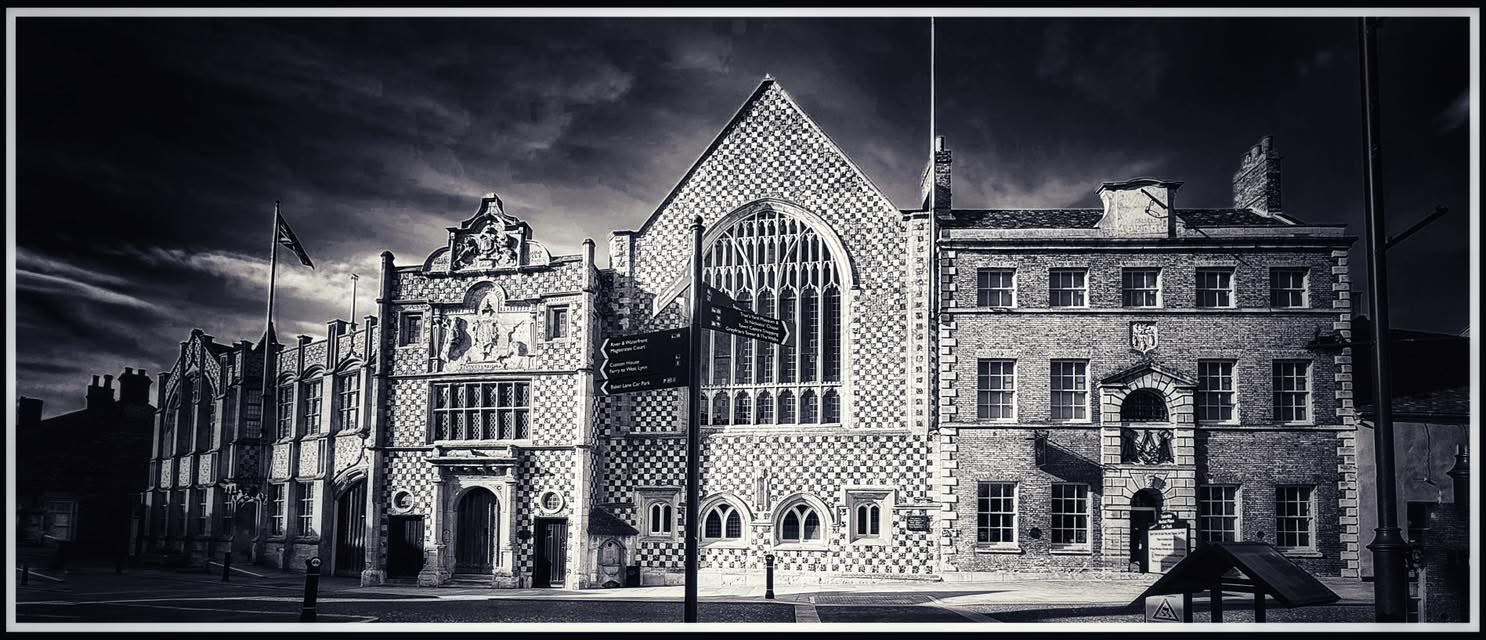
Sir John Turner is one of those late Stuart figures who changed the look of King’s Lynn without quite becoming a familiar name. His memorial is in St Nicholas’ Chapel, his house is remembered at 1 King Street, and his money helped to shape two of the town’s best-known secular buildings: the Custom House on the Purfleet and the Duke’s Head on Tuesday Market Place.
Turner was not a nobleman, a bishop, or a courtier. He belonged to the working elite of the borough: merchants, aldermen, MPs, wine importers, civic patrons, and men who understood that trade needed buildings as well as ships. In him, commerce, office-holding, church patronage, and architecture met in one compact stretch of King’s Lynn.
From North Elmham to Lynn
John Turner was born about 1631 or 1632, the eldest son of Charles and Elizabeth Turner of North Elmham. The family was not simply local in the narrow sense. Its later connections ran through North Elmham, Lynn, Warham, Cambridge, and London, and several Turner men became entangled in Norfolk politics across the late seventeenth and eighteenth centuries.
That repetition of names is a nuisance but a useful warning. The John Turner of this article is the older Sir John Turner of Lynn, the wine merchant, mayor, MP, and patron of Henry Bell. He must not be confused with the later Sir John Turners of the Warham baronetcy, who also sat for King’s Lynn.
Turner’s younger brother Charles followed him into the civic world of Lynn. Charles was a merchant and lawyer, and served as mayor in 1694 and 1706. The family’s power did not rest on one man alone, but Sir John was the figure who gave it its most visible architectural expression.
A Marriage Into a Cambridge Trading Circle
Turner’s marriage drew him into another mercantile connection. The pedigree evidence names his wife as Jane Syms, daughter of John Syms and widow of Edward Allen of Cambridge. Later family notes associate Allen with the wine trade, which makes the connection especially suggestive for Turner, himself a wine merchant. The marriage therefore placed him not simply within a Norfolk family network, but within a Cambridge trading circle linked by remarriage, stepchildren, and commercial standing.
The marriage itself is better attested than the occupational label. Even so, the connection fits the pattern of Turner’s life. He operated in a world where kinship, credit, urban office, and the movement of goods were closely tied together.
Jane Syms Turner died in December 1689. Her commemoration in heraldic material at Lynn confirms her as daughter of John Syms and wife of Sir John Turner. Turner himself never left a direct line. That fact later mattered, because the political and property story of the Turners continued through his wider family, not through children of his own.
A Merchant’s House on King Street
The practical place to begin Turner’s Lynn story is 1 King Street. Historic England dates the house to about 1670 and identifies it as built for Sir John Turner. Its present façade is later, about 1750, and the Purfleet Quay return belongs to the early eighteenth century, but the building still marks Turner’s position in the town.
The location was well chosen. King Street stood close to the Purfleet, the quays, Tuesday Market Place, and the business of the port. Lynn’s medieval and early modern mercantile geography was not abstract. It was made of river frontage, warehouses, narrow plots, cellars, yards, bridges, and streets that carried goods as much as people.
Turner’s house stood within that working landscape. He lived near the water, near the civic centre, and within a short walk of the exchange he would commission. The arrangement was almost theatrical: the merchant’s private house and the public face of Lynn’s trade stood only yards apart.
Mayor, MP, and Knight
Turner’s career joined three forms of authority: commerce, municipal office, and parliamentary service. Historic England describes him as a local wine merchant, MP, and three-times mayor of King’s Lynn. In a port town, the wine trade was not a genteel label. It involved ships, customs, credit, cellars, imported stock, inland distribution, and the confidence of other merchants.
He represented Lynn at Westminster, but his politics were local in the most immediate sense. In November 1685, when Lynn’s knitters complained to the Town Council about the decline of their trade after the introduction of worsted-hose weaving, the borough turned to its MPs, Sir Simon Taylor and Sir John Turner, to carry the matter to Parliament. This was borough representation as Lynn expected it to work: craft grievance, corporation action, and parliamentary advocacy moving through the same men.
Turner was knighted in the reign of Charles II. The best working date is 1684, although some local and architectural sources connect the honour with 1685. The uncertainty is not large, but it is worth keeping in mind, because the mid-1680s were politically charged years for borough corporations.
In June 1688, James II’s government intervened directly in Lynn’s civic life. Several corporation figures were removed from office by order of Council. Among the names were Robert Sparrow, Sir John Turner, Henry Bell, Charles Turner, and other leading townsmen. Patron and architect, Turner and Bell, were caught in the same political storm.
The Organ Loft at St Margaret’s
Turner’s first major remembered benefaction was not a commercial building, but a church gift. In 1679 he gave the pedestal and loft, or gallery, for the organ at St Margaret’s.
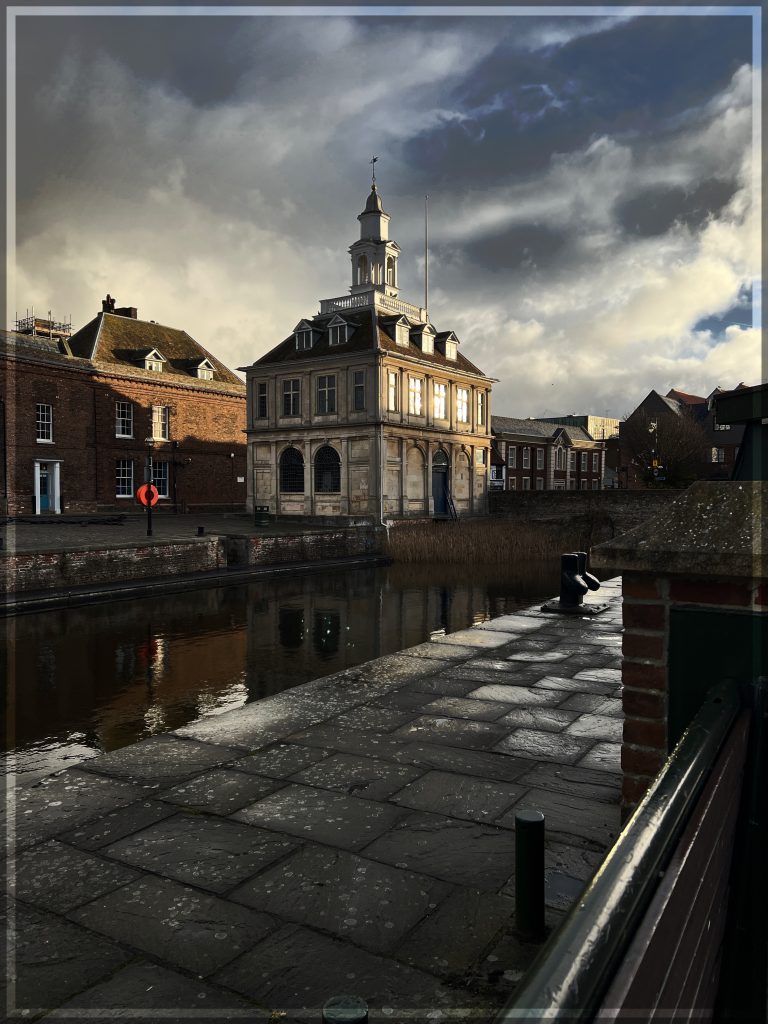
Photo © James Rye 2023
This was more than a piece of church furniture. After the Civil War and Interregnum, organs and ceremonial church music carried strong associations with restored Anglican worship. Turner’s gift belonged to that post-Restoration world, in which a borough’s leading men used church patronage to show loyalty, piety, taste, and status.
His later memorial made the point clearly. It remembered him above all for two benefactions: the organ loft at St Margaret’s and the free-stone Exchange for merchants and tradesmen. Church music and mercantile exchange stood side by side in his public memory.
The Merchants’ Exchange on the Purfleet
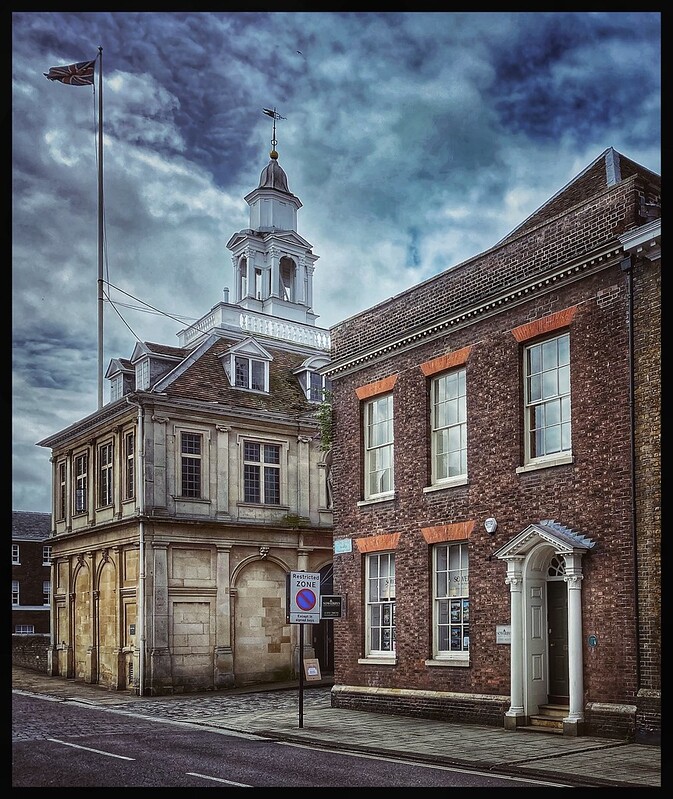
The building now called the Custom House was Turner’s greatest public work. Its familiar name is slightly misleading. It was first built as a merchants’ exchange, commissioned by Turner and designed by Henry Bell. The Council granted the site at an annual rent of one shilling, and the building opened for business in 1685.
Henry Bell was a natural choice. He was a Lynn merchant, mayor, and architect, educated at Lynn Grammar School and Gonville and Caius College, Cambridge. He had absorbed architectural ideas from London and the Low Countries, and he brought a new classical language into King’s Lynn.
The exchange was practical before it was picturesque. Its ground-floor arcades were originally open, except on the west side, so that merchants could meet and transact business. The first floor was let to the Collector of Customs. In 1703 the building became the official Custom House, and in 1717, after Turner’s death, it was sold to the Crown for £800.
Its decoration spoke directly to Lynn’s economy. The building was constructed in Ketton limestone, with Roman Doric pilasters at ground level, Ionic work above, and keystones including masks of Bacchus and Ceres. Wine and grain were not casual ornaments here. Turner was a wine merchant, and Lynn’s commercial strength increasingly rested on agricultural produce, especially corn.
The building made trade look permanent, ordered, and respectable. It placed Lynn’s merchants in a classical stone setting on the Purfleet, rather than leaving their business to be imagined only through ships, warehouses, account books, and taverns.
The Duke’s Head and the Business of Hospitality
Turner’s other great commercial building was the Duke’s Head on Tuesday Market Place. It was built between 1683 and 1689 as a coaching inn, probably to Bell’s designs, and was intended to accommodate people visiting the Merchants’ Exchange.

Photo © James Rye 1991
This was merchant thinking in brick, timber, plaster, and beds. An exchange needed more than a formal room for business. It needed visitors. Visitors needed lodging, dining, stabling, and a place to meet. The Duke’s Head supplied that setting on the most prominent open space in the northern part of the town.
The building has been altered, but its seventeenth-century core still matters. Historic England notes its fine staircase rising through three storeys and bolection-moulded panelling in the principal first-floor room. It was originally arranged around a central courtyard, with galleries giving access to chambers. A later inventory from 1773 gives a sense of scale: eleven chambers, a Great Dining Room, a Great Parlour, a bar, kitchen, stabling for twenty-five horses, and a room furnished for cockfighting.
The Turner family retained an interest in the inn until it was mortgaged to Elizabeth Shaw in 1719 for £700. By then Sir John was dead, but the building still expressed his understanding of how Lynn’s trade worked. Business was not only exchange. It was accommodation, food, horses, company, politics, and reputation.
Militia and Public Duty
Turner’s civic duties were not confined to trade and office. In 1697, during the war with France, Lynn supplied two companies to the Norfolk militia. Sir John Turner commanded the first company, with Henry Shenery as lieutenant and William Taylor as ensign. His company numbered 130 men.
This is a small detail, but a revealing one. The late seventeenth-century borough elite was expected to work across several forms of service. A man might sit in Parliament, serve as mayor, subscribe to church improvements, manage local trade, and command militia men. Turner’s career belongs to that civic culture.
Death, Monument, and Memory
Sir John Turner died in January 1711/12. The double date matters because England still used the old-style calendar, in which the legal year began on 25 March. A January date written as 1711 in contemporary usage is 1712 by modern reckoning.
His monument in St Nicholas’ Chapel was erected in 1715. The inscription praised him as a benefactor to the Corporation, especially for the organ loft at St Margaret’s and the “noble Fabrick of Free Stone” built as an exchange for merchants and tradesmen. It also recorded the Turner arms: sable, a chevron ermine between three millrinds or, on a chief argent a lion passant gules, with a lion crest holding a laurel branch.
There was also a portrait tradition. The National Trust holds a copper etching of Sir John Turner at Felbrigg, identifying him as “Sir John Turner knt. Many times Mayor and MP for Lynn.” It is a rare visual survival for a Lynn merchant-politician of his generation.
The Route He Left Behind
Turner died without issue. The later Turner baronets of Warham belonged to the same wider family, but they were not his direct descendants. This matters because the Turner name recurs in Lynn’s parliamentary and civic history. The older Sir John Turner, the man of this article, is the patron of Bell’s Merchants’ Exchange, the builder associated with the Duke’s Head, the donor of the St Margaret’s organ loft, and the man commemorated at St Nicholas’ Chapel after his death in January 1711/12.
He left no direct line, but he left a route through King’s Lynn. Begin at St Margaret’s, go to the Custom House, then to 1 King Street, move on to the Duke’s Head, and end at St Nicholas’. This was not a scattered legacy. It was a compact map of late Stuart civic power.
At St Margaret’s he gave the organ loft. At the Purfleet he gave merchants an exchange. On Tuesday Market Place he built accommodation for those who came to do business. In Parliament he acted for the borough. In the militia he commanded Lynn men. In the corporation he rose high enough to be removed during a political crisis and remembered after death as a benefactor in difficult times.
Turner’s achievement was practical, local, and highly visible. He understood what his town needed: a place for merchants to meet, a good inn for visitors, church fittings worthy of restored worship, and buildings that made commerce look dignified and durable.
Sir John Turner gave King’s Lynn a mercantile face: stone on the Purfleet, hospitality on Tuesday Market Place, and a monument in St Nicholas’ to remind later generations that trade, piety, and civic ambition once stood very close together.
© James Rye 2026
Book a Guided Tour with a Trained and Qualified King’s Lynn Guide Through Historic Lynn
References
Blomefield, Francis. “North Greehow Hundred: Warham.” In An Essay Towards a Topographical History of the County of Norfolk, vol. 9. London: W. Miller, 1808. British History Online. https://www.british-history.ac.uk/topographical-hist-norfolk/vol9/pp261-266 British History Online
Farrer, Edmund. The Church Heraldry of Norfolk: A Description of All Coats of Arms on Brasses, Monuments, Slabs, Hatchments, &c., Now to Be Found in the County. London and Norwich: A. H. Goose, 1887–93. https://archive.org/stream/churchheraldryn04farrgoog/churchheraldryn04farrgoog_djvu.txt Internet Archive
Hillen, Henry J. History of the Borough of King’s Lynn. 2 vols. Norwich: East of England Newspaper Co., 1907. https://archive.org/stream/historyofborough02hill/historyofborough02hill_djvu.txt Internet Archive
Historic England. “1, King Street, King’s Lynn.” National Heritage List for England, list entry 1291147. https://historicengland.org.uk/listing/the-list/list-entry/1291147 Historic England
Historic England. “Customs House Including North Bank of Purfleet Quay, King’s Lynn.” National Heritage List for England, list entry 1195414. https://historicengland.org.uk/listing/the-list/list-entry/1195414 Historic England
Historic England. “Duke’s Head Hotel, King’s Lynn.” National Heritage List for England, list entry 1212229. https://historicengland.org.uk/listing/the-list/list-entry/1212229 Historic England
National Trust Collections. “Sir John Turner (1632–1712), NT 1396512.” Felbrigg, Norfolk. https://www.nationaltrustcollections.org.uk/object/1396512 National Trust Collections
Richards, William. The History of Lynn, vol. 2. King’s Lynn: W. G. Whittingham, 1812. Project Gutenberg edition. https://www.gutenberg.org/cache/epub/62372/pg62372-images.html Project Gutenberg
Stirnet. “Turner of Lynn, Turner of Warham.” https://www.stirnet.com/genie/data/british/tt/turner02.php Stirnet
“Remembrances, 1671–1714.” Royal Historical Society Camden Fifth Series. Cambridge Core. https://www.cambridge.org/core/journals/royal-historical-society-camden-fifth-series/article/i-remembrances-16711714/38CA24A001AA6BDAC8DB8B74D918555A cambridge.org