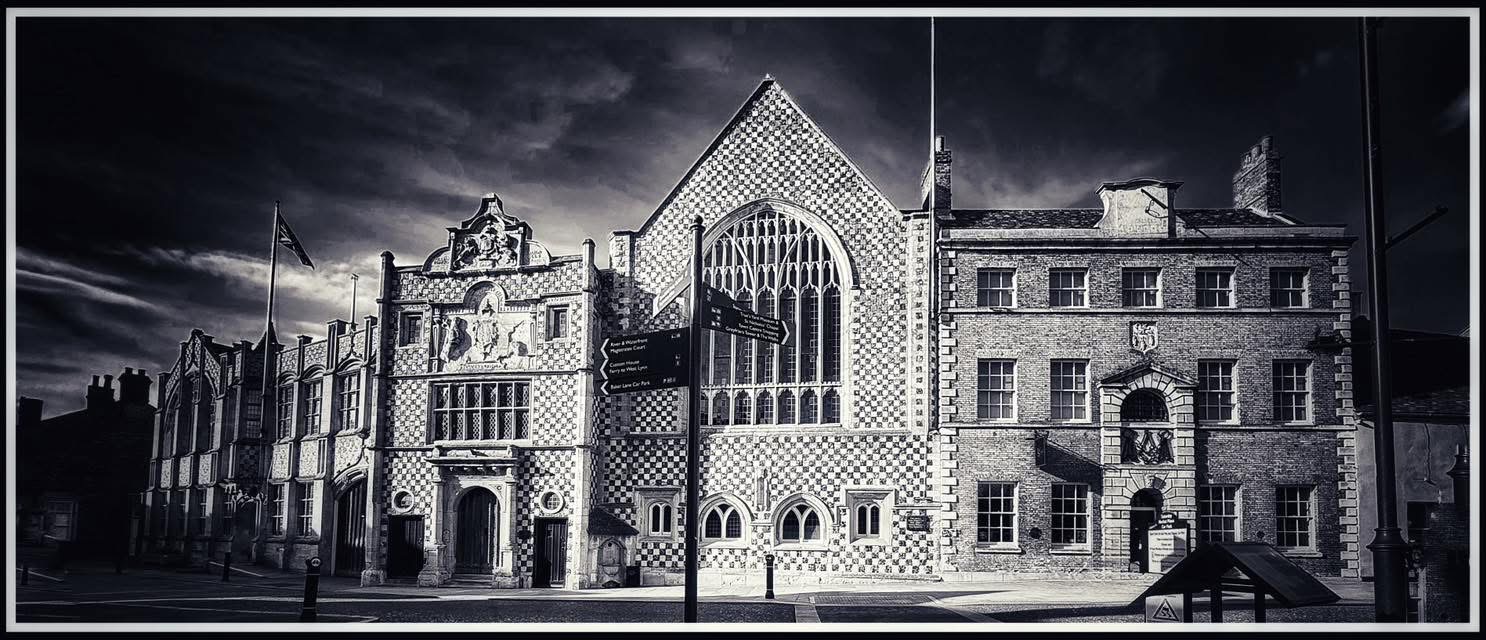
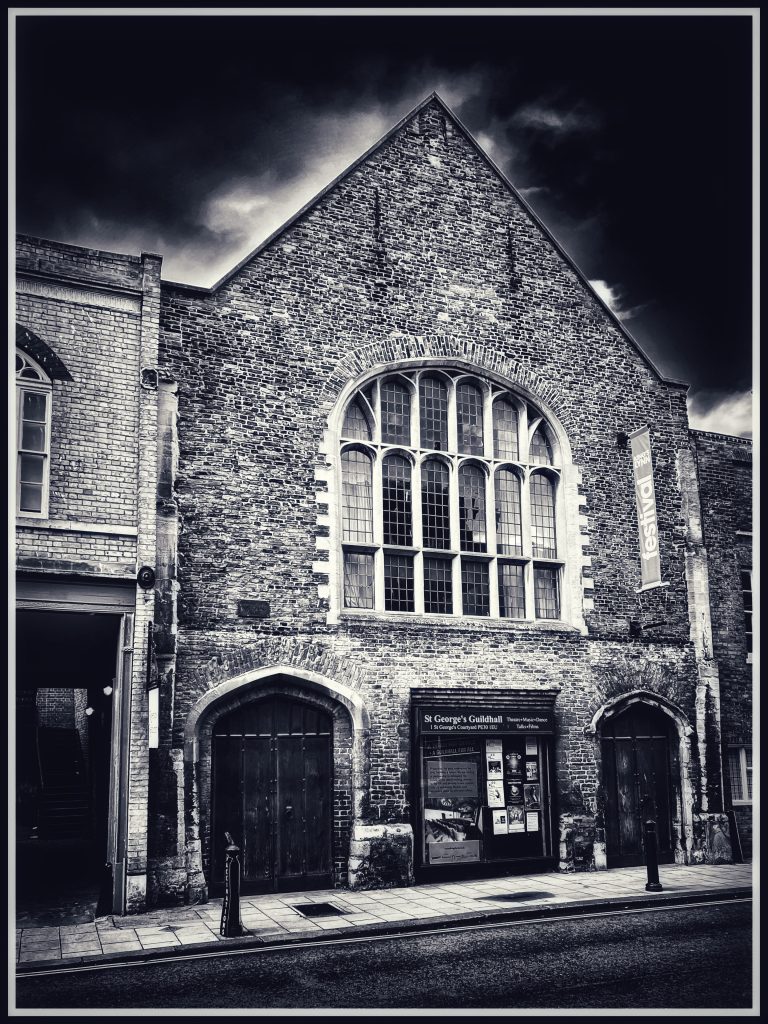
Photo © James Rye 2022
Beneath the modern seating of St George’s Guildhall lies an oak floor built more than 600 years ago. It survived religious upheaval, Georgian theatre managers, a century of warehouse use, and the threat of demolition. Those boards may also have supported a performance by William Shakespeare.
The Shakespeare connection has brought new attention to the Guildhall, but the building’s importance does not depend upon it. St George’s preserves the story of a medieval religious fraternity, King’s Lynn’s trading prosperity, the arrival of professional theatre, and one of the town’s most determined acts of historic preservation.
A guildhall beside the river
The Guild of St George existed by 1376. It was a religious fraternity whose members worshipped together, supported charitable work, attended one another’s funerals, shared feasts, and took part in public ceremonies. Membership also offered useful social connections among Lynn’s merchants and leading townspeople.
In 1406 Henry IV granted the guild a royal charter. It was to be governed by an alderman and four custodians elected by its brothers and sisters. The reference to sisters confirms that women were formal members, although their influence would have depended upon their wealth and social position.
The charter allowed the guild to acquire property in Chequer Street, now King Street. This was valuable land. The street ran close to the River Great Ouse, placing merchants within reach of the quays and warehouses through which Lynn’s trade passed.
The site did not originally extend as far towards the river as it does today. Land was gradually reclaimed as the waterfront shifted westwards. New warehouses were built behind the Guildhall, eventually creating a commercial complex stretching from King Street to a watergate beside the river.
Construction of the hall began early in the fifteenth century. Recent tree-ring analysis suggests that timbers for its roof were felled around 1400–06. The great oak floor was installed in or shortly after 1419.
The finished building contained an undercroft at ground level and a great hall above. The upper room is covered by a roof containing 61 closely spaced scissor-braced trusses. At the King Street end, tall windows and polygonal corner turrets gave the Guildhall a public presence appropriate to one of Lynn’s leading fraternities.
The floor is an exceptional piece of medieval carpentry. Massive oak timbers were shaped to act as both floorboards and structural joists. Some are more than ten metres long and over 400 millimetres square. Historic England describes St George’s as the largest complete medieval guildhall in England.
Plays, processions, and a dragon
In January 1445 the Guild of St George paid for a Nativity play performed as part of its annual celebrations. The surviving accounts identify people involved in the production, including William, a barber in the Grassmarket, and Richard Comber. They are among the earliest named participants in English provincial drama.
The hall was not a theatre in the modern sense. It was a room in which guild meetings, feasts, ceremonies, and entertainments could be held. A temporary platform and seating could be erected for a play and removed afterwards.
The guild also organised a procession for St George’s Day. Its accounts record payments connected with children, costumes, a dragon, and a castle carried or wheeled through Lynn’s streets. The dragon probably represented the creature defeated by St George, while the castle provided a moving setting for the pageant. The procession continued until 1546.
These performances belonged to a world in which worship and entertainment were not easily separated. A religious feast might include Mass, a communal meal, music, elaborate costumes, and a play based upon a biblical or saintly story.
That world was brought to an end by the Reformation. The government of Edward VI dissolved religious guilds in 1547. St George’s possessions included its hall, kitchens, warehouses, land, a quay, a limehouse, a coal yard, and goods valued at £30.
The property passed to the Mayor and Burgesses of King’s Lynn. The corporation retained the use of the hall even when other parts of the site were conveyed to private owners. St George’s became a civic building rather than the home of a religious fraternity.
It served as a court and meeting place. At various times it was also used as a merchant exchange, French school, armoury, powder store, maltings, warehouse, and venue for travelling players. In 1588 the Guildhall appears to have accommodated legal business, teaching, and theatrical performances during the same year.
Shakespeare and Pembroke’s Men
Professional acting companies travelled under the patronage of noblemen or members of the royal family. The Queen’s Men visited Lynn repeatedly between 1585 and 1595. Companies attached to the earls of Essex, Derby, Pembroke, and Worcester also received payments from the town.
One entry in Lynn’s municipal accounts has attracted particular attention. During the financial year 1592–93 the chamberlains recorded:
Item bestowed upon the Earl of Pembroke’s players, 20 shillings.
The payment of twenty shillings, equal to one pound, was probably a municipal reward made when the company visited the town.
Shakespeare is widely believed to have been associated with Pembroke’s Men at this time. Early versions of plays related to Henry VI, Parts 2 and 3 were performed by the company. Other works in its repertory probably included The Taming of a Shrew and Christopher Marlowe’s Edward II.
The timing also fits. London’s theatres were closed during the severe plague outbreak of 1592. Acting companies responded by touring provincial towns where performances were still possible. Shakespeare may have left London with Pembroke’s Men during the summer or autumn.
The Lynn account does not name Shakespeare. It does not identify the play, provide an exact date, or state where the company performed. A separate record from 1594 shows that performances took place in both St George’s and Trinity Guildhalls.
St George’s was the larger building and had hosted drama since at least 1445. It is therefore the most likely venue for Pembroke’s Men, but that remains an inference. The evidence supports the conclusion that Shakespeare probably visited Lynn and may well have performed in St George’s Guildhall. It does not prove that he stood on its stage.
Recent archaeology has added another layer to the story. The oak floorboards laid around 1419 were still in place when Pembroke’s Men came to Lynn. If Shakespeare performed in the hall, these are the timbers on which he walked.
Reports that archaeologists had discovered “Shakespeare’s stage” went too far. The raised stage uncovered beneath the modern auditorium appears to have been constructed during the 1740s. Medieval floorboards were cut, lifted, and reused to create it. Openings in the stage may have been used for traps and scenery.
The Georgian builders may have placed their platform on the site of an older stage, but this has not yet been demonstrated. What survives is probably Britain’s earliest theatrical stage structure, made partly from medieval boards which were present during Shakespeare’s lifetime.
A Georgian playhouse
By 1727 documents refer to stages and seats in the hall “for playing and seeing” plays. In 1766 Thomas Sharpe was employed to convert the interior into a permanent theatre at a cost of £450.
The walls were plastered and painted. Boxes, galleries, a pit, and a stage were installed. Parts of the seating were lined with baize, and an external staircase was later added on the northern side.
In 1769 the actor and theatre manager Thomas Snagg described Lynn as a good town for comedians and called its theatre “very pretty”. The audiences were not always orderly. Complaints were made about noise and about “irregular persons” mixing with their supposed social superiors.
Theatre bills survive from 1774. George Frederick Cooke, later celebrated for his performances as Richard III, Shylock, and Iago, is said to have appeared at St George’s during that year.
The neighbouring inn was known as the Sun by at least 1758. It was later renamed the Shakespeare’s Head, presumably to profit from the growing association between Shakespeare and the Guildhall. The later name is not evidence that Shakespeare stayed there.
St George’s remained Lynn’s principal theatre until a new Theatre Royal opened in St James Street in 1813. The following year the corporation sold the old Guildhall to William Lee Warner for £557 10s. Its life as a regular playhouse was over.
From wool warehouse to arts centre
The Guildhall became a warehouse. The Everard family acquired it in 1826 and used it in connection with the wool trade. In 1920 the property was sold for £2,650 to G. M. Bridges & Son, a firm of theatrical scenic artists already occupying part of the site.
Warehouse use caused alterations, but it also kept the building occupied. By the 1940s, however, its condition had deteriorated. There were plans to demolish it, apparently to allow the expansion of a neighbouring garage.
Alexander Penrose bought the site in 1945 and led the campaign to save it. The St George’s Arts Trust was formed in 1949. Restoration followed under the architect Marshall Sisson, supported by the Arts Council, the Pilgrim Trust, and money raised from the public.
Some decisions reflected the priorities of the time. Georgian theatrical fittings were removed to reveal what was thought to be the medieval character of the hall. A surviving Georgian proscenium, still visible in 1948, was taken out, although parts of it were retained.
Queen Elizabeth, later the Queen Mother, opened the restored building on 24 July 1951 during the first King’s Lynn Festival. Ownership passed to the National Trust. The Guildhall returned to live performance after almost 140 years as a warehouse.
A raked auditorium was installed around 1962. In the following year Lady Fermoy converted adjoining warehouses into exhibition galleries in memory of her husband, Lord Fermoy. St George’s became the centre of a larger arts complex rather than an isolated medieval monument.
Another chapter
The theatre closed as a regular performance venue in 2015. Investigation of its structure and archaeology eventually developed into a larger plan for the site.
Work on the present restoration began in November 2025. The scheme has an approved budget of up to £30.5 million, including more than £10 million from the King’s Lynn Town Deal. It will restore the theatre, improve the Fermoy Gallery, provide a permanent heritage display, and create new public facilities. Reopening is planned for late summer 2028.
St George’s is often advertised as Britain’s oldest working theatre. That description needs qualification. The building was not designed as a theatre, and performances were interrupted for long periods. For more than a century it was a warehouse.
Its genuine distinction is stronger. This is a medieval guildhall in which drama was recorded in 1445, professional companies performed during the Tudor period, a Georgian playhouse was constructed, and theatre returned in the twentieth century. Beneath the new auditorium will remain the oak boards laid down by Lynn craftsmen shortly after 1419.
© James Rye 2026
Book a Guided Tour with a Trained and Qualified King’s Lynn Guide Through Historic Lynn
References
- FAS Heritage. St George’s Guildhall, King’s Lynn: Written Scheme of Investigation. December 2024. https://docs.planning.org.uk/20250108/21/SPRN10IV0L700/p2v49xisu0y9uhir.pdf
- Historic England. “St George’s Guildhall.” National Heritage List for England, no. 1290960. https://historicengland.org.uk/listing/the-list/list-entry/1290960
- Historic England. Tree-Ring Analysis of Timbers from St George’s Guildhall, King’s Lynn, Norfolk. Ancient Monuments Laboratory Report 19/96. https://historicengland.org.uk/research/results/reports/4630/TREE-RINGANALYSISOFTIMBERSFROMSTGEORGESGUILDHALLKINGSLYNNNORFOLK
- National Trust. “The History of St George’s Guildhall.” https://www.nationaltrust.org.uk/visit/norfolk/st-georges-guildhall/the-history-of-st-georges-guildhall
- West Norfolk Borough Council. “St George’s Guildhall and Creative Hub.” https://www.west-norfolk.gov.uk/info/20012/leisure_and_culture/1293/st_georges_guildhall_and_creative_hub
- Woodcock, Matthew. The Case for Placing Shakespeare in King’s Lynn. University of East Anglia. https://westnorfolkartists.org/artscentre/pdfs/The_Case_for_Placing_Shakespeare_in_KL.pdf