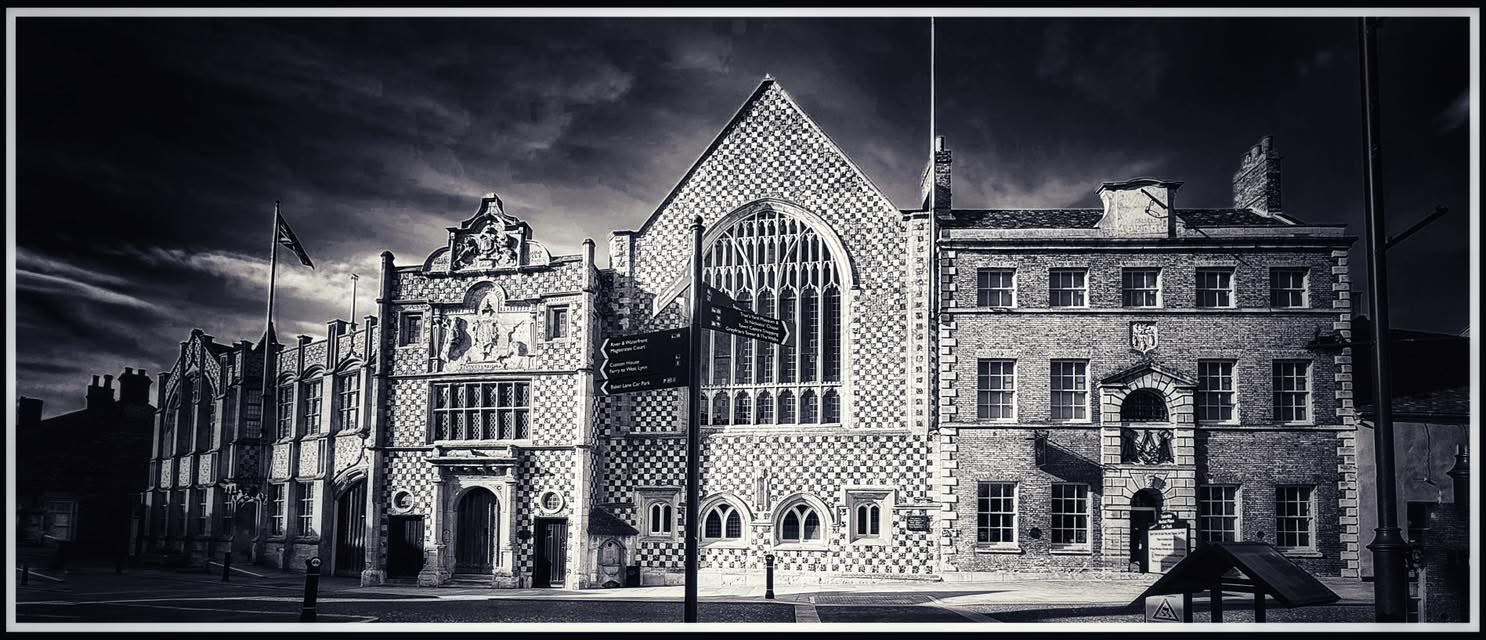
Walk across the Tuesday Market Place from the Duke’s Head to the Corn Exchange and you pass between the sites of two vanished inns. The Griffin stood where the Duke’s Head now dominates the eastern side of the square. The Angel occupied part of the ground beneath the Corn Exchange. Neither building survives, but their histories reach back through Tudor commerce, seventeenth-century rebuilding, stagecoach travel, and the ambitions of Lynn’s Corporation.
The Griffin in Tudor Bishop’s Lynn
The earliest known reference to the Griffin comes from a commercial agreement dated 4 August 1526, when King’s Lynn was still called Bishop’s Lynn. Christopher Coo of Lynn sold the Essex clothier Jaques Darnell a package of property and goods valued at £470. It included land at Bawsey, 1,000 stone of Norfolk wool, and a Lynn messuage called “the Gryffyn”. Darnell was to pay £150 in cash and the remaining £320 in woollen cloth.
The transaction belonged to the trading world that made Lynn prosperous. Norfolk wool was being exchanged for finished cloth, while urban property and country land formed part of the same agreement. The £470 was the value of the complete package, not the Griffin alone, but it was a considerable commercial arrangement.
The wording creates one uncertainty. In 1526 the Griffin was described as a “messuage”, meaning a house with its associated buildings and land. The document does not call it an inn. It establishes that a property bearing the name existed, but not that travellers were already sleeping or drinking there.
By the seventeenth century, the Griffin was certainly recognised as an inn. A compiled licensing history places it in operation in 1646. More decisive evidence comes from title deeds held by the Norfolk Record Office. These cover the period from 1663 to 1769 and describe the later property as the “Duke’s Head Inn, late the Griffin”. The legal succession from one establishment to the other is therefore clear.
The sign would have been readily understood even by customers who could not read. The griffin, part eagle and part lion, was widely used on inn signs, heraldry, and trade tokens. Nothing yet discovered connects Lynn’s Griffin with a particular family’s coat of arms.
The Duke’s Head replaces the Griffin
The Griffin was not merely given a new sign. During the 1680s it was replaced by a larger coaching inn built for Sir John Turner, a local wine merchant and MP. Turner also served three times as mayor of Lynn. Work began in 1683 and was completed by about 1689. The architect may have been Henry Bell, although no conclusive documentary evidence has been found.
Turner’s new inn stood close to the Merchants’ Exchange, now the Custom House. Its scale suited a town receiving merchants, carriers, officials, coach passengers, and their horses. The original Duke’s Head was arranged around a central courtyard with timber galleries. An inventory taken in 1773 recorded eleven bedrooms, a Great Dining Room, a Great Parlour, a bar, kitchen, cockfighting room, and stabling for twenty-five horses.
Parts of the seventeenth-century Duke’s Head remain, including the staircase, panelling, and columns from the courtyard galleries. No surviving timber or masonry has yet been securely identified as belonging to the earlier Griffin. What survives is the Griffin’s place in the property deeds and beneath the footprint of its successor.
The Angel across the square
The Angel stood on the western side of the Tuesday Market Place, on part of the site now occupied by the Corn Exchange. It was already established when it entered the Corporation’s Hall Book on 10 March 1731/2. The entry granted John Bagge, then mayor, an eleven-year lease from Lady Day. References to the existing rent and covenants suggest that the inn had been operating before the new lease was agreed.
The Corporation owned the property and let it to members of the Bagge family, whose interests included brewing. This arrangement joined municipal property ownership to the production and sale of beer, a common feature of eighteenth-century innkeeping.
Repairs authorised in 1764 give some idea of the building. The work included rooms over the gateway, the stables, yard walls, doors, windows, roofing, and tiling. The Angel was therefore more than a drinking room facing the market. Visitors entered through a covered gateway into a yard surrounded by accommodation and service buildings, with horses sheltered at the rear.
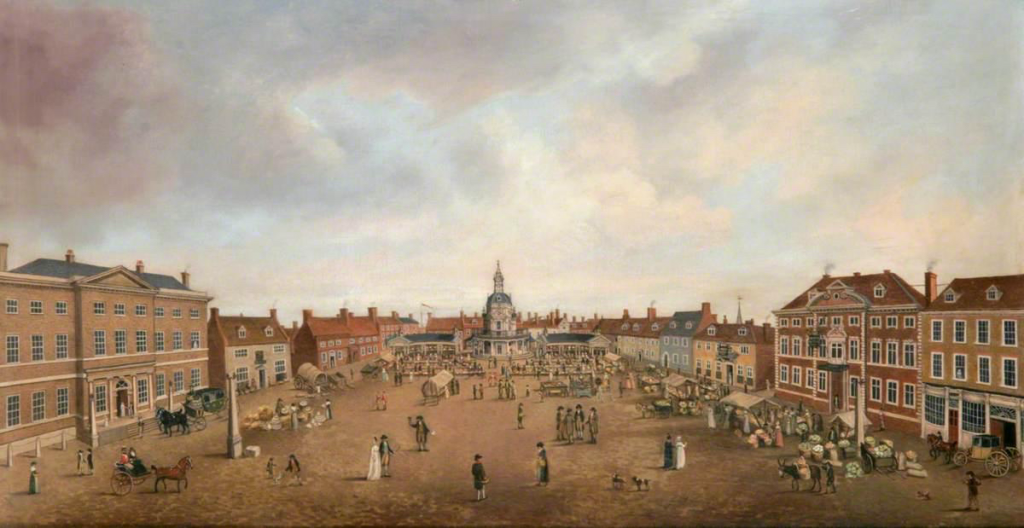
Its appearance can be seen in Robert Pollard’s 1797 aquatint after a drawing by J. Butcher. The Angel was a low, plain building with a steep roof, dormer windows, and a broad entrance into the yard. Beside it stood George Hogge’s much grander house. The contrast shows how buildings of different ages and status stood together before Victorian redevelopment gave the square a more uniform appearance.
The Angel served travellers as well as local customers. A directory from the mid-1790s records a stagecoach calling there, although the available evidence does not justify describing it as Lynn’s principal coaching inn. John Cozens was listed as its licensee in 1791. By the early 1820s the landlord was John King.
A dead King and a vanished Queen
The surviving ship register suggests that King was also involved in Lynn’s maritime economy. A John King, described as a Lynn victualler, owned a 10/64 share in the Lovely Nelly, a ship registered at the port. This was a type of two-masted merchant vessel. He was probably the Angel’s landlord, although the register does not name his inn. His share was sold by Ann King, his executrix, on 26 June 1833.
King’s name became part of a rhyme about the inn. Henry J. Hillen recorded the surviving lines in his 1907 history of Lynn:
“The King and Queen, they once lived here; the Angel kept the door. The King is dead, the Queen is fled…”
The joke depended upon John King’s surname, his wife becoming the “Queen”, and the Angel serving as their sign. It continued by saying that the Angel would be seen no more. The verse preserves a local memory of the inn, but should not be read as an exact account of when King died or what happened to his widow.
The Corporation had ordered the Angel’s demolition on 23 July 1829. Its disappearance formed part of a scheme to redevelop this side of the market place and replace the old Market House. The inn’s licence lapsed in 1830.
Beneath the Corn Exchange
The foundation stone of the new Market House was laid on 13 April 1830, and the completed building passed to the Corporation in 1832. It survived for little more than twenty years. In 1854 it was demolished to make way for the present Corn Exchange, which opened on 9 January 1855.
Archaeological work undertaken at the Corn Exchange in 1995 found about two metres of rubble backfill, together with earlier riverbank deposits, refuse layers, a bell-casting pit dated to 1611, and possible medieval walling. The published summary did not identify any structure securely belonging to the Angel.
The Duke’s Head and Corn Exchange now face one another across the market place. The Griffin’s name survives in deeds. The Angel survives in a 1797 print, council records, and a joke about a dead King and a vanished Queen.
© James Rye 2026
Book a Guided Tour with a Trained and Qualified King’s Lynn Guide Through Historic Lynn
References
- Albertina. “A North East View of the Tuesday Market Place of Lynn Regis.” Robert Pollard after J. Butcher, 1797. https://sammlungenonline.albertina.at/objects/608976/a-north-east-view-of-the-tuesday-marketplace-of-lynn-regis
- Great Britain, Public Record Office. A Descriptive Catalogue of Ancient Deeds in the Public Record Office. Vol. 2. London: HMSO, 1894. Item A.2961. https://archive.org/details/descriptivecatal02greauoft/page/138/mode/2up
- Hillen, Henry J. History of the Borough of King’s Lynn. Vol. 2. Norwich, 1907. https://archive.org/details/historyofborough02hill
- Historic England. “Corn Exchange.” National Heritage List for England, entry 1212488. https://historicengland.org.uk/listing/the-list/list-entry/1212488
- Historic England. “Duke’s Head Hotel.” National Heritage List for England, entry 1212229. https://historicengland.org.uk/listing/the-list/list-entry/1212229
- King’s Lynn Borough Archives. Hall Book, KL/C 7/13, fol. 5, and KL/C 7/14, fol. 152.
- Maritime Heritage East. King’s Lynn ship-register transcription concerning the Lovely Nelly. https://www.maritimeheritageeast.org.uk/ux/file/ref%3D41%26ty%3DDOCS
- Norfolk Public Houses. “Angel, Tuesday Market Place, King’s Lynn.” https://www.norfolkpubs.co.uk/kingslynn/akingslynn/klang3.htm
- Norfolk Public Houses. “Griffin, Tuesday Market Place, King’s Lynn.” https://www.norfolkpubs.co.uk/kingslynn/gkingslynn/klgfn.htm
- Norfolk Record Office. “The Angel Inn of King’s Lynn.” 19 February 2020. https://norfolkrecordofficeblog.org/2020/02/19/the-angel-inn-of-kings-lynn/
- Norfolk Record Office. “Title Deeds Relating to Duke’s Head Inn, Late the Griffin, King’s Lynn.” BL/EV 1/1. https://nrocatalogue.norfolk.gov.uk/index.php/title-deeds-relating-to-dukes-head-inn-late-the-griffin-kings-lynn-aa96-115