AI altered image from an original by https://www.boutiquehotelier.com/
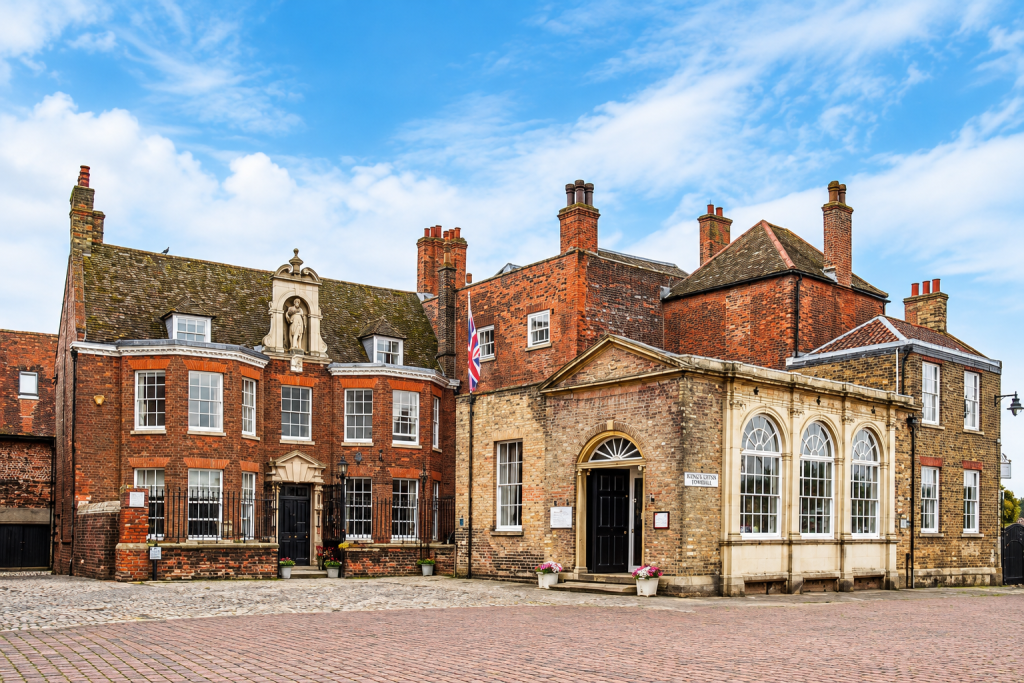
The riverside restaurant at Bank House was once a bank counting house. Clerks worked behind its arched windows, handling merchants’ bills, paying out gold, and issuing King’s Lynn’s own banknotes. In 1896, the business became one of twenty banks that combined to create the modern Barclays.
Barclays was not founded in King’s Lynn. Its London ancestry stretches back to 1690. Yet the Lynn bank was far more than a provincial branch. It was a separate partnership with its own customers, banknotes, and offices at Swaffham and Downham Market.
A bank beside the harbour
The Gurneys were Norwich Quaker merchants and manufacturers who gradually moved into banking. Merchants already entrusted them with money, asked them to arrange payments, and borrowed from them to finance trade. John and Henry Gurney formalised these activities when they opened the Norwich and Norfolk Bank in 1775.
Their advertisement promised to discount bills, arrange payments through London, negotiate foreign business, and act with “secrecy, safety, and despatch”. The bank expanded quickly. Great Yarmouth received a Gurney partnership in December 1781. The Lynn Bank opened on 1 January 1782.
John Birkbeck moved from Settle to Lynn in December 1781 and took a lease of the substantial merchant’s house now known as Bank House on King’s Staithe Square. The Lynn Bank opened there on 1 January 1782, using part of the house in which John and Martha Birkbeck also lived. The familiar adjoining counting house with its three arched windows was built in 1788.
Lynn was an obvious choice. Ships brought coal, timber, wine, and other cargoes into the port. Grain passed through the town from West Norfolk and the fens. Merchants needed loans to buy goods and reliable ways of paying people in London, Newcastle, and overseas.
Bank House was an early eighteenth-century merchant’s residence. The adjoining counting house appears to have been built for the new bank in 1782. Although later dates are sometimes given, the bank’s own history and the Norfolk Historic Environment Record both support 1782.
When Lynn printed its own money
The business became known as the Lynn Regis and Lincolnshire Bank, reflecting its reach across the Wash and through the fenland waterways. It opened at Swaffham in 1807 and Downham Market in 1810.
The bank accepted deposits, provided loans, discounted bills, and safeguarded valuables. It also issued banknotes bearing its own promise to pay. Their value depended entirely upon confidence in the bank and its partners.
In April 1870, an average of £26,082 in Lynn Regis and Lincolnshire Bank notes was circulating. By November 1891 the figure had fallen to £12,304. These sums represented notes in people’s pockets and merchants’ tills, not the bank’s total wealth.
A story preserved in the bank’s history shows how quickly confidence could disappear. During an undated run on the Lynn Bank, customers crowded in and demanded their money. Francis Cresswell hurried to London by post chaise to fetch gold. Meanwhile, the prominent merchants William and Thomas Bagge stood behind the counter with Daniel Gurney and assured customers that they trusted the bank.
The doors remained open until Cresswell returned at about ten o’clock that night. Once the waiting crowd saw the gold, the panic ended. The incident has sometimes been dated to 1809, but that is doubtful because Cresswell was not then an established partner. It may have occurred during the banking crisis of 1825.
Daniel Gurney became the family’s principal representative in West Norfolk. He arrived in Lynn in 1809, settled at North Runcton, and remained connected with the bank until his death in 1880. He was also an antiquary and the author of the substantial Record of the House of Gournay.
Francis Cresswell married Rachel Elizabeth Fry, daughter of the prison reformer Elizabeth Fry. Their son, Samuel Gurney Cresswell, was born at Bank House in 1827 and later became one of the first naval officers to complete the North-West Passage.
From King’s Lynn to Barclays
The Lynn bank expanded by absorbing competitors. It purchased Everards and Company in 1861, while the failure of the East of England Bank in 1864 brought further customers. The cramped King’s Staithe premises could no longer contain the business, so in 1869 it moved to 21 Tuesday Market Place.
In 1888, the death of Sir Lewis Whincop Jarvis was followed by the failure of Jarvis and Jarvis, Lynn’s other leading private bank. Gurneys acquired most of its business. The partnership now held a commanding position in the town and traded under the impressive title of Gurneys, Birkbeck, Barclay, Buxton and Cresswell.
The appearance of Barclay in that name did not mean that it had already become Barclays Bank. The Gurneys, Barclays, Birkbecks, and Buxtons had long been connected through marriage and business.
By the 1890s, private banks were under pressure from large joint-stock companies. A family bank depended upon the wealth of a few partners. Death or retirement could weaken it, while expanding businesses increasingly required loans beyond the comfortable reach of a local partnership. After prolonged negotiations, Barclay and Company of London, Gurney and Company of Norwich, and Jonathan Backhouse and Company of Darlington formed the core of a new combination. Twenty banks eventually joined, including eight separate businesses with Gurney connections.
The King’s Lynn partnership entered in its own right. The others included the Gurney banks at Norwich, Fakenham, Great Yarmouth, Halesworth, Wisbech, Ipswich, and Colchester. Together they formed Barclay & Company Limited in July 1896, with deposits of more than £26 million and approximately 182 branches. The new company retained regional head offices and appointed former partners as local directors. Somerville Arthur Gurney and George Francis Addison Cresswell became directors of the Lynn and Wisbech district. Customers entering the Tuesday Market Place bank therefore continued to deal with familiar people.
Barclay & Company became Barclays Bank Limited in 1917. The King’s Staithe counting house had served the Lynn Bank for eighty-seven years before the move to Tuesday Market Place. Its arched windows, built for banking when George III was king, still overlook the river today.
© James Rye 2026
Book a Guided Tour with a Trained and Qualified King’s Lynn Guide Through Historic Lynn
References
- Barclays Group Archives. “Gurneys, Birkbeck, Barclay, Buxton, Cresswell, King’s Lynn.” https://home.barclays/archive-barclays/founding-banks/gurneys-birkbeck-barclay-buxton-cresswell-kings-lynn/
- Bidwell, William Henry. Annals of an East Anglian Bank. Norwich: Agas H. Goose, 1900. https://archive.org/details/annalsofeastangl00bidwrich
- Historic England. “Bank House, King’s Staithe Square.” List entry 1220654. https://historicengland.org.uk/listing/the-list/list-entry/1220654
- Matthews, P. W., and A. W. Tuke. History of Barclays Bank Limited. London: Blades, East & Blades, 1926. https://archive.org/details/historyofbarclay0000matt
- Norfolk Heritage Explorer. “The Bank, King’s Staithe Square.” Record MNF75576. https://www.heritage.norfolk.gov.uk/record-details?Index=62667&MNF75576-The-Bank-King%27s-Staithe-Square=