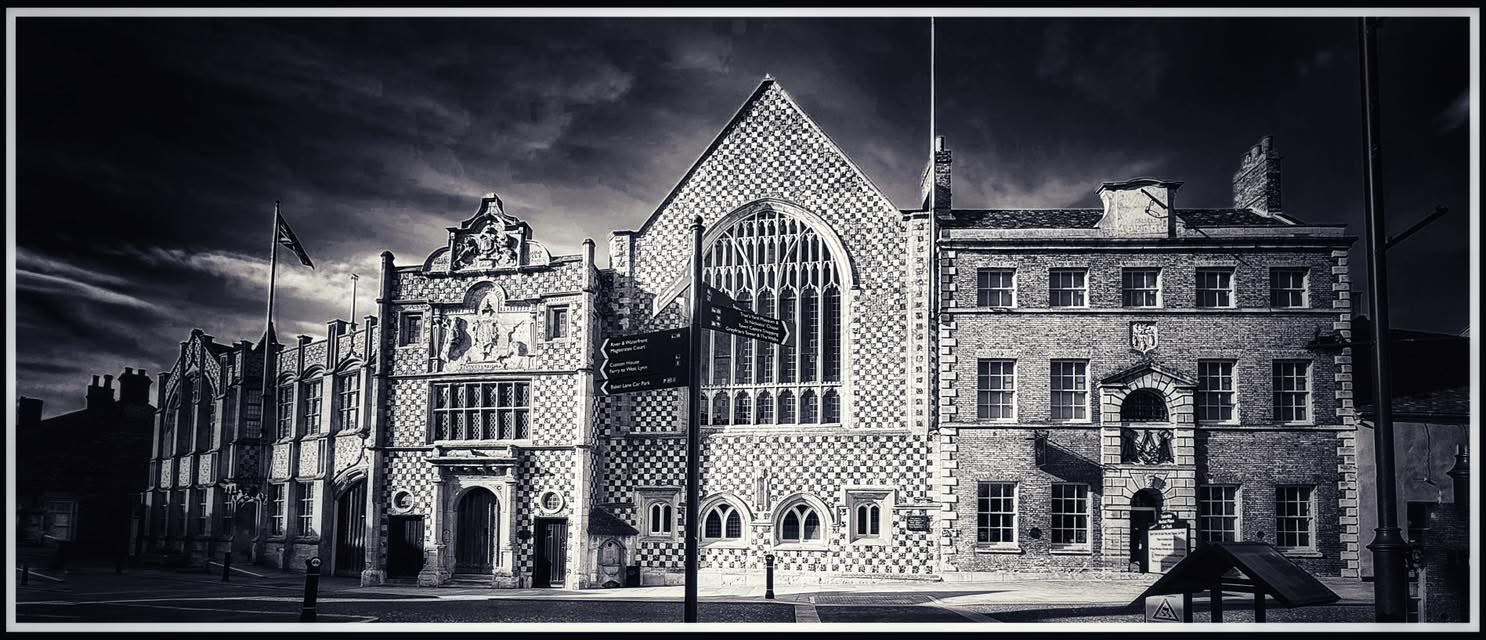
Ask most people what happened to King’s Lynn’s Catholic past at the Reformation and you’ll likely get a single mental image: a mob, a market square, a bonfire of old idols. The real story, pieced together from eighteenth- and nineteenth-century Lynn historians working from borough records now lost to easy view, is both less dramatic and more interesting. It is not one bonfire but a sequence of them, spread across sixteen years, each with a different character, a different set of victims, and a different degree of certainty attached to it.
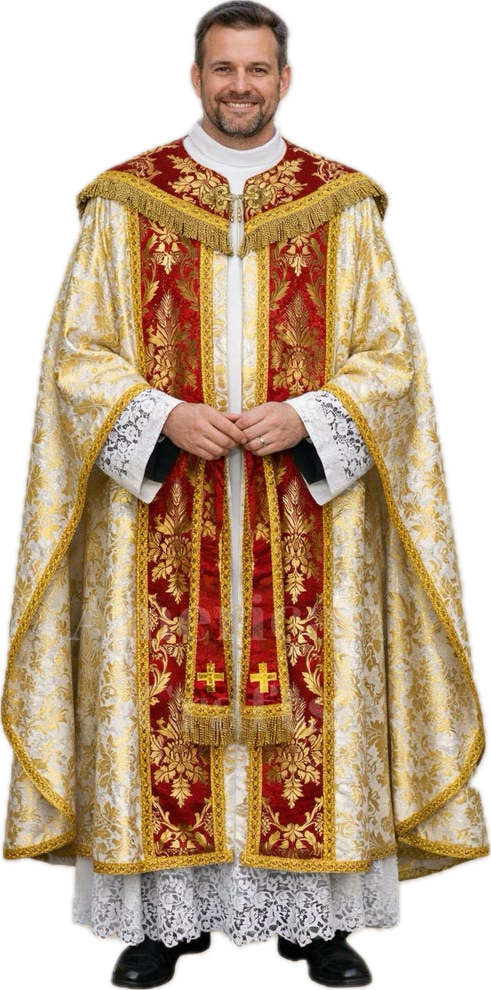
Traditional Catholic Cope With Matching Stole
A first wave of confiscation, not combustion
The story usually begins in 1552, under Edward VI, when royal commissioners moved through Lynn’s parish churches taking inventory of everything valuable.
The surviving lists, transcribed by the Victorian historian H. J. Hillen, are striking for their sheer bulk: St Margaret’s alone yielded two chalices and patens (the shallow plates used to hold the bread during Mass), a run of copes (long, cloak-like ceremonial vestments worn by priests in processions) and vestments generally, and a silk cross-cloth embroidered with an image of Mary Magdalene. St Nicholas’s Chapel gave up two chalices, twenty-nine copes, five vestments, ten tunicles (a shorter, sleeved vestment worn by a subdeacon assisting at Mass), altar cloths, an altar cross, curtains, bells, and a lectern. St James’s handed over further copes and vestments along with censers (vessels for burning incense, swung on chains during services) and a holy-water stoup (a basin, usually set near a church door, holding water blessed for worshippers to bless themselves with on entering). All Saints, South Lynn, gave up a pyx (a small container, often a locked box, used to reserve consecrated bread) among its plate and vestments.
The commissioners valued the goods at St Margaret’s at more than £92. The property of All Saints was assessed at over £53, while the contents of St Nicholas’s and St James’s were each worth almost £50. These were substantial sums when a skilled craftsman might earn only a few pence for a day’s work.
A small number of chalices and bells could remain, but much of the other property was surrendered. Metal objects might be melted down, while vestments and hangings could be sold. Some church linen was to be distributed among the poor. The inventories describe confiscation and dispersal rather than burning, but Lynn’s churches must have been stripped of much of their former colour and ceremony.
Service books are absent from the inventories. That does not mean that Lynn’s churches possessed none. The commissioners were chiefly concerned with valuable plate, textiles, bells, and other saleable objects. Missals, breviaries, processionals, and other liturgical books may have been destroyed or collected separately.
This was confiscation and redistribution — items sold, melted down, or requisitioned for the Crown — rather than public destruction by fire. It’s worth resisting the urge to fold this episode into the later bonfires. The commissioners were accountants, not iconoclasts, and their target was value, not theology.
It may be that this was the time when the “offending” words (“pro ora anima” [Pray for the soul of …]) were chiselled off the door at Thoresby College.
A Marian restoration, briefly
What makes the next phase so poignant is how short-lived it was. Under Mary I, Lynn’s churches began putting things back. The borough’s chamberlains’ accounts record a payment in April 1558 — 42 shillings to a Thomas Clabourne’s wife — for “the Rowde of Mary and John for St Margaret’s,” almost certainly the traditional rood group: a large image of Christ crucified, flanked by figures of the Virgin Mary and St John, typically mounted above the entrance to the chancel. A further sum went to the churchwardens for the same purpose. Rood lofts — the raised galleries or platforms on which the rood stood — were rebuilt, and damaged images of saints repaired and repainted across the town.
That restored rood at St Margaret’s cannot have stood for much more than a year.
1559: the systematic dismantling
Elizabeth’s accession brought the royal injunctions of 1559, which ordered the “utter extinction and destruction” of shrines, images, and anything smacking of pilgrimage or superstition. Lynn’s response, as recorded by the antiquarian Benjamin Mackerell in his 1738 history of the town, was thorough: rood lofts and the images upon them were taken down “from all the Churches in this Town,” the altar steps removed, and the ground at the east end of each church levelled.

This is worth pausing on, because it changes what kind of event we’re describing. Levelling a chancel floor and repairing carpentry is not the work of an angry crowd. It looks far more like an organised operation — churchwardens, tradesmen, and borough officials working to a civic and national programme, coordinated across every parish in the town at once. We don’t have named participants, but the coherence of the work across multiple churches argues strongly against spontaneous mob action.
1561: relics and mass-books in the marketplace
Two years later came the event most often remembered as the Lynn bonfire. Mackerell records that “many Popish Reliques and Mass-Books were Burnt in this Market-Place” — later writers, including Richards and Hillen, place this in Tuesday Market Place, though Mackerell himself does not name it.
It’s tempting to picture this as the destruction of statues and stained glass, but the source is precise in a way that’s easy to miss: it names relics and mass-books, not images. The images had already gone in 1559. What burned here was liturgical material — mass-books, meaning missals or other books containing the text and rubrics needed to celebrate the Mass — along with objects the Protestant town clerks were content to call “reliques.” In Tudor usage that word could stretch well beyond bone fragments of saints to cover reliquaries (the often elaborate containers built to house and display such relics) and other apparatus of shrine devotion.
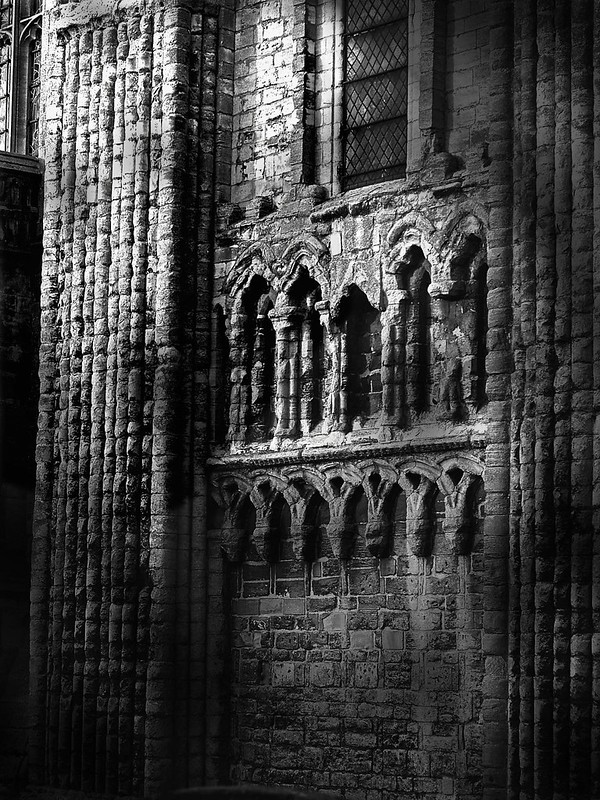
Photo © James Rye 2021
The timing lines up suggestively with Bishop John Parkhurst’s 1561 visitation of the Norwich diocese, which asked churchwardens directly whether anyone had hidden away mass-books, beads (rosaries, strings of beads used to count prayers), or vestments after the first purge, and whether any super-altars (portable consecrated stone slabs, used to convert an ordinary table into an altar fit for Mass) survived, ordering that any recovered material be destroyed. No surviving instruction says in as many words “burn these at Lynn,” but the overlap between what Parkhurst’s interrogatories asked after and what actually went up in smoke that year is hard to dismiss as coincidence.
There’s one further thread worth flagging as speculative rather than established. Hillen notes that as late as 1525 the skull of St Margaret was venerated as a relic in the Trinity Chapel, with offerings from pilgrims split between the priory and the parish. It’s an obvious question whether that relic was among the “reliques” burnt in 1561 — but neither Mackerell nor Hillen gives an inventory of what actually went into the fire, so this has to stand as an intriguing possibility, not a fact.
1568: importing the problem from Tilney
A second, less-discussed fire followed in 1568. This time the material — vestments, “Popish reliques,” strings of beads, and crucifixes — was brought in from Tilney and burnt in an unspecified Lynn market. Richards’s main account agrees with Mackerell on Tilney as the source, though a later chronological list in Richards attributes the material instead to “St John’s and Tilney,” a discrepancy against his own narrative that shouldn’t be treated as settled without checking the original borough manuscript.
What the episode does tell us, reliably, is that Lynn was functioning as more than just a parish enforcing its own conformity — it was a hub where material confiscated from the wider district could be brought in and destroyed as a public, civic demonstration of authority.
What doesn’t quite hold up
Not every colourful detail in the old histories survives scrutiny. Mackerell also claims that in 1567 Dutch ships in the Haven fired on St Margaret’s spire and knocked down its crosses — a story William Richards later dismissed as “a blind and queer kind of a tale.” It’s worth noting for context that Lynn’s Dutch exile congregation only arrived around 1567, after the 1561 fire, so there’s no plausible link between that community and the earlier purge, whatever the truth of the spire story.
There’s also a small, genuinely hopeful coda: a fragment of a painted medieval rood screen — the timber and stone partition, often painted with figures of saints, that separated the nave from the chancel and originally supported the rood loft above — survives at All Saints, South Lynn, its apostles reportedly the only surviving medieval painted panel in the town. Some accounts attribute scratches on the figures’ faces to reforming zeal, though no conservation report I’ve found securely dates that damage to this period. The screen’s survival at all is a useful reminder that “all the Churches” stripped of their roods in 1559 didn’t necessarily mean every painted image was destroyed outright — some, evidently, were merely taken down and set aside.
Reading the evidence honestly
What can be said with real confidence is this: Lynn’s Reformation was not one moment but a sequence — confiscation in 1552, restoration under Mary, systematic dismantling in 1559, and two further public fires in 1561 and 1568, the second one importing its material from outside the town. What can’t yet be said, because the surviving printed accounts don’t tell us, is who exactly ordered the fires, how large they were, or what became of specific named objects, including St Margaret’s contested relic.
© James Rye 2026
Book a Guided Tour with a Trained and Qualified King’s Lynn Guide Through Historic Lynn
References
Frere, W. H., and W. M. Kennedy, eds. Visitation Articles and Injunctions, vol. III. London: Longmans, Green and Co., 1910.
Hillen, H. J. History of the Borough of King’s Lynn, vol. I. Norwich: East of England Newspaper Co., 1907.
Joby, Christopher. “The Dutch Exile Community in King’s Lynn: A Forgotten Moment in Anglo-Dutch Contact.” History 110 (2025): 194–214.
Mackerell, Benjamin. The History and Antiquities of the Flourishing Corporation of King’s-Lynn. London, 1738.
Richards, William. The History of Lynn, vol. II. Lynn: W. Whittingham, 1812.
Walsham, Alexandra. Recycling the Sacred: Material Culture and Cultural Memory after the English Reformation. Oxford: Oxford University Press, 2017.