King’s Lynn’s health history begins long before the NHS, the London Road hospital, or the present Queen Elizabeth Hospital. It begins with medieval religious charity, leper houses, parish relief, poor-law discipline, cholera, public water, overcrowded courts, voluntary medicine, infectious disease hospitals, maternity clinics and the slow growth of public health.
The town’s position helped shape the story. Lynn was a port on the Great Ouse, close to the Wash, tied to fenland, river traffic, seaborne trade and inland markets. That made it prosperous, but also exposed. Goods, animals, sailors, servants, merchants, travellers and disease all moved through the town. Water brought trade. It also carried waste.
Medieval hospitals before modern hospitals
In medieval Lynn, a hospital was usually not a hospital in the modern sense. It was more often a religious and charitable house offering shelter, food, prayer, washing, a bed and simple care. The poor, the sick, the aged, travellers, disabled people and those without secure family support might all come within its reach.
St John the Baptist’s Hospital, in the Norfolk Street area, was one of Lynn’s early religious hospitals. It was not only a place of care, but also a public religious setting. In 1399 William Sawtre, a Lynn priest later burned for heresy in 1401, made a public recantation in the church of St John’s Hospital. That small detail places the hospital within the visible life of the town, not in some hidden charitable corner.
The more directly medical story lies with leprosy. Medieval people feared leprosy and often separated those believed to have it. They also gave alms to them, prayed for them and endowed small houses for their support. Lynn had more than one such place.
Cowgate, Gaywood and Lynn’s leper houses
St Mary Magdalen’s Hospital at Gaywood Road was the best-known of Lynn’s leper foundations. It is usually described as a medieval hospital for a chaplain, twelve brethren and sisters, including three leprous persons. The present almshouse site preserves a long charitable history. The medieval institution was badly damaged during the siege of Lynn in 1643, rebuilt in 1649, restored in 1904 and modernised in the twentieth century.
Cowgate gives a more elusive glimpse of the same world. A fifteenth-century bequest by Stephen Guybon of North Lynn, dated 1432, left twelve pence to each house of lepers around Lynn. The named places included West Lynn, Cowgate, Hardwick, Setchey, Magdalen and Gaywood. These were probably small, poorly endowed houses, dependent on gifts, passing charity and occasional bequests.
Cowgate is usually associated with the Common Staithe area. That makes it especially interesting. The leper house was not placed in a remote wilderness. It stood within the working geography of Lynn, near movement, trade, river traffic and almsgiving. The leprous poor were separated from ordinary household life, but they were not entirely outside the town’s attention.
Other fragments survive. St Lawrence’s Hospital near the present Hardwick Bridge had a chapel and had burned down by 1477. West Lynn, Setchey and Gaywood also belonged to this small ring of care around the town. These places were modest, but they show how medieval Lynn dealt with illness that was feared, visible and socially isolating.
Almshouses and the respectable poor
Almshouses formed another layer of care. They were not hospitals in the clinical sense, but they provided security for selected poor people, often the aged, widowed or locally rooted. They joined housing, charity and social reputation.
Framingham’s Hospital is one example. Henry Framingham’s almshouses were originally built off Broad Street in the seventeenth century and later moved. As with many almshouses, the help was limited and selective. It did not solve poverty across the town, but for those admitted it could mean shelter, dignity and protection from the workhouse.
Gaywood Hospital also continued this almshouse tradition after its medieval leper-hospital origins. Its long history shows how a place founded for one kind of religious charity could survive into a different world of social care.
St James’ Chapel becomes a workhouse
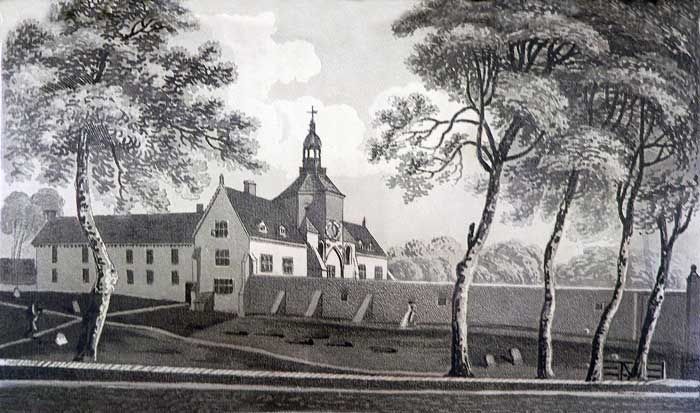
St James’ Chapel has one of the most striking care histories in Lynn. A medieval chapel of ease to St Margaret’s, it was converted into a workhouse in 1582. In 1597, when plague was prevalent, it was used as a hospital. In 1645 it became a pest house. In 1682 it was fitted up by subscription for “fifty decayed old men, women, and children”.
That phrase is blunt, but useful. It tells us that the building was used for those worn down by age, poverty, illness or lack of support. The same site served many purposes: chapel, workhouse, plague hospital, pest house, poor people’s refuge and later poor-law institution.
The old categories did not match modern ones. Health care, social care, poverty relief, infection control and old-age provision often occupied the same building. A person might enter because they were ill, elderly, orphaned, infectious, disabled, homeless, unemployed or simply without family resources.
The poor law and the St James’ workhouse
In 1699 the parishes of St Margaret and All Saints formed a local poor-law incorporation. A Court of Guardians administered poor relief and workhouse provision. St Margaret’s used the old St James’ site as its workhouse, with accommodation for about 170 inmates.
The New Poor Law brought a more formal system. The King’s Lynn Poor Law Union was formed on 30 September 1835. Its population at the 1831 census was 13,370, and its average annual poor-rate expenditure for 1833 to 1835 was £9,220. The old St James’ workhouse continued in use. In 1837 the Poor Law Commissioners approved £750 for additions and enlargement, raising capacity to about 200.
The workhouse provided food, shelter and medical care for some of the poorest people in the town. It also carried stigma. It was designed to deter the able-bodied poor from seeking relief unless they had no alternative. In practice, many inmates were not able-bodied at all. They were elderly, sick, disabled, widowed, orphaned, mentally distressed, pregnant, abandoned or chronically poor.
In 1823 a forty-bed infirmary had been added at St James’. That detail is important. The workhouse was not only a place of labour and discipline. It was also one of the town’s main places for the sick poor.
The tower collapse of 1854
The old St James’ building came to a dramatic end as a workhouse. In August 1854 its central tower collapsed on a Sunday morning. Reports describe cracks appearing in the building, inmates moving outside, the clock stopping at 10.45, and a clockmaker climbing the tower to repair it. The collapse came at about 11.20. Two people were killed: the clockmaker and an inmate who had refused to leave his bed.
The disaster made the old building’s inadequacy plain. A new union workhouse was built on Extons Road. It was designed by James Medland and Alfred Maberly, begun in 1855, completed in 1856, and cost £13,545. It was planned for 468 inmates and included an infirmary, chapel, dining hall and separate accommodation blocks.
By 1864 it contained 206 inmates. A later medical account praised its ventilation, school provision, infirmary and chapel, and noted a Turkish bath for both sick and healthy poor. Additions followed, including a vagrant or receiving ward in 1882 and an extra infirmary block in 1901. The building later became St James’ Hospital and remained in use until 1985.
Freebridge Lynn and the rural poor
The poor-law story was not confined to the borough. Freebridge Lynn Poor Law Union was formed on 16 November 1836 and covered thirty-two parishes around Lynn. Its workhouse was built near Gayton, designed by William J. Donthorn, and intended for up to 150 inmates.
From 1904, birth certificates for children born there gave the address as 1 Old Swaffham Road, Gayton, rather than naming the workhouse. That was done to reduce the stigma of a workhouse birth. It is a small administrative detail, but it shows how deeply the workhouse label could mark a person.
Cholera and sanitary reform
Lynn suffered cholera outbreaks in 1832, 1848 and 1854. The disease was sudden, frightening and often fatal. In the early and mid nineteenth century, cholera was still widely explained through foul air, bad smells and decaying matter. The theory was wrong about the main means of transmission, but it drew attention to filthy streets, cesspools, drains, polluted water and overcrowded housing.
William Lee’s 1853 report to the General Board of Health examined Lynn’s sewerage, drainage, water supply and sanitary condition. Its subjects included cholera, cesspools, defective drains, court-yards, burial grounds, mortality, nuisances, the Purfleet, the River Ouse, water supply, sewerage and zymotic diseases, an older term for infectious diseases associated with foul or decaying conditions.
Cholera made the town’s physical condition a medical issue. A bad drain was not merely unpleasant. A foul yard was not only a nuisance. A polluted watercourse could be a source of danger. The older town, with its courts, yards, privies, fleets and river outfalls, had to be inspected as a health environment.
The Millfleet is one local example. The road is wide because a watercourse once ran along its south side. It was covered over in 1897, partly in response to sanitary fears and the continuing memory of cholera. The Millfleet had been the outfall of the Gaywood River into the Great Ouse. Its history links medieval water management, urban drainage and nineteenth-century public health.
Clean water, sewage and refuse
By the 1920s Lynn had a more organised public health system. The borough’s 1925 Medical Officer of Health report recorded water supply, drainage, refuse collection, infectious disease arrangements, clinics and housing conditions.
The town’s water came from the Gayton waterworks and was stored in a reservoir at Leziate. The public analyst described the water as pure, unpolluted and fit for drinking. For a town that had known cholera, that was a major civic achievement.
Sewerage still reflected Lynn’s geography. The 1925 report stated that sewage was discharged into the River Ouse through outfalls with tidal doors. The Medical Officer judged the system generally satisfactory for the time, but the fact itself is striking. The river remained part of the town’s waste system long after modern public health had begun.
Refuse collection also came under health administration. The report noted the regular removal of refuse, the use of ashbins, and the need for twice-weekly collection in parts of the borough. It criticised dumping at Harding’s Pits and suggested that an incinerator should be considered.
Housing as a health problem
The 1925 report described many older low-rent houses as congested in courts and yards, with poor light and air. Some had rotten tiles, dampness and decayed woodwork. The borough had a shortage of at least 200 low-rent houses. Overcrowding was noted especially in Highgate and in streets east and south of Coronation Square, where two or more families sometimes lived in houses built for one.
These were not only housing defects. They affected health directly. Damp, darkness, poor ventilation and overcrowding increased the risks of respiratory illness, tuberculosis, childhood sickness and general physical decline. A clinic could advise a mother, but it could not make a damp house dry. A doctor could treat a child’s chest, but not give the family more space.
The 1947 Medical Officer of Health report, written just before the NHS began, still treated housing, water, food inspection, infectious disease, maternity and infant welfare as connected parts of local health. It recorded 550 confinements and twenty-one deaths of children under one year. It also described the continuing post-war problem of old houses needing repair after years of deterioration.
The London Road hospital
The West Norfolk and King’s Lynn General Hospital was established in the 1830s and based in London Road. It belonged to the voluntary hospital tradition. Such hospitals depended on subscriptions, donations, committees, patrons and local support. They were charitable institutions, not public services in the NHS sense.
The hospital treated the sick poor, but admission was not a universal right. Rules, recommendations and institutional judgement mattered. The voluntary hospital therefore occupied a different social position from the workhouse infirmary. The workhouse carried the stigma of pauperism. The hospital on London Road carried the respectability of civic charity and medical improvement.
The hospital expanded in stages during the nineteenth century and again in the twentieth. It became part of the NHS after 1948. It closed in 1980 when the Queen Elizabeth Hospital opened and was demolished in 1988.
Infectious disease, maternity and children
By the early twentieth century Lynn’s health provision had widened beyond hospitals and workhouses. In 1925 the borough had an infectious diseases hospital with twelve beds and a separate smallpox hospital with fourteen beds, placed more than a mile from the nearest houses.
That year Lynn had a small diphtheria outbreak in May and June. There were ten cases, three of them fatal. All but one were in South Lynn, around Wisbech Road and Saddlebow Road. The Medical Officer reported that prompt precautions prevented wider spread.
Maternity and child welfare were also part of the system. A weekly maternity and child welfare clinic was held at the Friends’ Meeting House in New Conduit Street. A school clinic met every morning in St James’ Road. Tuberculosis clinics were held at the West Norfolk and King’s Lynn Hospital, and the same hospital had a venereal disease centre.
Nursing was still partly voluntary. The district nursing service was supplied through the Nursing Association, supported by subscriptions and fees. Only two registered midwives were practising in the borough, and they were not subsidised by the council. Lynn had moved beyond Victorian charity alone, but it was not yet a welfare state.
St James’ Hospital and the NHS inheritance
The creation of the NHS in 1948 transformed access to medical treatment. The old voluntary hospital world became part of a national system. Treatment was no longer supposed to depend on subscription, recommendation or poor-law status.
Even so, the NHS inherited older buildings and older local patterns. St James’ was the clearest example. It had been a chapel, workhouse, plague hospital, pest house, poor-law institution and then hospital. The former workhouse site continued in health use until 1985.
This continuity is easy to overlook. Modern health services did not begin on empty ground. They absorbed older institutions, altered their purposes and gradually changed their meanings.
The Queen Elizabeth Hospital
The Queen Elizabeth Hospital opened in 1980, replacing the older hospital arrangements and becoming the district general hospital for King’s Lynn and a wide surrounding area. Today it serves about 331,000 people across West Norfolk, North Cambridgeshire and southern Lincolnshire, with more than 4,000 staff and volunteers.
The present hospital has now become part of a new chapter. It was built using Reinforced Autoclaved Aerated Concrete, known as RAAC, and was designed for a life of about thirty years. RAAC is present in the roof and walls of much of the main building. Thousands of steel and timber supports have been installed across wards, waiting areas, clinic rooms and offices as part of the safety programme.
Plans for a new hospital place Lynn’s health story back where it has often been: with buildings, money, need and public responsibility. Medieval care needed chapels and almshouses. Poor relief needed workhouses. Cholera reform needed waterworks and drains. Voluntary medicine needed wards and operating space. The NHS needs hospitals that are safe, accessible and fit for modern care.
© James Rye 2026
Book a Walk with a Trained and Qualified King’s Lynn Guide
References
- Historic England. “Almshouses, Formerly Gaywood Hospital, Gaywood Road, King’s Lynn.” National Heritage List for England, list entry 1219806. https://historicengland.org.uk/listing/the-list/list-entry/1219806
- Historic England Archive. “West Norfolk and King’s Lynn Hospital, King’s Lynn.” Archive item JRC01/01/010/048. https://historicengland.org.uk/images-books/photos/item/JRC01/01/010/048
- Higginbotham, Peter. “The Workhouse in Freebridge Lynn, Norfolk.” The Workhouse. https://www.workhouses.org.uk/FreebridgeLynn/
- Higginbotham, Peter. “The Workhouse in King’s Lynn, Norfolk.” The Workhouse. https://www.workhouses.org.uk/KingsLynn/
- King’s Lynn Civic Society. “Further Afield.” King’s Lynn Pilgrimage Trail. https://www.kingslynncivicsociety.co.uk/pilgrimage-trail/further-afield/
- King’s Lynn Borough and Port Council. Annual Report of the Medical Officer of Health for 1925. Internet Archive and Wellcome Library digitisation. https://archive.org/details/b29533375
- King’s Lynn Borough and Port Council. Annual Report of the Medical Officer of Health for 1947. Wellcome Collection text. https://api.wellcomecollection.org/text/v1/b29533491
- Lee, William. Public Health Act: Report to the General Board of Health on a Preliminary Inquiry into the Sewerage, Drainage, and Supply of Water, and the Sanitary Condition of the Inhabitants of the Borough of King’s Lynn. London: Eyre and Spottiswoode, 1853. https://books.google.com/books/about/Public_Health_Act_Report_to_the_General.html?id=DVYuJJeVPeQC
- Norfolk Record Office. “Hospitals P to W: St James Hospital, King’s Lynn, and West Norfolk and King’s Lynn General Hospital.” https://www.archives.norfolk.gov.uk/article/31306/Hospitals-P-to-W
- Queen Elizabeth Hospital King’s Lynn NHS Foundation Trust. “Our Strategy 2024-2030.” https://www.qehkl.nhs.uk/about-us/our-strategy/2024-2030/
- Queen Elizabeth Hospital King’s Lynn NHS Foundation Trust. “Why We Need a New QEH.” https://newqeh.org.uk/why-we-need-a-new-qeh/
- Victoria County History. “Lazar-Houses, Lynn.” In A History of the County of Norfolk, volume 2. Wikisource edition. https://en.m.wikisource.org/wiki/Page%3AVCH_Norfolk_2.djvu/484