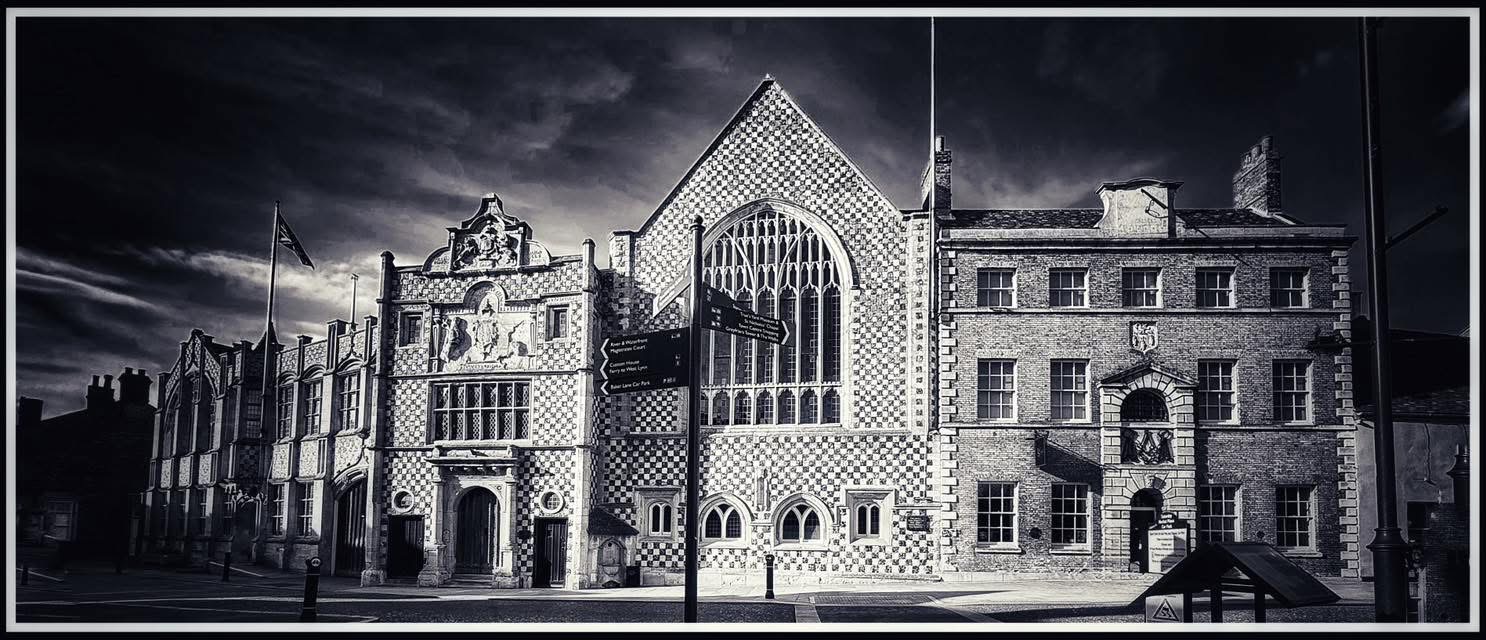

Sometime in 1592, William Shakespeare may have walked into King’s Lynn with a company of travelling actors. He was not yet thirty and was only beginning to make his name in London. If the evidence has been read correctly, he may also have performed in St George’s Guildhall.
As far as the writer is aware, at the time of writing, there is no document recording Shakespeare’s visit. His name does not appear in the Lynn accounts, and we do not know which plays were performed. Yet the case assembled by Dr Matthew Woodcock of the University of East Anglia is considerably stronger than the local legend might suggest. It connects Shakespeare with a theatrical company known to have visited Lynn at precisely the period when plague was driving London actors onto the road.
Lynn and the travelling players
Elizabethan Lynn was well accustomed to professional actors. Its growing economy offered the prospect of paying audiences, while its position made it part of an East Anglian touring circuit that included Norwich, Ipswich, Aldeburgh, and Dunwich.
The Corporation’s surviving accounts reveal an impressive succession of visiting companies. The Queen’s Men appeared repeatedly between 1586 and 1596. The Lord Chamberlain’s Men came in 1586, the Earl of Essex’s Men in 1591, the Earl of Derby’s Men in 1594, and the Earl of Worcester’s Men in 1598–99.
Among these records is one particularly intriguing entry. In the Hall Book for 1592–93, the Corporation recorded:
“Item bestowed vpon the erle of pembrookes players xx s”
Pembroke’s Men had come to Lynn and received twenty shillings.
The significance lies in the people and plays associated with this company.
Shakespeare and Pembroke’s Men
Pembroke’s Men existed in various forms, with actors moving between companies. Richard Burbage, later the great interpreter of Shakespeare’s leading roles, was associated with them. So were Gabriel Spencer and, possibly, Ben Jonson.
More importantly, so was Shakespeare.
Several of his early plays were performed by Pembroke’s Men. The printed editions of Titus Andronicus, The Taming of the Shrew, and 3 Henry VI explicitly connect the plays with the company, while 2 Henry VI can also be added to its repertoire. Shakespeare scholar Andrew Gurr argued from details in the early texts of the Henry VI plays that Shakespeare was not merely supplying scripts. He was probably present with the company when they were being staged.
There is also the famous attack on Shakespeare by the dramatist Robert Greene. Writing in 1592, Greene mocked him as an “upstart crow”, using language that echoed 3 Henry VI. Close examination of the passage has led to the suggestion that Greene may have seen Shakespeare performing in the play around the middle of that year.
Then plague intervened.
The plague sends Shakespeare on the road
London suffered a severe outbreak in 1592. When plague deaths rose, the authorities closed the theatres, cutting companies off from their audiences and income. Pembroke’s Men responded by undertaking an extended provincial tour through the Midlands and East Anglia during 1592–93.
Shakespeare had every reason to go with them. The Henry VI plays required large casts, even when actors doubled roles, and a touring company needed its players. Remaining in plague-stricken London while his colleagues took his plays around the country would have made little practical sense.
This is where the Lynn record becomes so tantalising. We know Pembroke’s Men came to the town. We have good evidence connecting Shakespeare with them at this period, and we know they were travelling because the London theatres had closed. Woodcock suggests that their Lynn visit most probably occurred during the summer or autumn of 1592.
If Shakespeare was with Pembroke’s Men, he came to King’s Lynn.
But where did they perform?
St George’s Guildhall
The evidence does not identify their venue. It does, however, point towards St George’s Guildhall.
A record from September 1594 shows that plays were being performed in both Trinity Guildhall and St George’s Guildhall. Trinity was heavily used for the business of local government, while St George’s offered a substantial alternative performance space and had been under Corporation control since 1545.
Drama there also had deeper roots. Accounts from 1513–20 record payments for collars decorated with dragons’ heads. These probably relate to some form of St George play or pageant, similar to performances known elsewhere. Long before the arrival of the professional Elizabethan companies, the Guildhall had associations with public entertainment.
The pieces therefore fit together remarkably well. Shakespeare was associated with Pembroke’s Men. Plague drove the company out of London. Pembroke’s Men toured East Anglia and were paid twenty shillings by the King’s Lynn Corporation in 1592–93. Lynn had established venues for visiting actors, of which St George’s Guildhall is the strongest candidate.
What we do not have is the final piece of evidence: a document naming Shakespeare or recording that Pembroke’s Men performed specifically at St George’s.
Shakespeare in Lynn?
Historical claims often become more certain with repetition. “Shakespeare may have performed here” gradually turns into “Shakespeare performed here”. The evidence does not justify that final step.
Yet neither should the story be dismissed as mere folklore. Woodcock’s argument rests on contemporary records and what is known about Shakespeare’s theatrical career. It makes a credible case that Shakespeare travelled to Lynn with Pembroke’s Men, probably during the summer or autumn of 1592.
Picture the Guildhall as it may have been that day. There was no modern stage, no electric lighting, and no audience arriving because they had come to see the greatest playwright in the English language. They had come to watch a travelling company from London.
Among the players may have been a young man from Stratford-upon-Avon, still in the early stages of his career. Perhaps Lynn’s audience saw him perform in one of the Henry VI plays. Perhaps they heard lines that had only recently been written.
We cannot know.
But sometime around 1592, William Shakespeare may have stood beneath the roof of St George’s Guildhall and performed for the people of King’s Lynn.
© James Rye 2026
Book a Walk with a Trained and Qualified King’s Lynn Guide
References
- Ackroyd, Peter. Shakespeare: The Biography. London, 2005.
- Donaldson, Ian. Ben Jonson. Oxford, 2011.
- Gurr, Andrew. The Shakespearean Playing Companies. Oxford, 1996.
- Honan, Park. Shakespeare: A Life. Oxford, 1999.
- Norfolk Record Office. KL/C7/8, King’s Lynn Hall Book 6.
- Shakespeare, William. 2 Henry VI. Edited by Ronald Knowles. Walton on Thames, 1999.
- Shakespeare, William. 3 Henry VI. Edited by J. D. Cox and E. Rasmussen. Walton on Thames, 2001.
- Wasson, John. Records of Plays and Players in Norfolk and Suffolk, 1330–1642. Malone Society Collections, Vol. XI, 1980/81.
- Woodcock, Matthew. “The Case for Placing Shakespeare in King’s Lynn.” University of East Anglia.