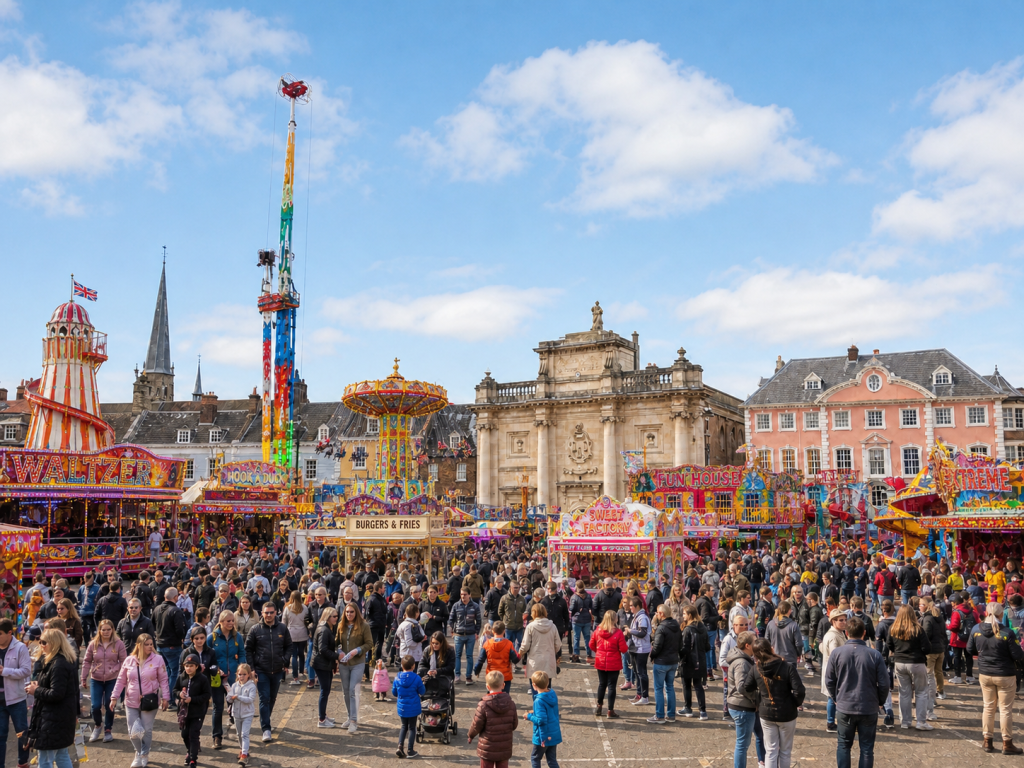
Imagine standing in Tuesday Market Place in February. The music is deafening, the fairground rides are spinning, and the smell of hot food hangs in the air. For centuries, the people of King’s Lynn have gathered here to enjoy themselves, although medieval visitors would scarcely recognise today’s Mart.
Lynn has a surprisingly rich history of entertainment. It once had a racecourse at West Lynn that attracted thousands of spectators, a football club that dreamed of joining the Football League, and public swimming baths beside the river. Its medieval Guildhall hosted theatrical performances long before Shakespeare was born, while The Walks provided generations of residents with somewhere to stroll, listen to music, and escape the crowded streets.
The Mart: Eight Centuries of Fun and Fairs
Lynn’s oldest organised public entertainments grew out of its markets. A Sand Market is recorded in 1104, and King John’s charter of 1205 gave the town important commercial privileges. By 1268, Lynn had regained earlier rights withdrawn by Henry III, and foreign merchants were expressly permitted to attend the town’s fair under its protection.
Medieval fairs were major commercial occasions, but the opportunity to meet friends, encounter strangers, and enjoy itinerant entertainers was part of their attraction. Lynn’s annual Mart developed from these traditions. Local histories date its move to Tuesday Market Place to 1584, during a period of plague, when gatherings in the narrower streets were regarded as dangerous.
By the nineteenth century, the Mart offered increasingly elaborate amusements. An especially important figure was Frederick Savage, whose engineering works made Lynn famous in the fairground industry. His firm manufactured gallopers, velocipedes, Dobby Horses, and other mechanical rides that travelled throughout Britain. Savage did not invent the steam-driven roundabout, but his engineering improvements helped transform the travelling fairground.
Some of his inventions were extraordinary. His Switchback, patented in 1888, carried passengers in cars shaped like fantastical boats, dragons, and other elaborate vehicles. His gallopers gave their wooden horses an exciting rising and falling movement as the roundabout gathered speed. Lynn was not simply a town where people enjoyed fairground rides. It was one of the places where those rides were developed and manufactured.
The Mart remains a major event. In February 2026, the traditional mayoral opening once again brought showmen, families, and visitors into Tuesday Market Place, continuing a custom with roots stretching back hundreds of years.
When Lynn Had Its Own Racecourse
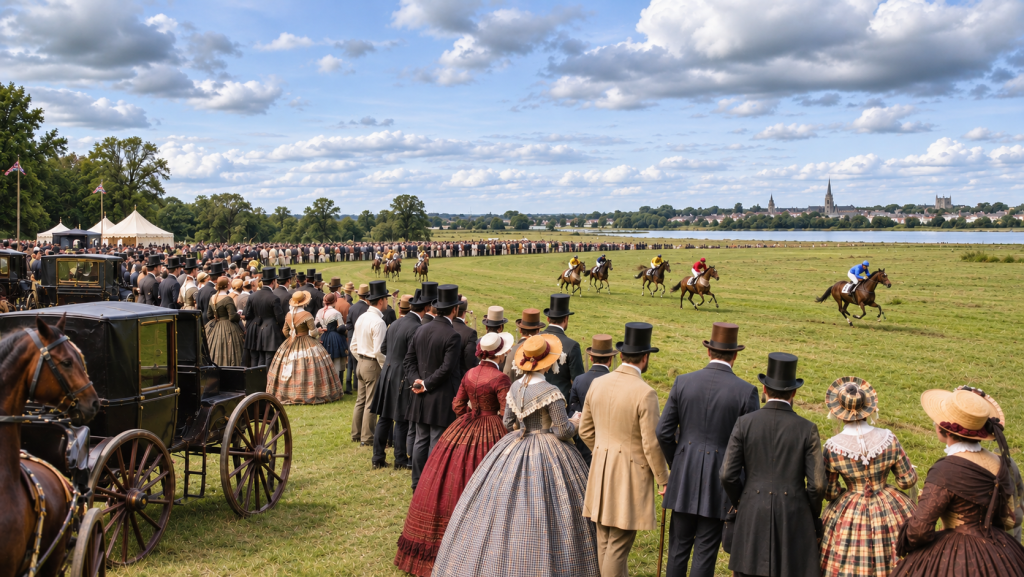
On Wednesday 11 September 1850, West Lynn witnessed an extraordinary spectacle. Thousands of people gathered to watch the first meeting of Lynn Races, a venture promoted by Robert Henry Bollin, landlord of the Duke’s Head Hotel and an energetic businessman with a lifelong interest in horses.
The new racecourse occupied about 50 acres of pasture on land that had previously formed part of the Great Ouse before the construction of the Eau Brink Cut. The course was approximately a mile long, with a substantial grandstand at its northern end. Local subscribers raised £150 towards prizes for six races, and Bollin became clerk of the course.
The opening meeting was a tremendous success. Special trains brought visitors into Lynn, while others arrived in carriages and pony carts. The Lynn Advertiser estimated the attendance at between 20,000 and 30,000, although the figure was not an official count. The spectators were described as a colourful crowd who had dressed in their best clothes and were determined to enjoy themselves. That evening, Bollin entertained sixty patrons, stewards, and guests at a celebratory banquet at the Duke’s Head.
Unfortunately, enthusiasm was easier to generate than profit. The following year’s two-day meeting was badly affected by rain. Around 3,000 spectators attended the first day, while approximately 10,000 came on the second. Heavy rain also disrupted the 1852 meeting.
There were no races in 1853, but the organisers tried again on 4 October 1854. Although the weather was favourable, attendance was disappointing, and delays meant the final race was run in failing light. The judge could not distinguish between two horses at the finish, requiring further heats to settle the result. At the customary banquet afterwards, the organisers decided not to continue.
The racecourse had lasted just four seasons of racing. Bollin’s fortunes declined, and he was declared bankrupt in January 1857, owing £1,790. His ambitious sporting enterprise had been one of the most spectacular, and shortest-lived, entertainments in Victorian Lynn.
Football Comes to The Walks
Football brought a more lasting enthusiasm. The earliest known newspaper reference to a King’s Lynn Football Club appeared in April 1868, although that organisation seems to have disappeared during the 1870s. A new club was established in 1881, and its first recorded match took place on 8 October.
Success came quickly. Lynn defeated Norwich Wanderers 5–1 to win the Norfolk Senior Cup in 1883. In 1891, the club amalgamated with Lynn Star, and by the end of the century The Walks had become firmly established as the home of Lynn football.
The game attracted considerable passion, occasionally too much. Crowd disturbances following matches against Lowestoft in 1898 and Yarmouth in 1906 led to temporary ground closures. Meanwhile, the club invested in better facilities. A new wooden grandstand seating 500 spectators was built in 1905, with the money borrowed to pay for it subsequently repaid from receipts from an FA Cup tie against Aston Villa.
Lynn’s greatest ambitions emerged after the Second World War. The club turned professional in 1948, although the players were not full-time. On 24 November 1951, a record 12,937 spectators packed The Walks for an FA Cup tie against Exeter City. The supporters helped finance additional terracing and a new grandstand, opened in 1956 by Arthur Drewry, chairman of the Football Association and president of FIFA.
Between 1956 and 1962, Lynn repeatedly applied to join the Football League. Membership was then decided by votes from existing League clubs, and Lynn’s best result came in 1958, when it received just two votes. The dream remained out of reach.
There was another memorable FA Cup adventure in 1962, when Lynn reached the third round and travelled to Goodison Park to face Everton. The Linnets lost, but 44,916 spectators watched the match. Floodlights were introduced at The Walks in 1963.
Later decades brought financial difficulties and repeated attempts to revive the club. The old organisation finally disappeared in 2009, and King’s Lynn Town FC was established in 2010. Promotions in 2019 and 2020 carried the new club into the National League. In the 2026–27 season, the Linnets are competing in National League North, still drawing supporters to the ground that has been associated with Lynn football for well over a century.
Taking the Plunge: Lynn’s Swimming Baths
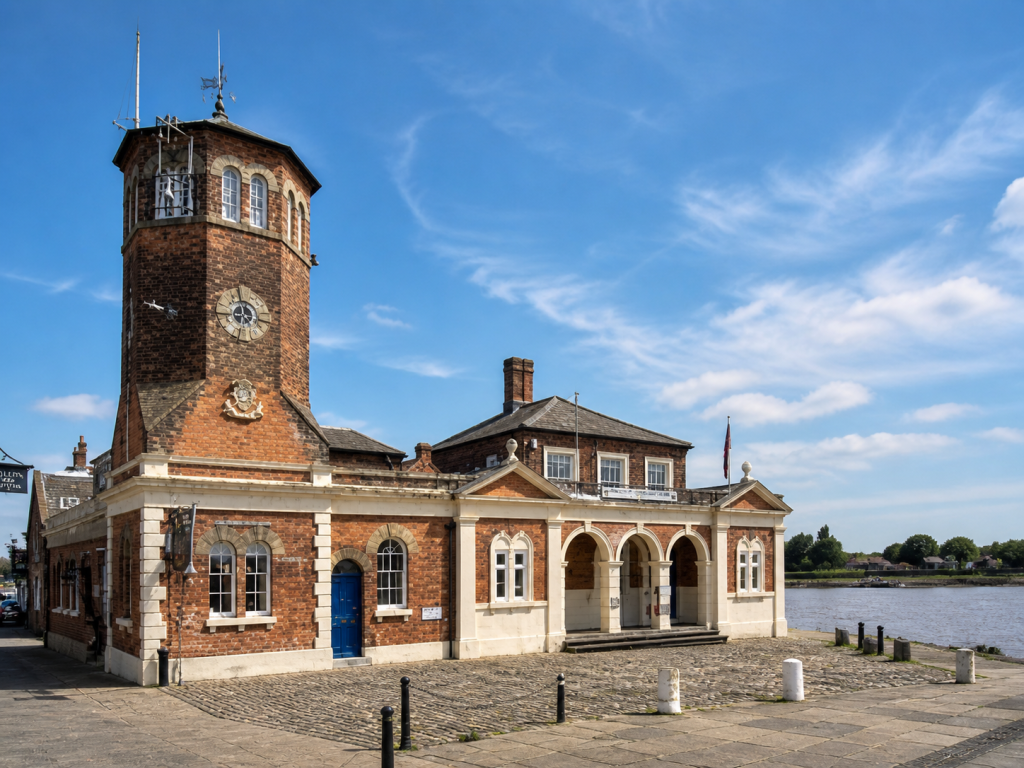
The impressive tower of the Pilots’ Office on Common Staithe Quay has a surprising connection with swimming. The building incorporates the remains of Lynn’s Victorian public baths, which opened on 4 July 1856.
The original complex provided hot and cold baths, salt and fresh water bathing facilities, showers, and a swimming bath. There were twenty dressing compartments, with separate classes of private baths. At a time when many homes lacked adequate washing facilities, public baths offered something considerably more useful than recreation alone.
The swimming pool was situated behind the waterfront frontage. In 1864, the Pilots’ Office and its distinctive observation tower were added to the northern end of the complex, combining facilities for public bathing with the administration of Lynn’s busy harbour.
The baths eventually declined, and the swimming pool was covered by an inserted floor. Remarkably, much of the original structure survives beneath it, including the stepped northern end of the pool. The building became part of the King’s Lynn Conservancy Board’s premises in 1987.
Modern municipal swimming centred on St James Swimming Pool in Blackfriars Street, which opened in 1975. Its six-lane, 25-metre pool provided facilities for recreational swimming, lessons, and competition.
That provision is now approaching another change. In September 2026, borough councillors agreed to proceed with further design and feasibility work for a proposed standalone aquatic centre at Lynnsport. The scheme includes an eight-lane, 25-metre pool, a smaller teaching pool with a movable floor, and a children’s splash area. A final decision on whether to build it is expected in 2027. St James remains an existing facility, but the council considers it to be approaching the end of its economic life.
From Medieval Players to the Cinema Screen
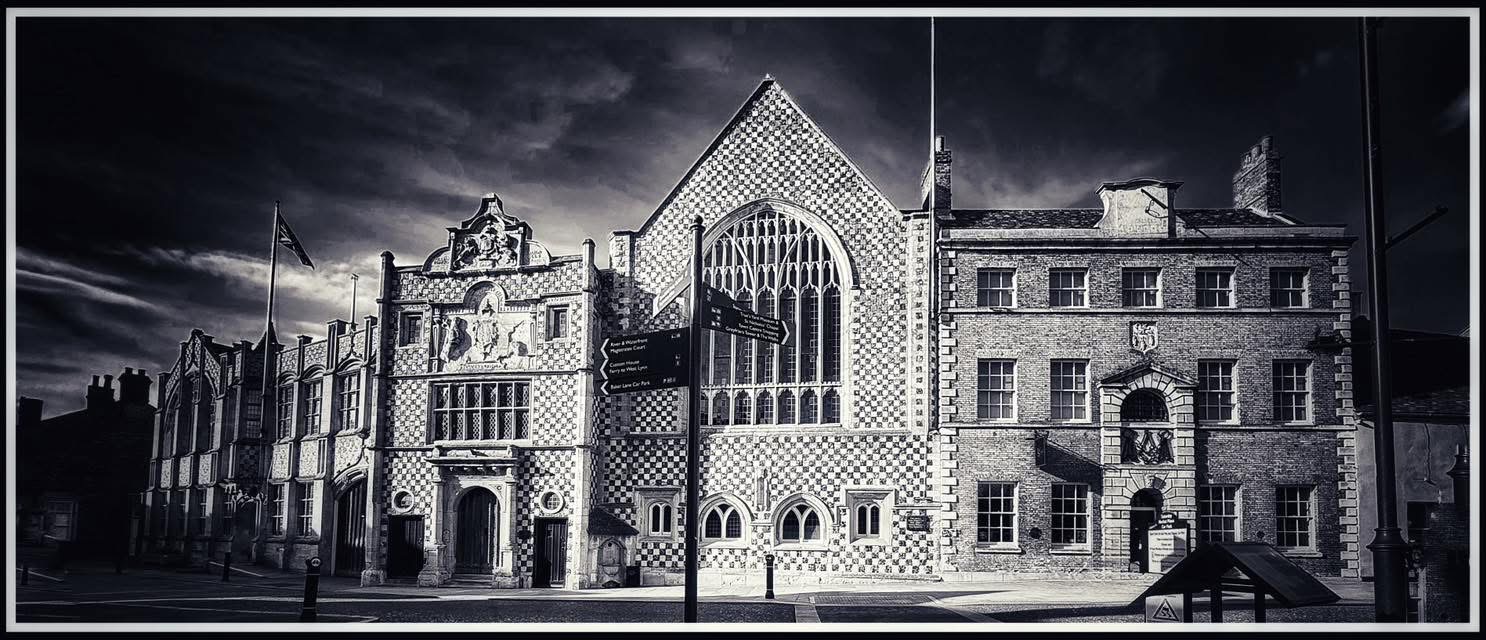
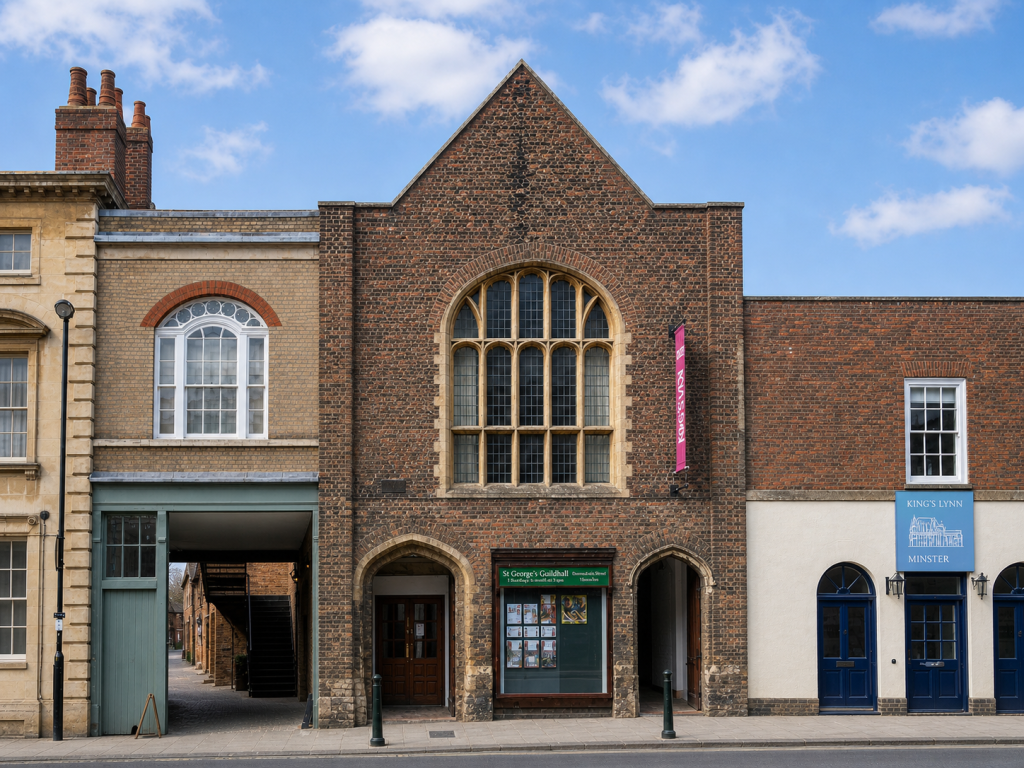
Few English towns can match Lynn’s theatrical history. St George’s Guildhall, on King Street, is the country’s largest surviving medieval guildhall and one of its most remarkable performance venues.
The Guild of St George acquired land for its hall in 1406, and the building was in use by 1428. Its earliest recorded theatrical performance was a Nativity play in 1445. The guild also organised elaborate St George’s Day processions featuring children, a dragon, and a castle on wheels.
The Dissolution of the Guilds in 1547 transferred the building to Lynn Corporation, but theatrical performances continued. Elizabeth I’s Players appeared there seven times between 1585 and 1595. The celebrated connection with William Shakespeare comes from the visit of the Earl of Pembroke’s Men in 1592–93, when plague had closed London’s theatres. Shakespeare may have been among the performers, although his personal presence cannot be established beyond doubt.
Recent archaeological discoveries have made the story still more interesting. In 2025, investigations uncovered what is believed to be the earliest surviving theatrical stage arrangement in Britain. The identified stage dates from the 1740s but incorporates boards from a medieval floor dating to around 1419. Archaeologists also found evidence of earlier theatrical arrangements. Some of these boards may once have formed part of a stage used during Shakespeare’s lifetime, but that remains a possibility rather than a proven fact.
The Guildhall continued to attract audiences after the Restoration. Touring theatre companies performed there during the February Mart, and in 1766 the mayor commissioned an internal playhouse costing £450. The success of these productions helped encourage the construction of the Theatre Royal in St James’s Street in 1813.
Lynn’s entertainment venues subsequently changed with public tastes. The Theatre Royal later operated as a cinema, suffered a disastrous fire in May 1936, and was replaced by a building that opened in 1938. Broad Street had acquired an Electric Cinema in 1911, while the Majestic was designed in the late 1920s. The Pilot Street Cinema, which opened in November 1938, remained in use until 1983. Filmgoing had become an established part of everyday leisure.
The Corn Exchange underwent its own transformation. Built in 1854 for agricultural trading, it became a major entertainment venue after a £4.4 million redevelopment completed in 1996. A further £1.6 million investment added two cinema screens in 2020. In September 2026, the venue celebrated thirty years since its reopening as a modern theatre.
Meanwhile, another major chapter is being written at St George’s Guildhall. Restoration and redevelopment began in November 2025, with plans to conserve the medieval building, improve accessibility, and create new spaces for performances and exhibitions. The Guildhall is currently closed for these works, with reopening planned for 2028.
The Walks: Lynn’s Outdoor Playground
Lynn’s oldest surviving public promenade is The Walks, a remarkable green space whose formal origins stretch back more than three centuries.
The Broad Walk was laid out around 1713 and appeared on Rastrick’s map of 1725. By 1762, it was lined with trees and bordered by hedges containing semicircular seating alcoves. Visitors could stroll, converse, and enjoy the fresh air away from the town’s busy streets. In the 1770s, the walk was described as approximately 340 yards long and 11 yards wide.
During the nineteenth century, the landscaped walks expanded across land associated with Lynn’s former defences. The Guannock Gate became a picturesque feature, while the Red Mount Chapel, originally built for pilgrims, remained one of the park’s most distinctive landmarks.
The park also acquired facilities for more active recreation. In 1892, the Corporation considered how the open spaces could be better used for sport. Tennis courts, bowling facilities, and recreation grounds became part of the developing landscape. St James Park opened in 1902, and an ornamental garden and bandstand were added near the Red Mount in the early twentieth century.
Tower Gardens developed separately on land once occupied by the Franciscan friary. Laid out in 1911 to commemorate the coronation of George V, the gardens incorporated Greyfriars Tower, which had survived partly because it was a valuable navigational landmark for ships approaching Lynn. The gardens were restored and improved in 2006.
These spaces remain part of the town’s public entertainment. During the summer of 2026, The Walks hosted fourteen weeks of Sunday bandstand concerts. The annual Fawkes in The Walks celebration, with fireworks, music, fairground rides, and food stalls, was scheduled to return on 6 November.
There has also been a significant recent development in South Lynn. On 20 October 2026, Harding’s Pits received statutory Village Green status, protecting the area for public recreation. The designation covers Harding’s Pits, the South Lynn Community Orchard, and the Beuys’ Acorns area, securing a much-loved open space for future generations.
Still a Town That Likes to Play
The surroundings have changed, but some habits have proved remarkably durable. The Mart still fills Tuesday Market Place with rides and crowds. Football continues at The Walks, and the Corn Exchange remains a centre for performances and films. Even the medieval Guildhall, currently undergoing restoration, is preparing for another life as a place of entertainment.
Lynn’s old racecourse has disappeared, the Victorian swimming pool lies beneath a floor, and many former cinemas have vanished. Yet their stories survive in the newspapers, buildings, and public spaces of a town that has spent centuries finding ways to enjoy itself.
© James Rye 2026
Book a Walk with a Trained and Qualified King’s Lynn Guide
References
- Borough Council of King’s Lynn and West Norfolk. “Fawkes in The Walks.” 2026. https://www.west-norfolk.gov.uk/info/20195/events/1241/fawkes_in_the_walks
- Borough Council of King’s Lynn and West Norfolk. “Harding’s Pits Protected for the Future with Village Green Status.” 20 October 2026. https://www.west-norfolk.gov.uk/news/article/2109/hardings_pits_protected_for_the_future_with_village_green_status
- Borough Council of King’s Lynn and West Norfolk. “History of Markets.” https://www.west-norfolk.gov.uk/info/20186/markets/407/history_of_markets
- Borough Council of King’s Lynn and West Norfolk. “Proposed Aquatic Centre at Lynnsport: Q&A.” Updated 2026. https://www.west-norfolk.gov.uk/info/20072/sport_and_leisure/1164/leisure_facilities_renewal_-_qanda
- Borough Council of King’s Lynn and West Norfolk. “St George’s Guildhall and Creative Hub.” Updated 2026. https://www.west-norfolk.gov.uk/guildhall
- Borough Council of King’s Lynn and West Norfolk. “Tower Gardens.” https://www.west-norfolk.gov.uk/info/20067/parks_and_gardens/410/tower_gardens
- Borough Council of King’s Lynn and West Norfolk. “Unique Opportunity to View Historic Stage Linked to Shakespeare.” 16 May 2025. https://www.west-norfolk.gov.uk/news/article/1865/unique_opportunity_to_view_historic_stage_linked_to_shakespeare_%E2%80%93_open_to_public_from_26_may
- Historic England. “The Conservancy Board and Pilots’ Office.” National Heritage List for England, no. 1195305. https://historicengland.org.uk/listing/the-list/list-entry/1195305
- Historic England. “The Walks, King’s Lynn.” National Heritage List for England, no. 1001374. https://historicengland.org.uk/listing/the-list/list-entry/1001374
- King’s Lynn Corn Exchange. “History and Heritage.” https://www.kingslynncornexchange