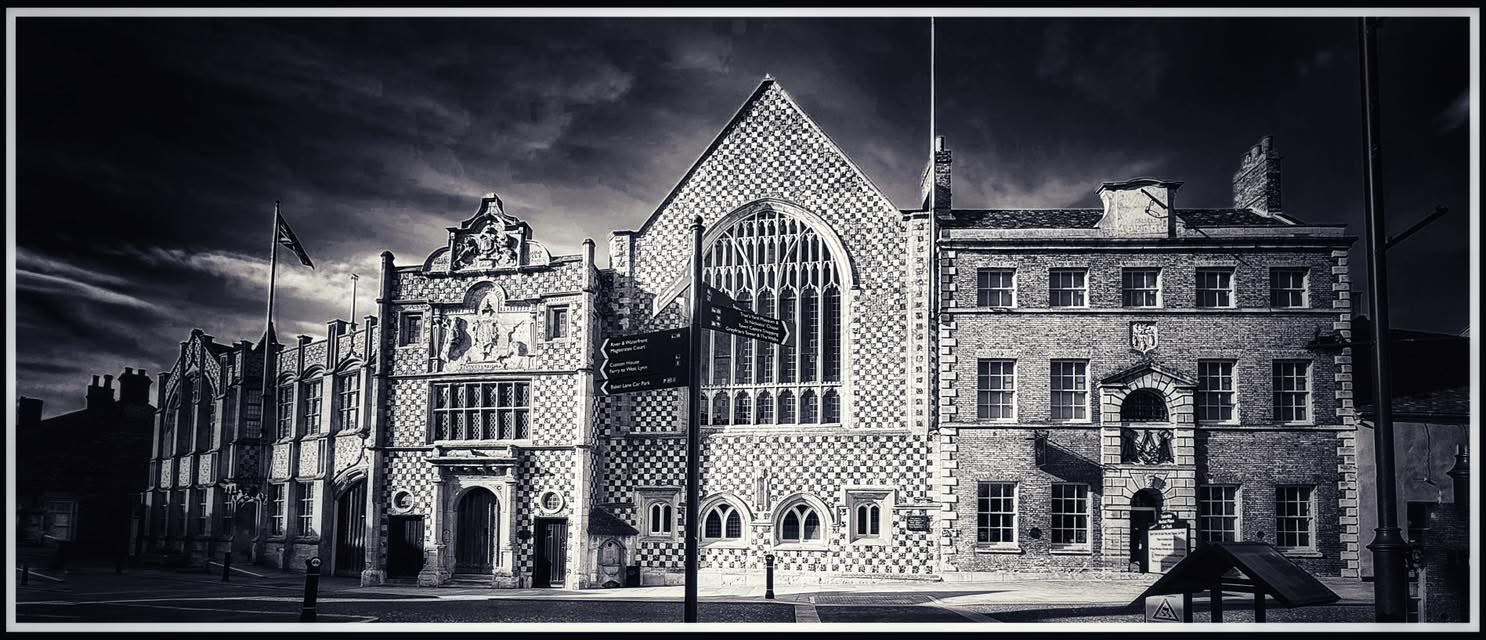
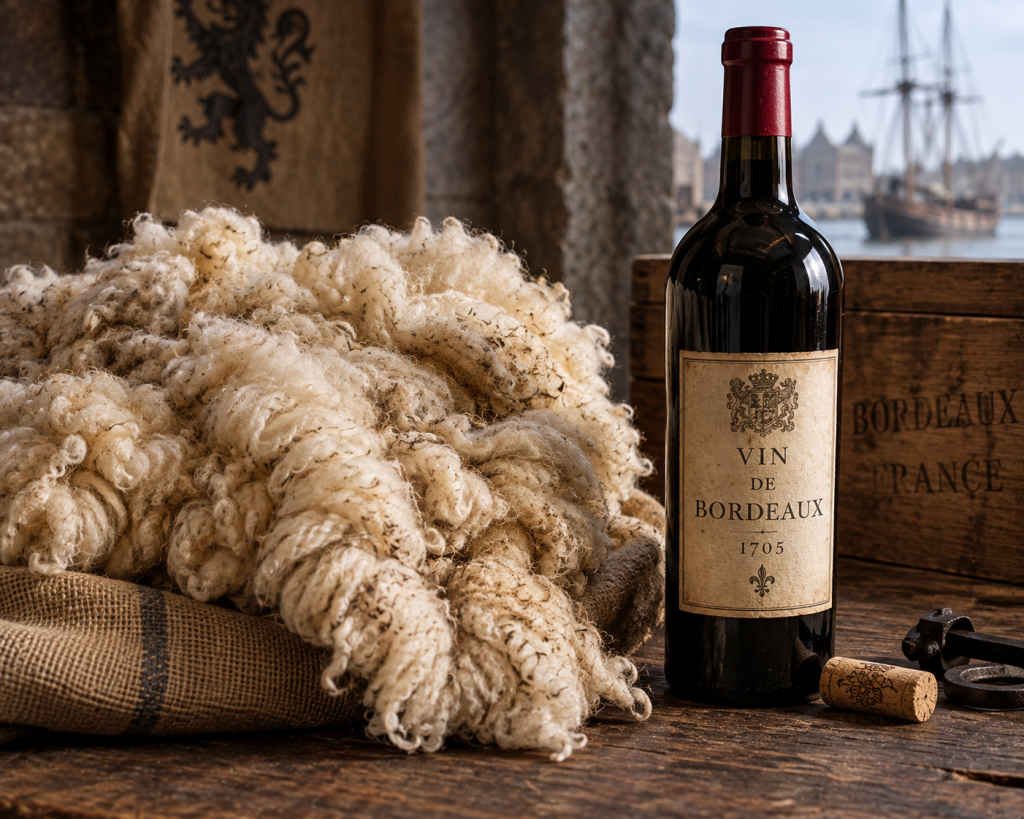
King’s Lynn’s history is written in movement. The town grew where river traffic could meet sea traffic, and where inland produce could be gathered, stored, measured, taxed, and sent out again. That commercial logic shaped its streets, its quays, its warehouses, and later its docks. It also shaped its politics, because the men who controlled trade so often controlled civic power.
Historic England’s overview captures the broad arc: two settlements, one around St Margaret’s and one laid out north of the Purfleet from about 1145 with a market at Tuesday Market Place, were united under a royal charter in 1204; by the thirteenth and fourteenth centuries Lynn was one of England’s busiest ports, exporting wool and cloth and importing wine, timber and luxury goods, and by the fourteenth century it ranked as England’s third port after London and Southampton. That summary is accurate as far as it goes, but it can blur the single commodity that most decisively lifted Lynn into international importance: wool.
A port made for export
Lynn’s advantage was always double. It lay on routes that pulled agricultural and pastoral produce down from fenland and inland Norfolk, and it lay close enough to the sea to link those goods to the North Sea world. Royal fiscal returns already hint at the scale of early thirteenth-century trade. In 1203, when King John levied a tax of one fifteenth on imports and exports, Boston and Lynn together produced more revenue than any ports except London and Southampton, a strong sign that very large quantities of goods were moving through the Wash at an early date.
At this stage Lynn was not trading in a single line. A characteristic mix included imports such as timber, furs, wine and cloth, and exports such as corn, wool, salt and fish. That mixture, shifting in emphasis over time, becomes one of the port’s defining habits. It imported bulky necessities and valuable commodities and exported what its hinterland could produce in quantity or quality.
Wool: the export that fed Flanders
It is hard to overstate how central the wool trade was to medieval Lynn. The town was not a major cloth-manufacturing centre on the scale of Bruges or Ghent. Its strength lay in gathering wool from a rich hinterland, organising its export, and linking local production to the most lucrative manufacturing markets of north-west Europe.
The overseas buyers arrived early. Before 1200, merchants from Bruges, Ghent and other Flemish cloth towns were coming to Lynn specifically for wool. Great ecclesiastical landlords moved huge quantities through the port, including the abbeys of Ely, Ramsey, Crowland and Peterborough, and the scale of this trade encouraged expansion of fenland flocks to meet demand. The mechanism matters. Lynn was a brokerage point where monastic, seigneurial and rural supplies could be assembled, graded, packed, and shipped in exportable units.
The numbers underline that this was not small-scale commerce. In 1267–68, 1,406 sacks of wool worth £3,440 were exported from Lynn; in the early fourteenth century, about 2,000 sacks a year were leaving the port, alongside corn, ale and dyestuffs. These figures help explain why royal government watched the trade so closely. Wool and wine were among the most profitable sources of customs revenue, underpinning taxation, credit, and England’s wider international dealings.
In terms of what physically moved, it was not only raw fleece. Woolfells, fleeces still attached to the skin, formed an established export, and cloth also featured. A typical outward cargo from medieval Lynn might include grain, wool, woolfells, leather, cloth and salt, while incoming cargoes could include timber, stockfish, furs, wax, millstones, wine, spices and other high-value goods. Wool sat at the centre of this system, but it travelled in a world of provisioning, ship-stores, food preservation, and profitable luxuries.
The routes show how widely Lynn’s wool economy reached. One route sent wool to Flanders to feed the cloth industries of Bruges and Ghent; another sent grain to Bordeaux and brought wine back from Gascony; another linked Lynn to Norway and the Baltic for timber, fish and maritime stores. By 1274, Hanseatic merchants were beginning to dominate some of this commerce in their own ships. Because English merchants were not allowed to export bullion, exchange increasingly relied on bills of exchange and other financial devices, encouraging a triangular pattern: wool to Flanders, Flemish cloth onwards into German markets, and Baltic goods returning to Lynn.
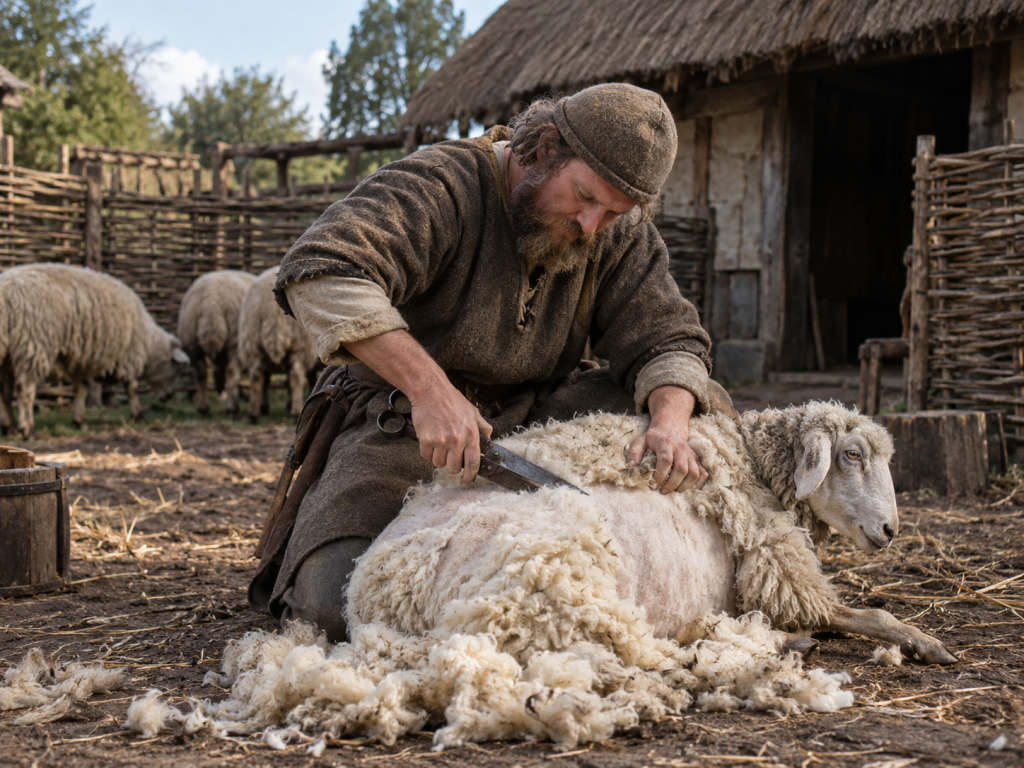
Italian involvement ties Lynn’s wool directly to the politics of war. Agents from Florence and elsewhere operated at Lynn, and in 1339 wool shipped from the port was used as payment in kind to Edward III’s Italian financiers. Under Edward III, Italian merchants active in this sphere were wealthy enough to farm the English customs in return for large loans that helped fund the Hundred Years War . Wool leaving the Purfleet could, in practice, be simultaneously feeding Flemish looms, filling royal coffers, and circulating through Italian credit networks.
This trade was also embodied in specific local careers. John Braunch, active in the early fourteenth century, exported wool in 1308 and 1313, dealt in timber as well, and was fined for obstructing the market with goods, a small incident that still conveys the everyday pressure of commerce in a crowded port town. John Burghard operated at a higher level. He purchased the Lynn franchise in 1305, prospered as a wool merchant, and in 1322 was one of four Lynn men summoned to a council of leading wool merchants. He accumulated property in the town, including rents and two quays on the Purfleet, and in 1332 the king acknowledged a debt of more than £34 to him for wool taken. He also held sheep farms in villages near Lynn, neatly illustrating the link between rural production, urban property, and overseas export. At the very top stood Thomas de Melcheburn, among the great merchant capitalists of fourteenth-century England. He joined the merchant gild in 1318, obtained a royal safe-conduct in 1319 as a king’s merchant, bought or requisitioned wool, grain and ships for the king, and became Mayor of the Staple at Bruges, placing him at the heart of the machinery that raised customs on England’s wool supply.
Nor did wool vanish as abruptly as older narratives of “decline” sometimes suggest. Later fourteenth and early fifteenth-century exports by merchants including Nicholas Martyn, James Nicholasson, Richard de Thorpe, Robert de Walpole and Thomas de Waterden included wool, woolfells, and sometimes cloth and skins, indicating persistence and adaptation within a more mixed pattern of trade. Thomas Thoresby was a “flock master” – a great merchant of Lynn. He served as mayor in 1477, 1482 and 1502, placing him at the centre of borough decision-making at a time when quays, markets, weights and measures, and overseas dealings all depended on firm municipal control.
Cloth in Lynn: present, but not dominant
Lynn certainly had textile activity, but it should not be mistaken for a major cloth-manufacturing centre. By about 1300, cloth trade was significant enough for a royal ulnager, a cloth inspector, to be stationed in the town to inspect and tax material. There are indications of woollen cloth production near the East Gate, and Chapel Street’s earlier name, derived from a Scandinavian word meaning “dyer”, points to dyeing or finishing in that part of town. Even so, Lynn’s comparative advantage lay in export, transhipment and exchange rather than large-scale manufacture.
Street names preserve this commercial memory. St Nicholas Street was known in the sixteenth century as Woolmarket, later Woollen Market and Woolpack Street. There is also a tradition of a Wool Hall near the broad space outside St Nicholas Chapel, though the strongest evidence lies in the naming pattern rather than in a securely identified surviving building.
Hanseatic links and the wider medieval cargo mix
Wool sits at the heart of Lynn’s medieval story, but it was woven into a larger exchange system. Historic England summarises the basic direction: exports of wool and cloth, imports of wine, timber and luxury goods. Hanseatic involvement sharpened and internationalised that pattern. The Hanse’s own account states that German merchants secured trading privileges at Lynn in 1271, confirmed in 1310. It also provides a clear commodity list: herring, timber, wax, iron and pitch were imported into England via Lynn in Hanseatic ships; wool, skins, cloth and lead were taken back to Danzig and other German harbours.
The survival of Hanse House makes this relationship unusually tangible. It is the sole surviving Hanseatic kontor in England and was development shortly after 1475 with warehouse ranges running down to the river; the property remained in Hanseatic hands until 1751. That physical survival matters for a trade history because it reminds us that “international trade” meant warehouses, leases, storage, and daily transactions, not just diplomatic privileges.
Early modern trade: what the port books reveal
The wool export peak belongs to the medieval high period, but Lynn’s overseas trade continued on a substantial scale. For the early seventeenth century, G. Alan Metters’ study based on overseas port books provides unusually quantifiable detail. Metters records 1,941 overseas shipments, inwards and outwards, across the decade 1604–14. He also shows how widely Lynn’s links could range: from Iceland and the Baltic to the Mediterranean in the best harvest years, when ports such as Marseilles, Genoa and Leghorn could appear in the trading picture.
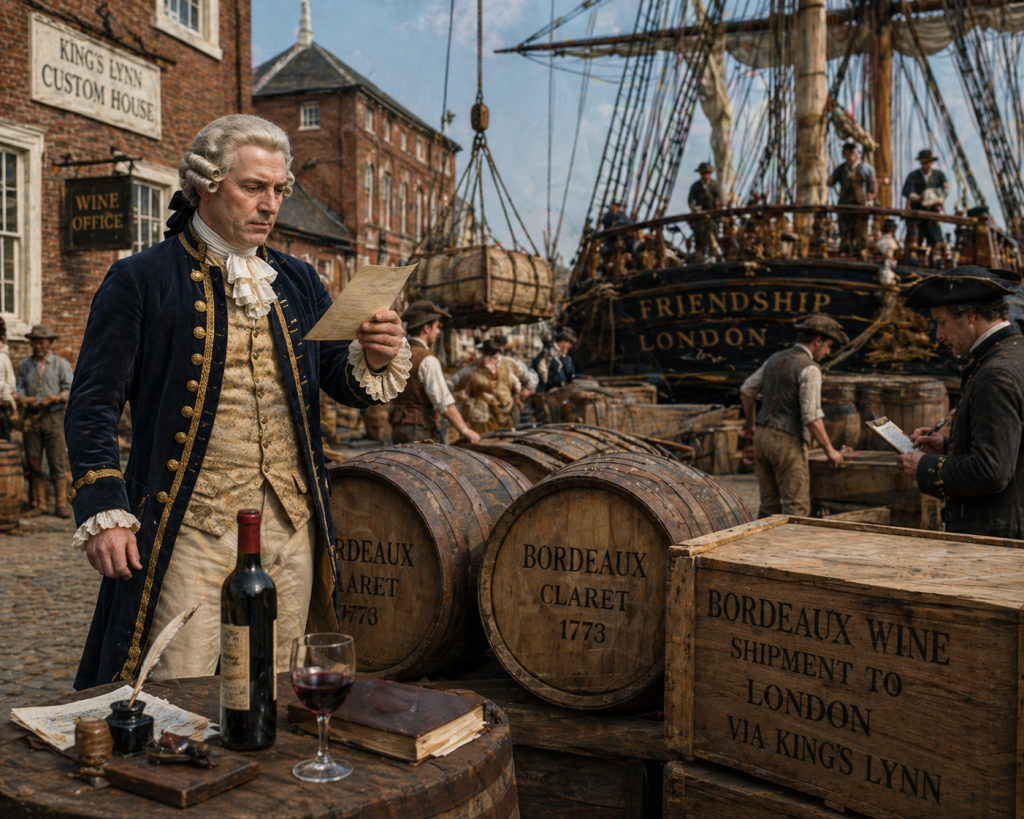
For imports, the port books capture a mixture of everyday essentials and high-value luxuries. Metters notes goods arriving through Dutch markets including bay salt and Spanish salt, rye, figs and raisins, spices, Icelandic fish, and increasingly French and Spanish wine. He also records luxury cargoes such as cloves, aniseed, ginger and pepper, alongside sugar and raisins. The “Iceland Venture” is particularly characterful: a combined fishing and trading expedition in which supplies went north in spring and fish, fish oil, hawks, and Icelandic woollen cloth (wadmal) returned in autumn. Here, wool still appears, transformed from English export staple into a northern imported textile.
Corn out, coal and wine in: the fenland century and the Custom House
From the later sixteenth century, and especially the eighteenth, Lynn’s centre of gravity shifted towards bulk agricultural exports and inland distribution of key imports. Historic England links Lynn’s prosperity directly to fen drainage. As land turned increasingly to agriculture, Lynn grew prosperous from the export of corn, with cereal export dominating from the sixteenth century and especially the eighteenth. Coal and wine continued to be imported for inland distribution, and until the railway age Lynn was the chief East Anglian port for both.
The Custom House on Purfleet Quay is the architectural expression of this regulated commercial world. Historic England states that it was built as a merchants’ exchange in 1683, commissioned by Sir John Turner MP, a wine merchant and three-times mayor, and opened for business in 1685; it became the official Customs House in 1703 and was sold to the Crown in 1717 for £800. Even its ornament speaks the language of cargo. The arcade keystones include masks of Bacchus and Ceres, representing two of Lynn’s main trading goods, wine and grain.
Coal importing was not merely a matter of ships arriving. It required measurement, standardisation, and civic oversight. The Norfolk Record Office notes that in August 1753 a committee was appointed for measuring coal imports after a new coal measure arrived from the Commissioners of the Customs, with new measures ordered and older ones used only until replacements arrived. This is trade in practice: revenue, regulation, and civic administration tied to a constant flow of essential fuel.
Keeping the river working: silting, engineering, and the cost of trade
Trade depended on navigation, and navigation depended on constant effort. Silting and shifting channels were not background irritations but existential threats to a port on the Great Ouse. The Eau Brink Cut shows how engineering could function as commercial policy. A note preserved on the Archives Hub blog explains that Thomas Telford acted as a checking engineer, appointed by the port of King’s Lynn to ensure that John Rennie’s design did not harm the port; the cut opened at the end of July 1821.
This belongs in a trade history because it helps explain why ports modernised their infrastructure in the nineteenth century. The ability to move bulk goods cheaply was always Lynn’s advantage. Losing navigable depth, or losing predictable access, meant losing the very business model that had made the town prosper.
Docks and rail: the nineteenth century rebuild of the port
Railways and dock investment reshaped Lynn’s port activity without changing its underlying purpose. Historic England notes that railway services arrived relatively late, in 1847, and links this to longer-term economic change and the decline of coastal trading [Historic England]. Yet the nineteenth century also saw deliberate investment designed to keep Lynn competitive. The legal hinge is the King’s Lynn Docks and Railway Act of 1865, authorising dock and railway development.
In physical terms, the crucial shift was the creation of larger enclosed docks downstream from the older quays. The Borough Council’s conservation area statement for the Friars explains why: Alexandra Dock, opened in 1869, could take larger deep-draught vessels and reduced dependence on tidal limitations; Bentinck Dock followed in 1883. Contemporary reportage aligns with this. An Illustrated London News image record dates the opening of Alexandra Dock to 17 July 1869.
The commodity logic did not change as much as the infrastructure. Lynn continued to thrive on the movement of agricultural produce and bulk materials, but the handling systems became more industrial. Enclosed docks, specialised storage, and tighter links to rail and road networks made the port better suited to larger volumes and heavier cargoes.
Wool’s long afterlife in a changing port
Although wool exports dwindled as London increasingly dominated foreign trade, wool did not disappear from Lynn’s commercial life. By 1600 Boston was shipping wool to Lynn, much of it purchased by East Anglian cloth manufacturers; in the 1730s Lynn was still taking half the wool shipped from Boston; and in the 1720s large quantities of wool passed through the town in connection with the commerce of Sturbridge Fair.
This continuity matters. It shows that even when Lynn’s headline export shifted towards grain, the town retained its role as a nodal point, a place where inland and coastal routes met, and where merchants could assemble, re-route, and resell.
The working port today: grain, agribulk, steel, and recyclables
Modern King’s Lynn is not a museum port. It remains a working link in regional supply chains. Associated British Ports describes King’s Lynn as handling around 400,000 tonnes of cargo per year, serving the western edge of East Anglia, and functioning as a gateway for agribulk and construction materials. The continuity with the old grain-export town is visible in the Alexandra Grain Silo complex. ABP states that it offers 25,000-tonne capacity storage with drying and screening facilities, alongside grain sampling and testing services, plus bulk stores offering up to 23,000 tonnes capacity for cereals and agribulks.
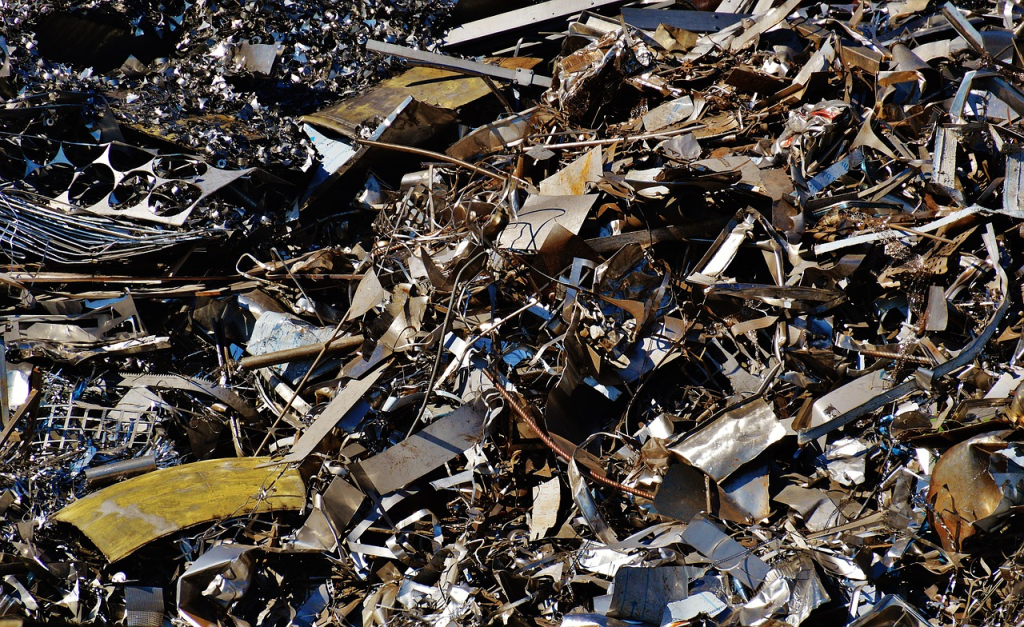
Alongside agricultural traffic sit modern bulk and industrial flows. ABP notes purpose-built steel transit sheds at Alexandra Dock for long-steel products such as coated pipes, coil, slab, sections and rebar, and facilities at Bentinck Dock for storage and distribution of recycled metal. Stated in plain import-and-export terms, modern exports still lean heavily towards agricultural cargoes, particularly cereals and related agribulks, supported by dockside drying, processing and storage, while imports include construction materials and industrial cargoes, with steel products prominent in ABP’s own description and recyclables forming part of the handling profile.
What trade did to the town
Trade did not merely enrich King’s Lynn. It shaped the built environment, the town’s social hierarchy, and the reach of its connections. In the medieval period, wool drew Flemish buyers, pulled monastic and seigneurial suppliers into a single export system, and linked Lynn to Hanseatic shipping and Italian finance. In the early modern period, port books reveal a busy, adaptable trade reaching from Iceland to the Mediterranean, with imports ranging from salt and wine to spices and sugar. In the eighteenth century, corn exports and coal and wine imports drove a regulated, customs-heavy economy, carved into the very stonework of the Custom House. In the nineteenth and twentieth, docks, rail, and bulk handling rebuilt the port for new kinds of vessels and cargo, without changing Lynn’s essential purpose: to connect inland production and inland demand to the sea.
At a glance
| Commodity | Mainly export or import? | When most prominent | Typical routes / trading links (examples) |
| Wool (including woolfells) | Export | Before 1200 to early 1400s (high medieval peak), then a long afterlife as a traded commodity | Strong links with Flanders (cloth towns such as Bruges and Ghent) and wider North Sea markets |
| Cloth | Export (with some local handling/finishing) | 1200s–1500s (continuing later as part of mixed outward cargoes) | North Sea trading world, moving alongside wool and other staples |
| Corn / cereals (grain) | Export | 1500s onwards, especially 1700s; still central today | Fenland and inland Norfolk produce funnelled downriver for shipment out |
| Coal | Import | 1600s–1800s (especially strong in the fenland distribution era) | Brought in by sea and redistributed inland by river, road and later rail |
| Wine | Import | Medieval onward; particularly visible in early modern and eighteenth-century commerce | Continental supply routes, often via the Netherlands or direct European connections |
| Timber (and later “forest products”) | Import | Medieval to modern (recurring whenever building and ship-repair demand is high) | North Sea and Baltic-oriented supply, later broadened through wider European channels |
| Fish (herring, stockfish, Iceland fish) | Import (with some regional export of fish and provisions) | Medieval and early 1600s (clearly prominent), with continuing presence | North Sea fisheries and seasonal northern ventures |
| Modern bulk cargo (steel, aggregates, agribulks, recycled metal) | Mainly import and throughput, alongside export-enabling grain handling | Late 1900s to present | Regional construction and industry supply chains; dockside bulk handling and storage |
© James Rye 2026
Book a Guided Tour with a Trained and Qualified King’s Lynn Guide Through Historic Lynn
References
- Archives Hub (Jisc). “Silt, sluices and smelt fishing: The Eau Brink Cut and the Bedford Level Corporation Archive.” Archives Hub Blog, 2 July 2018. Accessed 26 April 2026. https://blog.archiveshub.jisc.ac.uk/2018/07/02/silt-sluices-and-smelt-fishing-the-eau-brink-cut-and-the-bedford-level-corporation-archive/
- Associated British Ports. “King’s Lynn.” Accessed 26 April 2026. https://www.abports.co.uk/locations/kings-lynn/
- Borough Council of King’s Lynn and West Norfolk. List of Mayors of King’s Lynn (1248–2023) (PDF). Accessed 26 April 2026. https://www.west-norfolk.gov.uk/download/downloads/id/5646/list_of_mayors_of_kings_lynn_1248-2023.pdf
- Borough Council of King’s Lynn and West Norfolk. Norfolk Street Conservation Area Character Statement(PDF). Accessed 26 April 2026. https://www.west-norfolk.gov.uk/download/downloads/id/1922/kings_lynn_norfolk_street_con_area_leafletpdf.pdf
- Historic England. “Customs House including north bank of Purfleet Quay, Purfleet Quay, King’s Lynn, Norfolk, PE30 1HP (List Entry Number: 1195414).” National Heritage List for England. Accessed 26 April 2026. https://historicengland.org.uk/listing/the-list/list-entry/1195414
- Historic England. “Thoresby College, 31–33 Queen Street, King’s Lynn (List Entry Number: 1195418).” National Heritage List for England. Accessed 26 April 2026. https://historicengland.org.uk/listing/the-list/list-entry/1195418
- Metters, G. Alan. “King’s Lynn and the Low Countries in the Early Seventeenth Century: Maritime Trade and Sexual Scandal.” History 110, no. 390 (2025): 173–193. Open-access PDF. Accessed 26 April 2026. https://ueaeprints.uea.ac.uk/98558/1/Metters_2025_History.pdf
- Norfolk Record Office. Draper, Victoria. “Carrying Coals to King’s Lynn.” Norfolk Record Office Blog, 2 August 2019. Accessed 26 April 2026. https://norfolkrecordofficeblog.org/2019/08/02/carrying-coals-to-kings-lynn/
- Rye, James. “How Wool Made Medieval King’s Lynn Rich.” Circato.co.uk. Accessed 26 April 2026. https://circato.co.uk/kings-lynn-wool-trade
- THE HANSA (Union of Cities). “King’s Lynn.” Accessed 26 April 2026. https://www.hanse.org/en/hanse/kings-lynn
- Visit West Norfolk. Hanse Trail Leaflet (PDF). Accessed 26 April 2026. https://www.visitwestnorfolk.com/wp-content/uploads/2022/03/1390-46_Hanse_trail_leaflet_web.pdf