
Photo © James Rye 2022
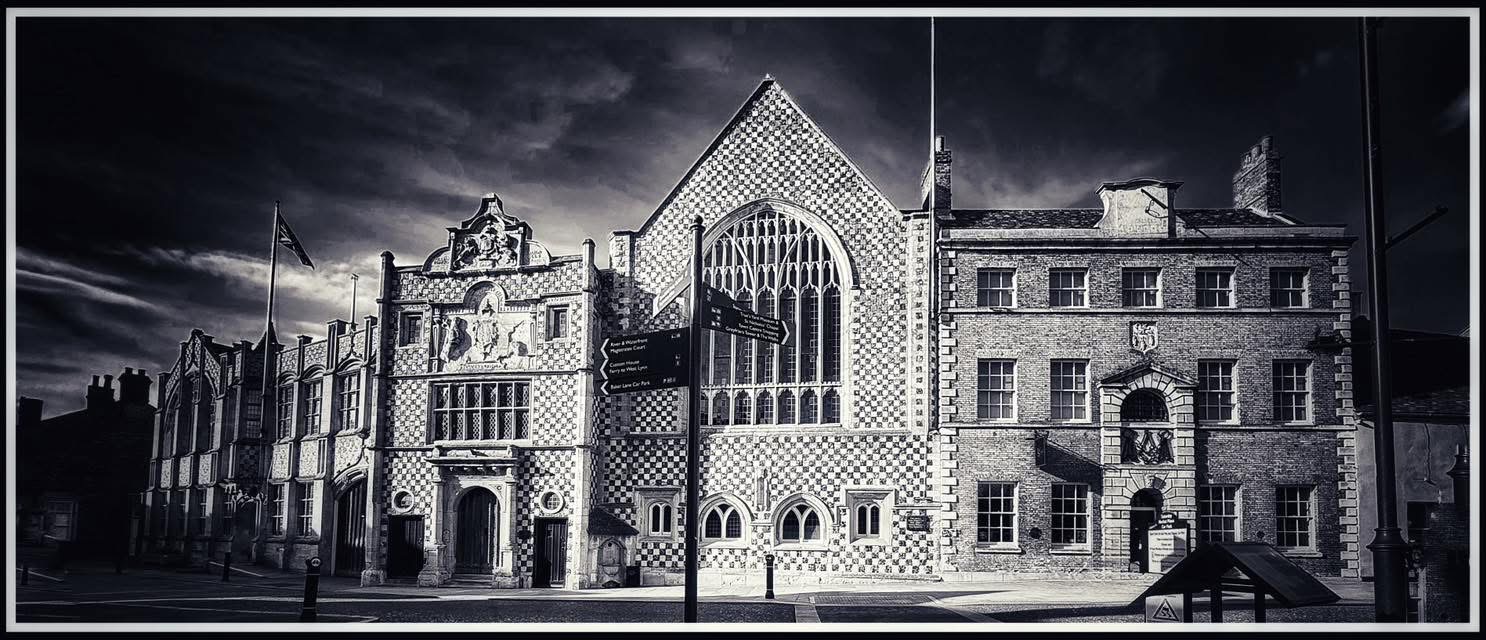
Under the Corn Exchange in King’s Lynn, archaeologists found a hole where someone had cast a bell. It was the right size for the bell that James Edberry made in 1611 for St Nicholas’s Chapel, a few minutes’ walk away. We cannot give Edberry the credit on measurements alone, but the ground beneath the casting pit tells a more certain story. There were layers of river sand mixed with refuse thrown out along the bank. Stand outside the Corn Exchange today and look across at the Duke’s Head. The view takes in what was once the waterfront of a medieval market.
It explains a good deal about Tuesday Market Place, beginning with its size. Why should Lynn have needed a second market when it already had one beside St Margaret’s? And why should the new one have been so much larger? To someone arriving by road today, it looks like a generous allowance of open ground in a town otherwise rather sparing with the stuff. To someone coming ashore in the twelfth century, its advantage would have been obvious. A cargo could be landed within yards of the people who had come to buy it.
Why Lynn has two market places
The older market belonged to the settlement around St Margaret’s, now King’s Lynn Minster. Early in the twelfth century, Herbert de Losinga, Bishop of Norwich, granted the monks of Norwich the Saturday market in his new parish on Gaywood marsh. The monks gained something more profitable than a convenient place to buy their dinner. A market yielded income from the people who traded there. Rights in that income could be granted away, divided, and inherited. Indeed, a widow’s claim to a share of the Tuesday market would still be worth recording in a royal document nearly three centuries later.
Within a couple of generations, Lynn had spread north of the Purfleet. Bishop William Turbe encouraged settlement in a district known simply as the Newland. A grant dated between 1146 and 1150 refers to land he had recently provided for settlers. Here the inhabitants acquired a spacious market and a chapel dedicated to St Nicholas. The chapel remained within St Margaret’s parish, but a family living in the Newland could now worship close to home. The walk from Saturday Market Place up through the town and across the Purfleet still follows the course of that expansion. You leave one bishop’s development and enter another’s.
When was the first Tuesday market? The historian Dorothy Owen thought a royal confirmation of Lynn’s market and port, issued between 1129 and 1133, might refer to an early market in the northern district. Maurice Beresford placed its establishment a little later, during Turbe’s time as bishop, between 1146 and 1174. We have firmer ground underfoot by 1222–23, when a market held on Tuesday is expressly recorded. King John’s borough charter of 1204 is a landmark in Lynn’s history, but it supplies no birthday for the square. Nor can Henry VIII’s market charter of 1529 have started a Tuesday trade already recorded more than three hundred years before.
The growth of the Newland can be traced in an unexpectedly domestic detail. Excavations south of Surrey Street, near the square’s south-eastern corner, found evidence of settlement beginning in the thirteenth century. Some property boundaries established then survived until redevelopment in the 1960s. Roofs had been renewed and whole houses replaced, yet for some seven hundred years successive neighbours had continued to agree where one person’s ground ended and the next one began.
Coming ashore for market day
In the early Newland the river reached the western and northern edges of the market. Wharves stood against it, and King Street followed the line of the bank. Over time the waterfront moved westwards. Townspeople helped it on its way by tipping material along the shore and making new ground. Plots on the western side of King Street lengthened in stages. A merchant could keep his entrance on the street while putting up a warehouse at the new water’s edge. The buildings now separating Tuesday Market Place from the river occupy ground won a piece at a time.
Walk towards the Common Staithe and something of the working arrangement survives. A staithe is a quay. Historic England’s survey identified a U-shaped layout here, with its open end facing the river. Warehouses occupied the two arms. At the closed end, towards the market, were an inn and a customs house. Part of the sixteenth-century quay wall survives near the Crown and Mitre. A merchant coming ashore could pay the dues on his cargo, arrange for it to be stored, find a bed, and learn what prices were being asked in the market, all within this little corner of Lynn.
Once in the square, a customer had a reasonable idea where to go. Rails marked out trading areas. Alongside visiting dealers were shops and stalls substantial enough to be let to retailers. Towards the northern end stood the butchers’ shambles, where meat was cut and sold. The north side was known as Iron Row. If the household needed a cooking pot, a better knife, or something to shift the coals in the hearth, that was the side to try. Tuesday supplied the name and the principal market day, although trading went on during the rest of the working week.
Among the beneficiaries was May, widow of John de Roos of Helmsley. On 9 May 1394 she received a share of the Tuesday market as part of her dower, the provision made for her out of her late husband’s property. We know nothing from that entry about whether May ever set foot in Lynn. What she possessed was an entitlement to some of the market income. For once the records allow us to see past the stallholder and the customer to a woman whose livelihood depended, in part, on their continuing to meet here on Tuesdays.
How February got the Mart
A visitor who returns to Lynn each February for the Mart might reasonably suppose that King John had something to do with the choice of Valentine’s Day. John did grant Lynn a fair, but the date he authorised on 10 July 1203 was in May. It was associated with the feast of the Translation of St Nicholas, which commemorated the removal of the saint’s relics. The Bishop of Norwich and the Earl of Arundel were to share the customs. The dedication makes the fair particularly interesting in a town with a chapel of St Nicholas beside its northern market, although the grant gives no plan of where the booths stood.
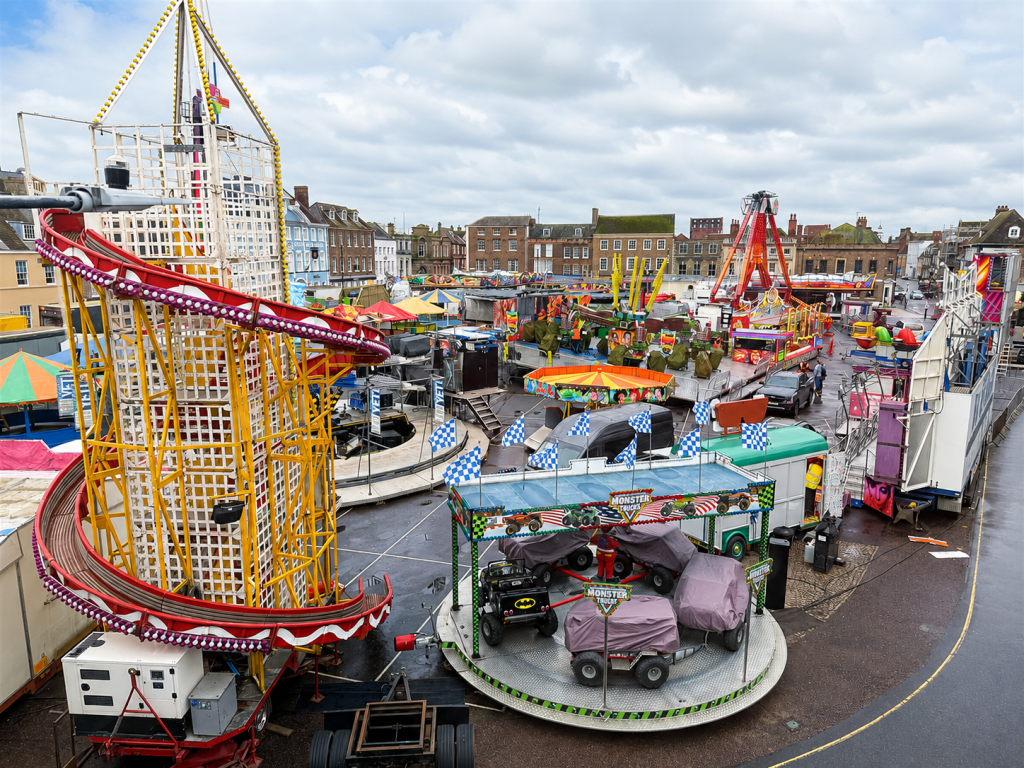
Lynn also had a summer fair associated with St Margaret. In 1283 Edward I authorised its transfer from July to early August. It would be easy to write that down as the date on which the fair moved. A later document reveals the snag. In 1316 the authorities acknowledged that the grant had gone unused. A king could give permission for a fair more readily than he could persuade anybody to attend. In 1478 Edward IV authorised Bishop James Goldwell to hold substantial fairs beginning in January and June. Lynn evidently had room in its commercial calendar for several such occasions, although a charter is better evidence of what was permitted than of what a shopper actually found on arrival.
The February Mart has Tudor roots. Lynn tradition associates it with Henry VIII and the year 1537, while a local chronology records its restoration in 1559. An early nineteenth-century account by William Hone explains how Valentine’s Day came into the picture. According to Hone, the Tudor grant appointed the day after Candlemas, the feast of the Purification of the Virgin. Candlemas was 2 February, putting the opening on the third. After the calendar changed, the old fair day fell on 14 February by the new reckoning. By Hone’s time an event originally authorised for about a week generally lasted a fortnight. Whatever the finer points of the Tudor grants, it is to Candlemas that we owe the curious sight of a Norfolk fairground opening in the season of valentines.
Centuries later the Mart offered Lynn people the chance to try out the work of one of their own engineers. Frederick Savage had made agricultural machinery before turning his attention to fairground rides. His velocipedes and Dobby Horses proved popular here and won customers farther afield. On his platform gallopers, machinery beneath the riders set the horses rocking. Lynn Museum credits another Norfolk man, Sidney George Soame of Marsham, with an earlier steam roundabout. Savage’s achievement lay in developing machines that showmen wanted to buy and their customers would pay to ride. Few manufacturers could have asked for a more public trial of their workmanship than a February afternoon in Tuesday Market Place.
The heart above the window
A little lane leading into the market preserves a less comfortable memory. Market Lane, which runs from Chapel Street, was once Pillory Lane. Public exposure was part of the sentence, and market day could be relied upon to supply an audience. The lane name tends to receive less attention than a small piece of brickwork on the north side of the square. Look above a first-floor window and you can make out a heart cut within a diamond.
Lynn’s story is that Margaret Read was burned for witchcraft in the market place in 1590. At the point of death, her heart flew from her body and struck the wall. One version sends it bouncing onwards to the river. The carving is there for anyone to see. The evidence for what happened to Margaret is considerably harder to find. A list of local executions published in the Lynn Advertiser on 26 August 1876 included the claim that she had been burned. That takes the claim back to Victorian Lynn, nearly three centuries after the supposed event. No contemporary trial record establishing her sentence and execution has been identified in the research for this account. The distinction matters because locally documented cases could easily supply material for a later storyteller. The people convicted of witchcraft in Lynn and named by the eighteenth-century town historian Benjamin Mackerell were hanged. Burning was associated with other offences, including the killing of a husband or master by a woman. The carving has earned its place on a town walk. So has the phrase with which its story is best introduced: “People in Lynn used to say…”
Eleven chambers and room for twenty-five horses
Across the square, the Duke’s Head offers an unusually good answer to a question seldom asked of a handsome old hotel. What did its first customers do with their horses? An inventory taken in 1773 records eleven chambers for human guests and stabling for twenty-five animals. Inside were a great dining room, a great parlour, a bar, and a kitchen. One room had furniture specifically intended for cockfighting. Guests reached their chambers by timber galleries overlooking a courtyard. Three round columns from one gallery still survive, embedded in the later partitions of the first floor.
The man behind the enterprise was Sir John Turner, a Lynn wine merchant, MP, and three times mayor. Between 1683 and 1689 he built the coaching inn to accommodate visitors to his other investment, the Merchants’ Exchange beside the Purfleet. We know the latter building as the Custom House. Henry Bell designed the exchange and may have designed the hotel, although the attribution is less certain there. Consider the two businesses together and Turner’s intentions become clear enough. He could provide the visiting merchant with somewhere to conduct his business and somewhere to stay when it was done. The Globe was already trading across the square, its name recorded locally by 1650. Turner evidently thought there was room for another inn.

Photo © James Rye 1991
The Duke’s Head became a political meeting place. Whig candidates used it as their headquarters, among them Sir Robert Walpole of Houghton. Masonic lodges met here from the later eighteenth century. The future Edward VII, by then living at Sandringham, joined a lodge in 1870. By that time it had also been possible for some sixty years to do one’s banking on the premises. Benjamin and Mary Massey’s bank took over the southern part of the inn in 1808, prompting alterations to the frontage. An oil painting of the square made about 1805 shows how it looked shortly before the work, with the red brick exposed. An independently owned bank continued to operate in the hotel building until at least 1930.
It is tempting to cast a glance round Tuesday Market Place and call it Georgian. Go round by house number and its age becomes much harder to guess. At number 18 a late fourteenth-century brick-vaulted cellar survives beneath part of a building with fine eighteenth-century rooms. Numbers 11 and 12 have sixteenth-century origins, although they were substantially rebuilt around 1830. On the corner with Surrey Street, the former Lloyds Bank presents a Portland stone front which looks thoroughly at home among its older neighbours. It was built in 1928 by Henry Munro Cautley, an Ipswich architect with a scholarly interest in medieval churches. To find one of the youngest buildings on the square, look for one of the most respectable.
The building that blocked the view
One building an eighteenth-century visitor would have known immediately is now missing altogether. Towards the northern end of the market stood Henry Bell’s market cross. The word cross hardly does it justice. Sixteen columns carried a domed, octagonal upper chamber. Butchers’ shambles and shops clustered round it. An eighteenth-century drawing in the antiquary Thomas Martin’s collection shows the cross and the shambles together. A shopper making for Iron Row would have picked a way past buildings in what we now experience as open space.
Bell’s cross replaced an earlier one and was built between 1707 and 1710, towards the end of the architect’s life. This was the Henry Bell who served as mayor in 1692 and 1703 and died in 1711. The cross lasted about 120 years. The town’s archaeological report attributes its loss to subsidence and dates demolition to 1829. Historic England and the borough’s market history give 1831. About 1830 is as close as the published accounts agree. It is easier to establish where the butchers and traders went next, and it explains a change in the shape of the square.
In 1830 the landlord of the Angel Inn on the western side of the market died. The inn came down, and a new Market House rose on its site. The business of the old cross had moved from out in the square to its edge. When the Corn Exchange succeeded the Market House, it inherited the Angel’s address. A small part of the Market House remained at the rear and served as a fire-engine house, surviving until the redevelopment of the 1990s. So, if you stand on the Corn Exchange steps and try to picture Bell’s lost building, you need to look out across the market. The inn is the building that once stood beneath your feet.
Corn upstairs? The farmers had other ideas
The new Market House had barely reached its twentieth birthday before the farmers and merchants of west Norfolk were asking for a building better suited to the grain trade. Corn, in this usage, meant cereal grain. Drainage and agricultural development in the Fens had helped make grain one of Lynn’s principal outward cargoes. In 1851 Mayor Walter Moyse called a meeting to discuss a corn exchange. Attendance was good, and those present readily agreed that one was needed. Agreement ended when somebody suggested appropriating part of the Market House. The proposal encountered vigorous opposition, and another two years passed before the project went ahead.
The local architectural firm of Cruso and Maberley designed the exchange. P. Edmunds’s tender was accepted on 30 January 1854, the stalls were allocated by ballot, and the doors opened on 9 January 1855. Historic England gives the cost as £2,986. Both dates commonly quoted for the building therefore have their place. It was built in 1854 and opened for business the following January. Above the ornamental stone front stood Ceres, the Roman goddess of grain. Behind her was a relatively plain hall in which farmers and merchants could get on with the business that had brought them there.
Outside, a Victorian visitor saw a rather different market from the one suggested by that imposing entrance. John Marius Wilson’s Imperial Gazetteer, published around 1870–72, estimated the square at three acres and described meat, poultry, and fish on sale. He also noticed a handsome pillar that combined a gas lamp with a public fountain. It is a surprisingly elusive object in later accounts of Lynn. For somebody crossing the market after dark or looking for drinking water, it must have been one of the most useful things in the square. A view made by William Austin in 1865, looking out from its northern side, provides a closely dated record of the market Wilson’s readers would have known.
As for the grain merchants, they soon had company. By 1877, when the roof was reconstructed with some 9,000 square feet of patent glazing, the Corn Exchange was already accommodating concerts, exhibitions, and sport. By 1909 people were roller-skating there. The extensive rebuilding of 1995–96 provided the modern stage and backstage accommodation. Anyone who remembers the reopening might reasonably think of it as the year the Corn Exchange became a place to go for an evening out. Lynn people had been doing precisely that for well over a century.
Back on a Tuesday
During the Second World War, the square acquired two more structures, this time below ground. The public air-raid shelters are thought to date from 1940–41. Made of steel-reinforced concrete, they lie about eight to ten feet beneath the surface and had an estimated combined capacity of 350 to 400 people. Long after their entrances had ceased to be familiar, the shelters remained in place. Survey work ahead of improvements to the market renewed interest in them, and in September 2014 people queued to go down into one for the first time in decades. For wartime families, the welcome moment must have been coming back up.
There are days when the square is given over to Festival Too or filled with classic cars. Each February the Mart takes possession again, and it can be surprisingly difficult to remember where everything usually stands. To see the square doing the job for which the Newland needed it, choose an ordinary Tuesday. There is still a weekly market here. Someone who traded on this spot in 1222 would have found the stone front of the Corn Exchange unfamiliar and might well have wondered where the river had gone. At least they would have come on the right day.
© James Rye 2026
Book a Guided Tour with a Trained and Qualified King’s Lynn Guide Through Historic Lynn
References
- Borough Council of King’s Lynn and West Norfolk. “History of Markets.” Particularly useful on the shambles, market cross, and Market House. Council market history.
- Borough Council of King’s Lynn and West Norfolk. King’s Lynn Urban Archaeological Database Project Report. March 2022. Read the archaeological report.
- Borough Council of King’s Lynn and West Norfolk. St Nicholas Conservation Area: Character Statement. Read the conservation-area appraisal.
- Historic England. The Common Staithe, King’s Lynn, Norfolk: An Architectural and Archaeological Assessment. 2018. Research report.
- Historic England. “Corn Exchange, King’s Lynn.” National Heritage List for England, entry 1212488. Building history and excavation findings.
- Historic England. “Duke’s Head Hotel.” National Heritage List for England, entry 1212229. Includes details from the 1773 inventory. Building history.
- Historic England. “Former Lloyd’s Bank, 1 Tuesday Market Place.” National Heritage List for England, entry 1450427. Building history.
- Hone, William. The Every-Day Book. Entry for 14 February, “Old Candlemas Day.” Digitised volume.
- Institute of Historical Research. Gazetteer of Markets and Fairs in England and Wales to 1516. Norfolk, entry for Lynn. Includes the early market evidence, the fair grants, and the reference to May de Roos’s dower in the Calendar of Close Rolls, 1392–96, page 212. Norfolk gazetteer.
- King’s Lynn Civic Society. Every Street Name Tells a Story and “The Witch’s Heart House.” Street names and the Witch’s Heart.
- Lynn Museum. Frederick Savage, Victorian Fairground Manufacturer. Museum account.
- Owen, Dorothy M., ed. The Making of King’s Lynn: A Documentary Survey. London, 1984. See particularly pages 6–11 and 35. Document references in the medieval markets gazetteer.
- Visit West Norfolk. “King’s Lynn Air Raid Shelter.” Shelter history and description.
- Wilson, John Marius. Imperial Gazetteer of England and Wales. 1870–72. Entry for Lynn. Contemporary description of the market and fountain.