During the Second World War blackout, an ambulance driver and an air-raid warden managed to drive an ambulance off Purfleet Quay and into the water. Fortunately, both escaped unharmed. The incident says something interesting about how much Lynn had changed. For centuries its inhabitants had negotiated narrow streets, alleys, bridges, fleets, yards, and quays with very little artificial light. By 1939 they had become so accustomed to an illuminated town that suddenly removing the lights made familiar places dangerous.
When darkness was normal
Before the nineteenth century, darkness was simply part of urban life. Candles and oil lamps illuminated houses, inns, shops, and workshops, while anyone venturing outside might carry a lantern. Light escaped through windows and doorways, but much of Lynn disappeared after sunset. This was a town crossed by fleets and drains, with narrow lanes, uneven surfaces, bridges, quays, and passages leading into crowded courts and yards. A moonless winter night could make even a familiar journey difficult.
Attitudes began to change at the end of the eighteenth century. In 1790 Lynn’s mayor promoted a scheme for the “paving, cleansing, lighting, watching and improvement” of the town. After considerable opposition, Parliament finally passed the King’s Lynn Paving Act in 1803. The wording is revealing. Lighting had become part of a wider attempt to make the town cleaner, safer, and more orderly. Early proposals envisaged hundreds of lamps, necessarily burning oil because Lynn had no gas supply. They would seem remarkably dim to modern eyes, each creating a small pool of light surrounded by darkness, but collectively they represented something new. Lynn was beginning to provide its inhabitants with a publicly organised night-time landscape.
Gas transforms the town
The decisive change came in 1825, when John Malam established a gasworks on Wisbech Road immediately outside the South Gate. Malam was an experienced gas engineer who had worked with London’s pioneering Gas Light and Coke Company and had been involved in improvements to gas purification and metering. At Lynn, coal was heated in retorts and the resulting gas purified, stored in a gas holder, and carried through pipes beneath the streets. The contrast at the southern entrance to the town must have been remarkable. Travellers passed through a fifteenth-century gateway while beside it stood an industrial plant manufacturing one of the newest products of the Industrial Revolution.
Gas gradually changed the experience of Lynn after sunset. It illuminated streets, but it could also be piped into shops, inns, meeting rooms, workshops, public buildings, and prosperous homes. High Street no longer necessarily disappeared when daylight faded. Shopkeepers could illuminate their windows and continue displaying goods into the evening. By 1889, when 107 High Street was advertised to let, its fittings were offered with the “gas complete”. Artificial light had become part of an ordinary commercial property.
The transition was not as smooth as the word “progress” suggests. When legislation was promoted to incorporate the King’s Lynn Gas Company in 1870, some consumers complained that the existing gas was poor, irregular, insufficiently bright, and expensive. Gas also brought naked flames into buildings packed with combustible material. Jermyn’s department store suffered a disastrous fire in 1884 while gas lighting associated with its Christmas displays was being lit. In December 1897 the store burned again after a boy lit a taper from a gas jet and carried the flame elsewhere in the building. The technology that allowed Victorian retailers to fill their shops with light could also burn them down.
Electricity arrives
By the time of the second Jermyn fire, gas had acquired a competitor. In 1896 the Corporation obtained authority to supply electricity within the borough and built a generating station at Kettlewell Lane. Electricity supply began on 19 August 1899. This did not mean that Lynn suddenly switched from gas to electricity. Gas was already deeply embedded in the town and continued to improve, particularly through the incandescent mantle, which produced a much brighter light than the old naked gas flame. The Gas Company even opened a showroom at 65 High Street in 1904, encouraging customers to adopt modern gas equipment.
For a time Edwardian Lynn therefore lived with two competing systems. Electric light still possessed an element of novelty. In 1902 Reddie & Sons of High Street advertised “Anglo American Animated Electric Dissolving Pictures” at St James’ Hall and could provide temporary electric lighting using a portable engine and dynamo. Elsewhere there were gas lamps, illuminated shop windows, electric lights appearing in buildings, and dark courts and passages only a short distance away. The transformation of Lynn at night happened street by street and building by building rather than with the flick of a single switch.
Kettlewell Lane expanded as demand increased. Electricity supplied from the station rose from about 524 megawatt hours in 1909 to 882 in 1921 and more than 8,000 by the late 1940s. By then electricity was doing much more than producing light. It powered machinery, commercial equipment, and an increasing range of domestic appliances. In 1930 Lynn’s electricity undertaking was authorised to extend into parts of the surrounding rural districts. A system established to serve the borough was spreading into the countryside.
Lynn goes dark again
Then, in 1939, more than a century of effort to illuminate Lynn was suddenly reversed. The blackout required streetlights to be extinguished or obscured, householders to prevent light escaping from their windows, and vehicles to operate with restricted lamps. Lynn’s docks, railway, industries, and position close to the east coast made enemy air attack a genuine threat, but the resulting darkness was profoundly unfamiliar to people who had grown up expecting streets to be lit.
That is what makes the ambulance disappearing over Purfleet Quay such a telling little incident. The physical town had not suddenly become more dangerous. What had changed was its inhabitants’ relationship with darkness. The eighteenth-century Lynn resident expected the night to be dark and behaved accordingly. The twentieth-century resident had come to depend upon artificial light.
After the war, Lynn gradually stopped making its own light. Gas and electricity were nationalised, electricity generation at Kettlewell Lane ceased around 1959–60, and the Wisbech Road gasworks closed soon afterwards. Most of the gasworks was demolished in 1964, although its great gas holders survived until 1988. For well over a century coal had entered Lynn and energy had emerged through pipes and wires to illuminate the town. Now the generating sites disappeared while the lights remained.
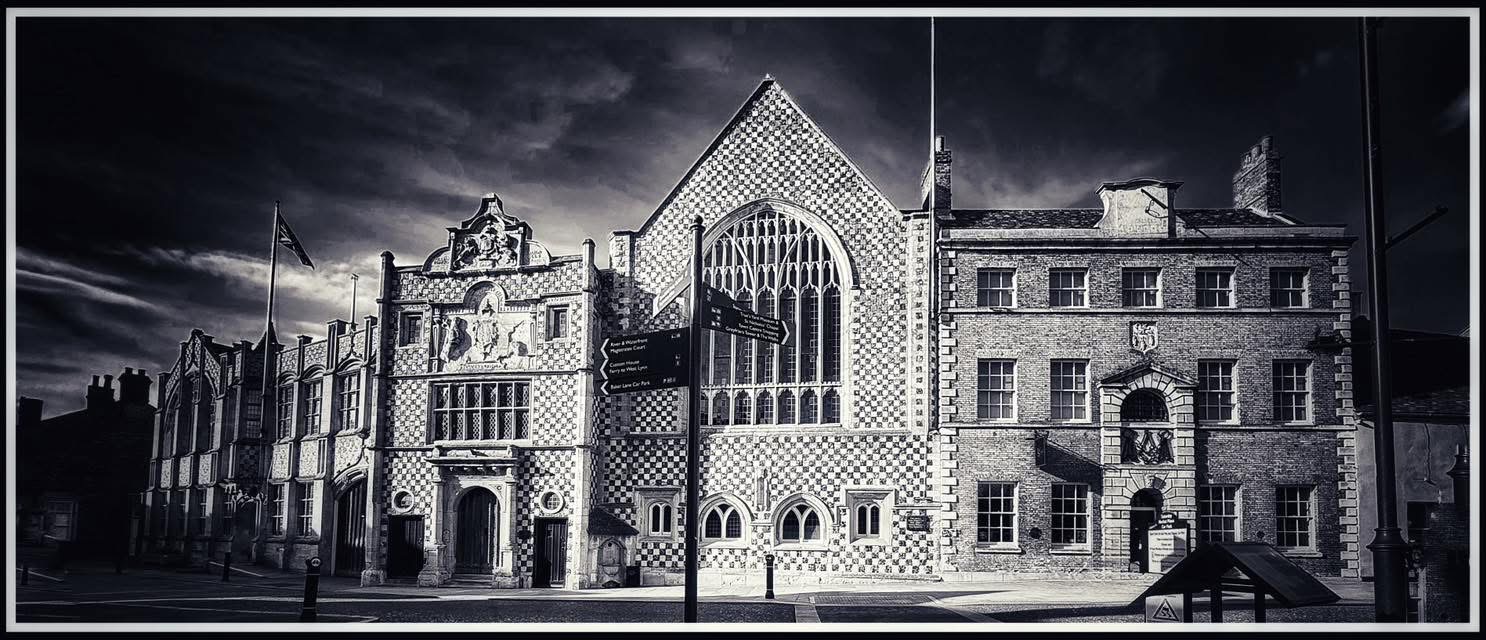
The appearance of Lynn at night continued to change. Later generations became accustomed to the yellow-orange glow of sodium streetlights, which washed brick, stone, pavement, and sky in much the same colour. Those lamps are now giving way to LEDs, producing a whiter and more directional light. Stand in Tuesday Market Place on a winter evening today and it is difficult to imagine the same space two centuries ago, when there were candles behind windows, lanterns carried through the streets, light spilling from inns, and darkness between them. Oil lamps began to break up that darkness after 1803. Gas transformed it after 1825, and electricity began another transformation in 1899. By 1939 Lynn had become so thoroughly accustomed to artificial illumination that taking it away had become hazardous.
For centuries Lynn’s inhabitants had learned how to live in the dark. During the nineteenth century, they gradually learned that they no longer had to.
© James Rye 2026
Book a Walk with a Trained and Qualified King’s Lynn Guide
References
Historic England. The Manufactured Gas Industry: Volume 1. Swindon: Historic England.
https://historicengland.org.uk/research/results/reports/8009/TheManufacturedGasIndustryVolume1
Historic England. “Southgates, King’s Lynn.”
https://historicengland.org.uk/whats-new/in-your-area/east-of-england/kings-lynn-research/southgates/
King’s Lynn History. “Jermyn’s Fire of 1897.”
https://kingslynn-history.uk/jermyns-fire-of-1897/
King’s Lynn History. “No. 65 High Street.”
https://kingslynn-history.uk/shops/no-65/
King’s Lynn History. “No. 107 High Street.”
https://kingslynn-history.uk/shops/no-107/
Norfolk Record Office. King’s Lynn Borough Archives. Catalogue description via The National Archives.
https://discovery.nationalarchives.gov.uk/details/c/F95971
True’s Yard Fisherfolk Museum. King’s Lynn in the Second World War.
https://www.storiesoflynn.co.uk/wp-content/uploads/2020/05/Trues-Yard-Kings-Lynn-in-WW2.pdf