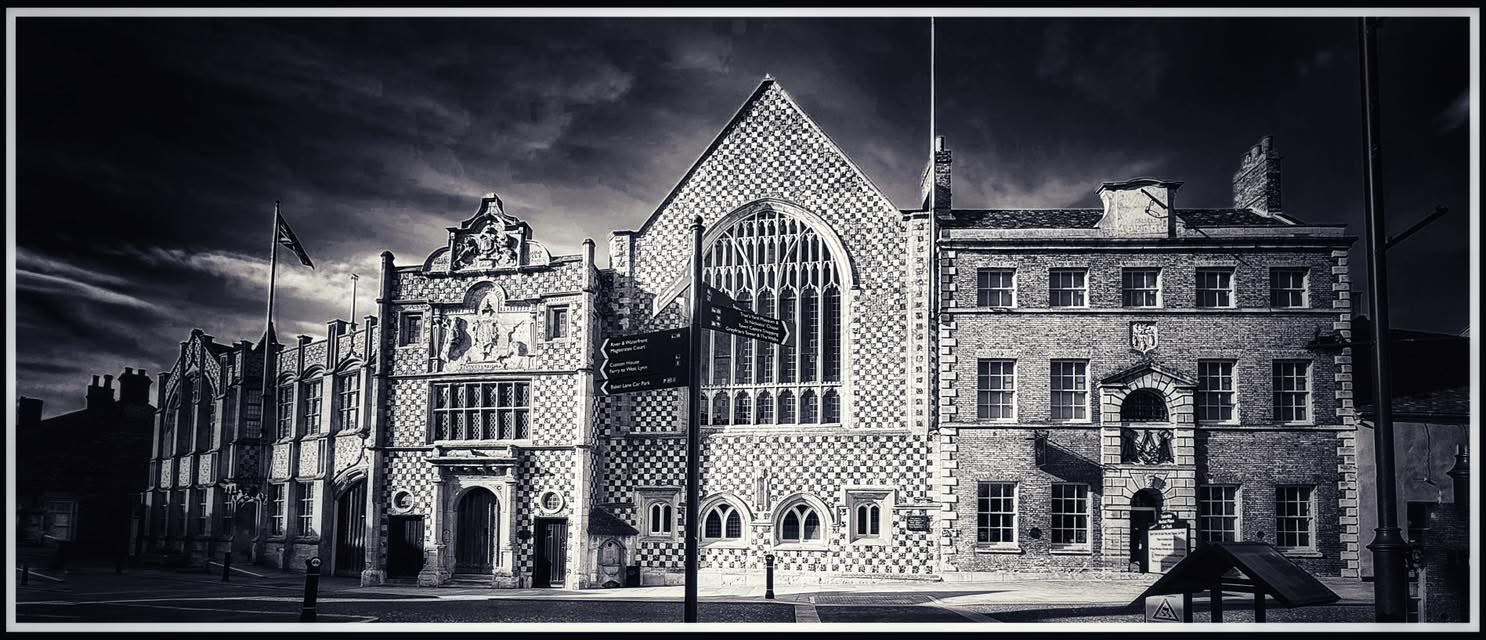
Britain and France were not officially at war in the spring of 1755. In King’s Lynn, however, sailors were already fleeing and the mayor was under Admiralty pressure. A naval gang was pursuing men along the Norfolk coast.
In the spring of 1755, King’s Lynn’s sailors disappeared.
News that the press was out spread quickly. Seamen deserted the quays and streets, then fled north-east along the coast. The naval gang followed by water to Wells, but local fishermen warned the fugitives. They moved east again towards Cley and the wooded country around Sheringham.
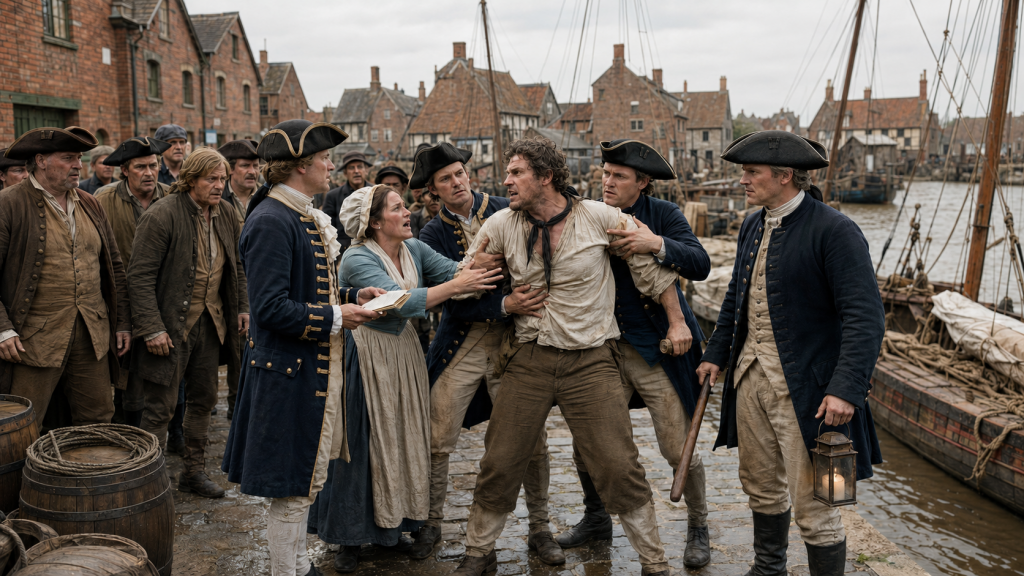
The chase reveals more than fear of forced service. The Royal Navy needed experienced seamen. Lynn’s merchants needed the same men to sail their ships and keep the port working. The Corporation defended its authority, while sailors and their families tried to protect their freedom and income.
The dispute came down to one question. Did the Navy’s claim outweigh every claim in Lynn?
Why 1755 mattered – waiting for the Seven Years’ War
Britain was still formally at peace with France, but the peace was collapsing.
Fighting had begun in North America in 1754. During 1755, Britain prepared its fleet for a wider conflict and demanded men with growing urgency. On 8 June, a squadron commanded by Admiral Edward Boscawen captured the French warships Alcide and Lys off Newfoundland. Britain did not declare war until May 1756.
This uneasy gap between peace and declared war helps to explain the confrontations in Lynn. The Admiralty believed delay threatened national security. The town was being asked to surrender skilled labour before war had formally begun.
The evidence does not show that impressment first reached Lynn in 1755. It does show the port being drawn into emergency mobilisation on a striking scale.
A port the Navy needed
Lynn was useful because its river and inland waterways connected the Wash with much of eastern England. Captain Patrick Baird, the officer directing the 1755 operation, described the town as a receiving station for three counties. Men collected across the region could be examined and confined in Lynn before being sent to the fleet.
Keeping them there was difficult. Baird wanted a tender, a vessel used to hold and transport pressed men, stationed below “the Deeps”. Farther upriver, it might ground at low tide and become vulnerable to escape or rescue.
The press gang was therefore part of an organised system. There was a shore rendezvous, a regulating officer, mobile gangs, and a vessel in the Wash. The location of the Lynn rendezvous remains unknown.
The Admiralty confronts the mayor
Lynn’s mayor initially appears to have delayed or resisted giving civic support to the press warrants. The Admiralty threatened him with a “general press” if he refused.
That threat struck at the port’s trade. Masters, mates, apprentices, and other necessary men could carry protections exempting them from impressment. Under a general press, those papers might be ignored. Regulated cooperation, the Admiralty implied, was the only way to prevent indiscriminate disruption.
The mayor gave way.
The dispute was not a simple contest between a bullying Navy and a defiant town. The mayor wanted to protect Lynn’s labour supply and preserve his own authority. The Admiralty wanted the Corporation’s help because local officials knew the port and its people. Each side needed the other, but neither trusted it.
Once the warrants were accepted, the struggle moved onto paper.
Baird accused a Lynn master carpenter of using only eight of the sixteen protections available to him. The empty places, he suspected, allowed favoured men to be “foisted in”. He also claimed that a merchant had secured the release of four sailors by exaggerating their ranks. One supposed master, Baird protested, had never been trusted with anything more responsible than a cook’s work.
These were Baird’s allegations, not proven facts. They show how merchants could fight impressment without confronting the gang. A sailor classified as a master, mate, apprentice, or owner might remain ashore.
Later records show that some evasions were deliberate. In 1776, William and Thomas Bagge sold the Liberty to its master, John Watts. A memorandum stated that the sale was intended to protect Watts from the press. Four years later, a share in the John and Mary was transferred to Edward Ford solely to make him its reputed owner.
No one needed to run. Ink supplied the protection.
When the King’s Lynn Corporation changed sides
The sharpest episode of 1755 shows that Lynn was not united against the press.
The historian J. R. Hutchinson, drawing on Admiralty correspondence, described a June disturbance in which a crowd threw mud and stones at local magistrates. The offended officials allegedly helped the gang identify about sixty participants, who were then pressed. Some were said to be poor or transient. Others were described as disabled, making their usefulness as seamen doubtful.
The episode exposes the Corporation’s priorities. In the spring, civic officers resisted the Navy when it challenged their control. When a crowd attacked the magistrates, they may have turned the same machinery against their opponents. Their first concern was not resistance to impressment. It was the defence of civic authority.
A wounded sailor fights back
Seven years later, Benjamin Bell tested the limits of naval power.
Bell had served in the Navy and been wounded at Quiberon Bay in 1759. His injury entitled him to protection from further impressment. Back in Lynn, he reportedly warned other sailors whenever the gang approached.
Lieutenant Runsiman seized Bell when he was not carrying his protection paper. Bell was held aboard a tender until he supplied a substitute. The officer may have been able to justify the detention under naval rules. In Lynn, it looked like punishment for obstructing the gang.
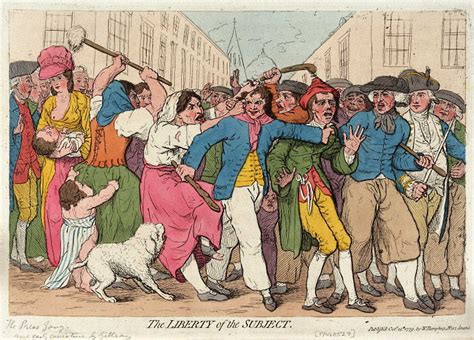
Image Historic-UK.com
The dispute also involved an assault on Bell’s father. In 1762, Runsiman and two gangsmen were prosecuted locally. Each was fined one shilling and imprisoned for two weeks. The Admiralty’s solicitor regretted the “disgrace of an immediate commitment”
The sentences were light, but the case drew a clear boundary. Impressment was lawful. Assault and personal retaliation were not automatically excused because naval officers committed them.
Bell was more than a victim. He had survived battle, obtained protection, warned his neighbours, and helped bring members of the gang before a Lynn court.
Families paid the price
The Navy took a sailor. His household lost his wages and his work. Sometimes it lost the man himself.
On 11 March 1756, Robert Underwood wrote from Lynn’s Town Clerk’s Office to the Treasurer of the Navy. He asked officials to accept the wills and administrations of dead pressed seamen so that their unpaid wages could reach their “starving families”. The surviving catalogue entry gives no names or sums, but its wording shows how quickly the mobilisation of 1755 produced bereavement and poverty.
The burden continued in later wars. In March 1779, Lynn gentlemen performed The Clandestine Marriage for the wives and other dependants of impressed men from the town and surrounding district. A later account says that the performance raised £120, although the original playbill or financial record has not yet been located.
Public charity softened the damage. It did not restore a husband or father taken without his consent.
Emergency becomes routine
During the wars with Revolutionary and Napoleonic France, Lynn’s press station became a permanent institution. Lieutenant William Knight served there from 1803 until 1812, and in 1805 Lynn appeared on a list of permanent naval rendezvous.
Men were sent from Lynn to the Nore, the great naval anchorage in the Thames Estuary. In 1801, the Admiralty allowed £2 15s for transporting and feeding each man on that journey.
The violence of seizure was now surrounded by paperwork and fixed costs, all governed by regulation. It was no less coercive for those caught inside it. In January 1809, men confined at Lynn petitioned after eight weeks in custody during a severe winter. Their allowance of sixpence to ninepence a day was not enough to live on.
Other men joined the Sea Fencibles, a coastal defence force whose members received pay and remained near home. Service protected them from impressment. Lynn had 257 Sea Fencibles in February 1804. Joining was voluntary, but the press made the alternative frighteningly clear.
In July 1809, William Tassell, mate of the Elizabeth, was found in an alehouse two hours after his leave had expired. He was pressed. There was no King’s shilling hidden in a drink and no midnight struggle in an alley. The King’s service had entered Lynn as an emergency. Half a century later, a missed deadline was enough.
© James Rye 2026
Book a Walk with a Trained and Qualified King’s Lynn Guide
References
The National Archives, ADM 1/1486. Captain Patrick Baird’s correspondence concerning Lynn, 1755. https://discovery.nationalarchives.gov.uk/results/r?_q=ADM%201%2F1486
The National Archives, ADM 1/920. Hawke correspondence associated with the reported Lynn disturbance, June 1755. https://discovery.nationalarchives.gov.uk/results/r?_q=ADM%201%2F920
The National Archives, ADM 1/3678. Admiralty Solicitor papers associated with Benjamin Bell and Lieutenant Runsiman, 1762. https://discovery.nationalarchives.gov.uk/results/r?_q=ADM%201%2F3678
The National Archives, ADM 1/579. Transport arrangements for pressed men, including Lynn to the Nore. https://discovery.nationalarchives.gov.uk/results/r?_q=ADM%201%2F579
The National Archives, ADM 1/1546. Lynn petitions and impressment cases, 1809. https://discovery.nationalarchives.gov.uk/results/r?_q=ADM%201%2F1546
Norfolk Record Office, BL/CS 3/62. Robert Underwood to the Treasurer of the King’s Navy, 11 March 1756. https://nrocatalogue.norfolk.gov.uk/index.php/robert-underwood-town-clerks-office-kings-lynn-to-the-treasurer-of-the-kings-navy-asks-them-to-accept-wills-and-administrations-of-deceased-pressed-seamen-to-recover-pay-due-to-them-for-their-starving-families-draft
Norfolk Record Office, BL/BG 3/4/1/39–40. Bill of sale of the Liberty and accompanying impressment memorandum, 1776. https://nrocatalogue.norfolk.gov.uk/index.php/bill-of-sale-of-the-liberty-by-william-and-thomas-bagge-to-john-watts-the-master-of-the-liberty-and-separate-memorandum-that-the-sale-was-made-in-order-to-protect-watts-from-being-impressed-into-h-m-service-1776-the-foot-of-the-bill-of
Norfolk Record Office, BL/BG 3/9/17. Edward Ford’s declaration concerning the nominal sale of the John and Mary, 1780. https://nrocatalogue.norfolk.gov.uk/index.php/declaration-by-edward-ford-that-a-bill-of-sale-made-to-him-by-john-pickering-of-the-john-and-mary-was-made-solely-in-order-to-protect-ford-as-the-reputed-owner-from-being-impressed-into-his-majestys-service