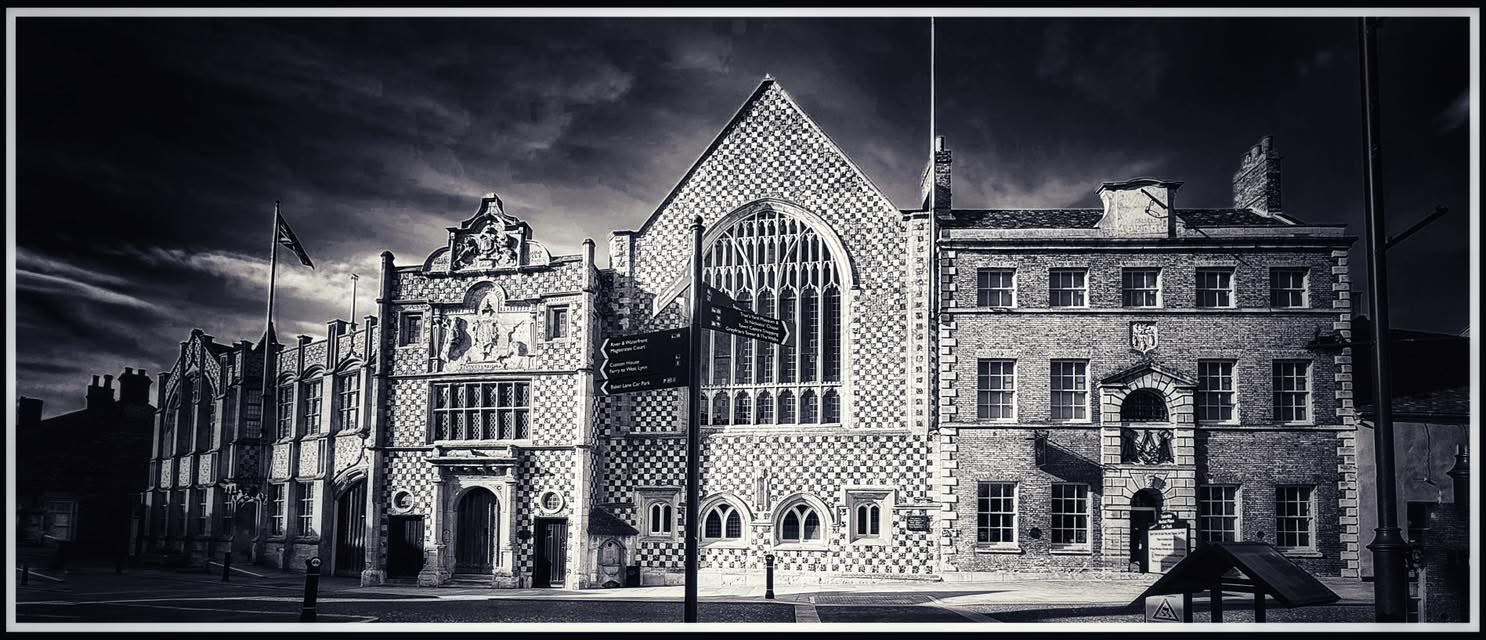
A refugee artist on the Tuesday Market Place
In the mid-1950s, shoppers on King’s Lynn’s Tuesday Market Place may have noticed a thin, intense young man selling second-hand books, pictures, furniture, and oddments from a market stall. He was not yet famous. He was trying to live.
His name was Gustav Metzger.
Today, Metzger is recognised as one of the most radical artists of post-war Britain: a refugee from Nazi Germany, a political activist, a pioneer of auto-destructive art, and an early warning voice on nuclear weapons, consumer waste, technological violence, and environmental catastrophe. Yet one of the key chapters in his life unfolded not in London, Paris, or New York, but in King’s Lynn.
Metzger lived in the town from 1953 to 1959. Jonathan P. Watts’s detailed study of these years argues that King’s Lynn “laid the foundations” for Metzger’s later fusion of art and activism, and helped move him from painted objects towards public actions, events, and manifestos.
Metzger later made a memorable claim: “Everything I know about activism I learnt in King’s Lynn.” It sounds almost too neat, but the local evidence gives it force. In Lynn, he became an artist-dealer, an exhibition organiser, a defender of threatened historic streets, an anti-nuclear protester, and finally the inventor of a form of art in which destruction itself became the central act.
From Nuremberg to Norfolk
Gustav Metzger was born in Nuremberg in 1926 to Polish-Jewish parents. In 1939, he reached Britain as a child refugee through the Refugee Children’s Movement, escaping Nazi persecution. His parents later died in the Holocaust.
These facts cannot be separated from his art. Metzger’s work was never simply about style or fashion. It was shaped by exile, organised violence, mass destruction, and the terrifying power of modern states.
After the war, he studied sculpture, drawing, and painting in London, including a period under David Bomberg, one of the most forceful art teachers of the time. He also studied in Antwerp and was connected with a circle of artists that included Frank Auerbach and Leon Kossoff.
By 1953, however, Metzger had quarrelled with Bomberg, resigned from the Borough Bottega exhibiting society, and stopped painting for a time. He left London for King’s Lynn.
At first, this looks like withdrawal. In fact, it became a turning point.
St Nicholas House
Metzger arrived in King’s Lynn in difficult circumstances. He had little money and did casual work, including pea-picking. In the winter, work was hard to find. Early in 1954, he found employment as a maintenance man in a town-centre fashion shop, cleaning the entrance, turning on lights, and doing basic practical tasks.
Then he noticed a vacant old building in St Nicholas Street.
St Nicholas House, now 11 St Nicholas Street, became his base. In spring 1954, he took a six-year lease on it. Across the road lay the Tuesday Market Place. Nearby stood St Nicholas’ Chapel. The house served as home, warehouse, studio, and workshop.
The setting was important. Metzger was living among the old mercantile fabric of Lynn, in a part of the town where medieval and early modern buildings still shaped daily life. From that point onwards, his art and activism were fed by a very particular local landscape: markets, old streets, threatened houses, church fragments, and a town uncertain how much of its past it wanted to keep.
Books, oddments, and survival
From St Nicholas House, Metzger began dealing. He bought and sold books, antiques, furniture, and miscellaneous goods. He traded on the Tuesday Market Place from around 1954, apart from a brief period when he tried to run a shop in Queen Street.
This was not a romantic artistic existence. It was a hard education in money, objects, use, reuse, and waste. Metzger sorted stock, shifted furniture, handled damaged things, and learnt how goods passed from one life to another. Later, his art would use nylon, acid, cardboard, steel, newspapers, packaging, and industrial materials. King’s Lynn did not give him a conventional studio career. It gave him contact with the discarded, the practical, and the precarious.
The market also placed him in daily conversation with local people. When he began campaigning over the North End, residents approached him at his stall. The Tuesday Market Place became a place not only of trade, but of argument.
Thirty Queens
In 1956, Metzger took a shop at 30 Queen Street. He intended it to be an art, antique, and bookshop. Commercially, it failed. Artistically, it was remarkable.
In July 1956, he arranged Sculpture at Thirty Queens, showing recent work by Eduardo Paolozzi, William Turnbull, and Anthony Hatwell. The exhibition opened on 19 July, coinciding with the opening of the King’s Lynn Festival, although it was not part of the official programme. Admission was free, and the show was open from 10 a.m. to 8 p.m.
Nothing sold. Visitors to Queen Street could apparently have bought a Paolozzi for £60, but the buyers did not appear. Still, for a short time, a small Norfolk shop became a serious modern art space. Metzger even reviewed the exhibition himself in the Lynn News and Advertiser under the striking title “These Artists are Possessed: They Gamble with Life”.
The episode catches something essential about him: bold, improvised, intelligent, commercially hopeless, and utterly serious.
Queen Street and the modern world
Metzger did not use Queen Street merely as a shop. On 9 August 1956, the same day that the celebrated This is Tomorrow exhibition opened at the Whitechapel Gallery in London, he pasted its posters in the window of 30 Queen Street. They stayed there until the Whitechapel exhibition closed in September.
This is Tomorrow is now seen as a landmark in post-war British art, design, architecture, and popular culture. Metzger was not simply bringing London art to the provinces. He was making King’s Lynn into a small relay point for new artistic ideas.
Later that year, he also showed paintings by Monica English. That exhibition remains more mysterious. English is difficult to place in standard post-war art histories, and Watts is cautious about how much can be inferred from the surviving evidence. The uncertainty is useful. Metzger’s King’s Lynn was not a tidy story of metropolitan modernism arriving in Norfolk. It was stranger and more mixed than that: market dealing, radical sculpture, local artists, medieval buildings, damaged church objects, and protest politics all pressed in on each other.
Broken church treasures
In 1957, Metzger organised Treasures from East Anglian Churches in the crypt of Clifton House, 17 Queen Street. It opened on 27 July as part of the sixth King’s Lynn Festival and ran until 10 August. The exhibition brought together thirty-six objects from regional churches, museums, institutes, and private sources. Many had been damaged, removed, or displaced between the Reformation and the end of the Commonwealth.
This is one of the strongest links between King’s Lynn’s past and Metzger’s later art. Before he became famous for auto-destructive art, he had curated an exhibition about objects already scarred by destruction.
The surviving catalogue drew attention to the loss of church art during the Reformation and Commonwealth periods. No known photograph of the installation appears to survive, so we should not over-imagine how it looked. But the idea is clear. In Lynn, Metzger was thinking about broken images, religious violence, survival, and the strange power of damaged objects.
The old town gave him more than atmosphere. It gave him a way of seeing destruction as a historical force.
The North End campaign
Metzger’s most direct local political battle concerned the North End. In 1957, he was living close to St Nicholas’ Chapel and near the old fishing quarter around North Street and Pilot Street. Earlier slum clearances had already altered the area. Further redevelopment threatened more of the historic street pattern.
Metzger saw a notice about a hearing into the future of the North End and went to investigate. He was horrified. He wrote to the Lynn News and Advertiser, attacking the proposed road scheme and warning about its impact on St Nicholas’ Chapel, which he regarded as one of Lynn’s greatest buildings.
The newspaper photographed him, and his protest appeared on the front page. People then began talking to him at his market stall. A North End Society emerged, with meetings, a secretary, a programme, and a constitution. Its aims, published in February 1958, included protecting North Street and Pilot Street from wholesale demolition, and pressing for repair and improvement instead. It drew support from bodies including the Society for the Protection of Ancient Buildings and the Norfolk branch of the Campaign for the Protection of Rural England.
The campaign was only partly successful. The later road scheme was modified, and some houses survived, but much was lost. Watts suggests that Metzger’s action and the North End Society helped create the conditions for the later King’s Lynn Preservation Trust, which restored 26 Pilot Street and other properties in 1978.
Here, Metzger learnt a hard local lesson. Destruction did not only come from bombs or dictators. It could come through planning committees, road schemes, official tidiness, and the language of progress.
Norfolk and the bomb
At almost the same time, Metzger became involved in anti-nuclear protest. Norfolk was part of Cold War military planning, and RAF North Pickenham, near Swaffham, was developed to house Thor ballistic missiles. Metzger was connected with the local Campaign for Nuclear Disarmament and with the Direct Action Committee Against Nuclear War.
The protests were not symbolic gestures from a safe distance. Eric Bamford’s film Rocket Site Story shows Metzger among demonstrators. A protest on 20 December 1958 led to arrests, and thirty-seven protesters spent Christmas in Norwich prison.
This helps explain the urgency of his later art. When Metzger turned to auto-destructive art, he was not merely inventing a new visual trick. He was trying to make visible a society that seemed capable of destroying itself.
Acid, nylon, and the birth of auto-destructive art
By the late 1950s, Metzger had returned to making art. In 1956, while living in King’s Lynn, he made a series of oil paintings and drawings of a three-legged table. Ben Uri notes that the form has been read as suggestive of a mushroom cloud, and that this period coincided with his growing anti-nuclear activity. Between 1957 and 1959, he moved further into abstraction, experimenting with cardboard, plastic, and steel.
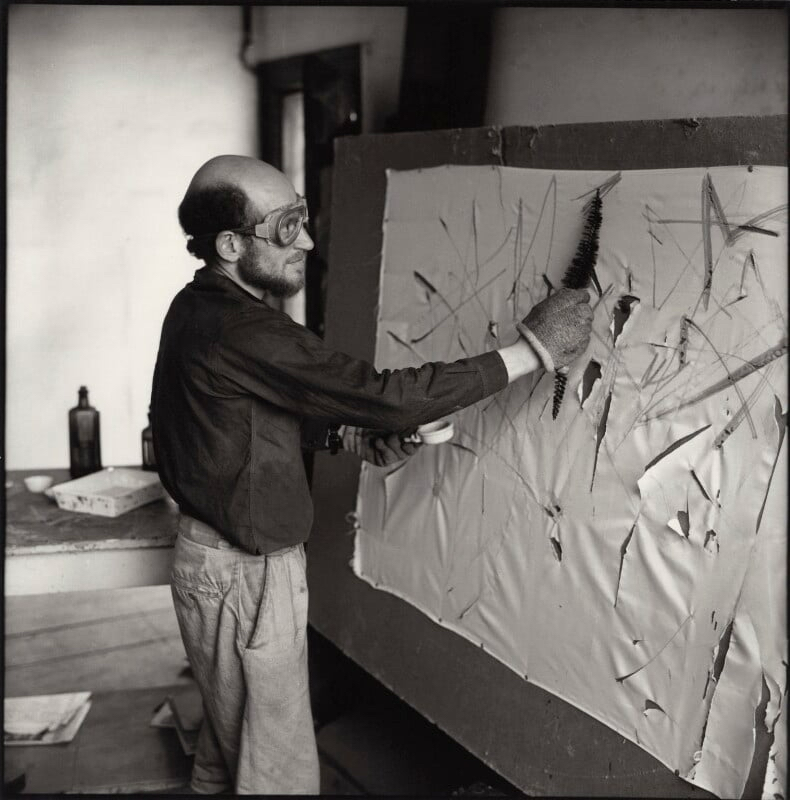
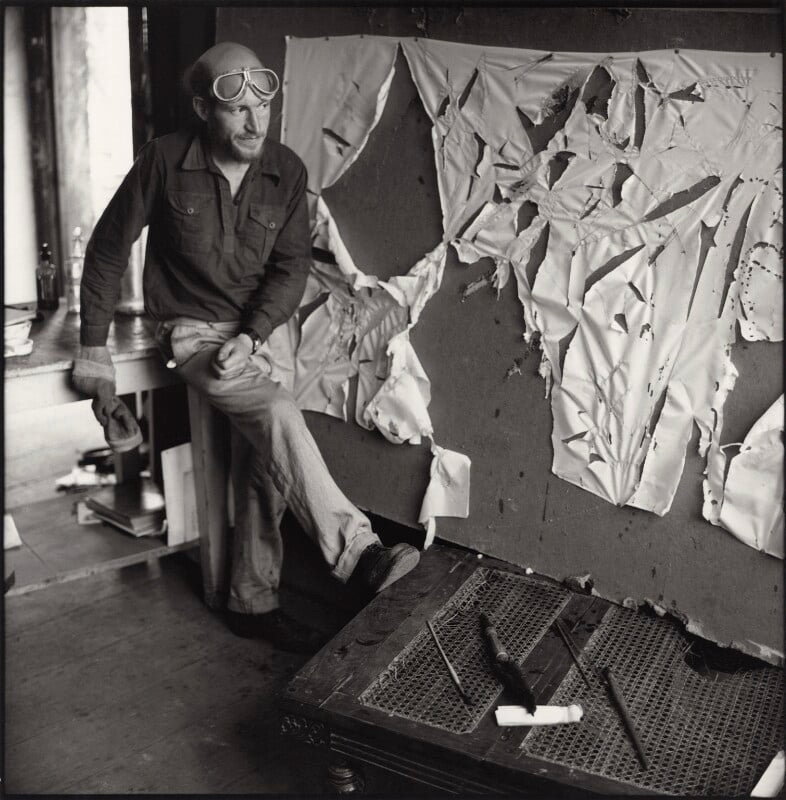
Then came the breakthrough. John Cox’s photographic series of 1959 shows Metzger experimenting with acid on nylon inside his studio at St Nicholas House. The National Portrait Gallery also holds 1960 negatives of Metzger practising for a public demonstration of auto-destructive art, with the place made and portrayed given as his studio in King’s Lynn.
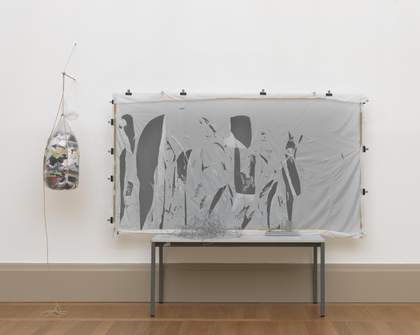
The method was stark. Acid was applied to nylon so that the material blistered, opened, and dissolved. The artwork was not a finished object to be admired safely on a wall. It was an event. It changed in time. It destroyed itself.
In 1960, Metzger gave his first public lecture-demonstration of auto-destructive art at the Temple Gallery in London. The British Council summarises the method plainly: Metzger developed auto-destructive art through manifestos and actions, notably by applying hydrochloric acid to nylon at Temple Gallery in 1960.
London saw the public breakthrough. King’s Lynn had helped form the idea.
The artist who left, and the town that remained
Metzger left King’s Lynn around the end of the 1950s, though his lease and some photographic evidence extend the local connection into 1960. He went on to become one of the most uncompromising figures in international post-war art. He published manifestos, staged actions, protested against nuclear weapons, was imprisoned in 1961 for civil disobedience, helped shape the Destruction in Art Symposium, and later made works concerned with newspapers, the Holocaust, technology, extinction, and environmental crisis.
King’s Lynn remained part of his story. Tate Britain’s 2015 exhibition Gustav Metzger: Towards Auto-Destructive Art 1950–1962 included work from these formative years. In 2019, the town revisited its connection with him through Destroy, and You Create: Gustav Metzger in King’s Lynn at the Fermoy Gallery and Red Barn.
The physical map of Metzger’s Lynn is still walkable: St Nicholas House in St Nicholas Street, the Tuesday Market Place, 30 Queen Street, Clifton House, St Nicholas’ Chapel, Pilot Street, and the North End. These places are not incidental. They were where Metzger learnt how art, politics, history, and destruction could meet.
Why Metzger belongs to King’s Lynn
There is a temptation to treat Gustav Metzger as a difficult modern artist who briefly lodged in an old Norfolk town. That misses the point. King’s Lynn gave him a practical education.
Here he learnt the market stall, the newspaper letter, the exhibition poster, the public meeting, the protest campaign, the partial victory, and the bitter defeat. He learnt that old streets were fragile. He learnt that broken fragments could still speak. He learnt that destruction could be respectable, planned, and municipally approved. He learnt that an artwork did not have to last in order to leave its mark.
Most towns like to remember the artists who painted them beautifully. King’s Lynn has something rarer: an artist who looked at the town, saw both its beauty and its vulnerability, and carried that lesson into one of the most radical art practices of the twentieth century.
© James Rye 2026
Book a Guided Tour with a Trained and Qualified King’s Lynn Guide Through Historic Lynn
References
Ben Uri Gallery and Museum. “Becoming Gustav Metzger: Uncovering The Early Years, 1945–59.” https://benuri.org/exhibitions/becoming-gustav-metzger-uncovering-the-early-years-1945-59/overview/
British Council Collection. “Metzger, Gustav.” https://collection.britishcouncil.org/author/metzger-gustav/6495b265425178137a390d78
Gustav Metzger Foundation. “About Gustav Metzger.” https://gustavmetzgerfoundation.org/about
National Portrait Gallery. “Gustav Metzger practicing for a public demonstration of Auto-destructive art using acid on nylon.” https://www.npg.org.uk/collections/search/portrait/mw205051/Gustav-Metzger-practicing-for-a-public-demonstration-of-Auto-destructive-art-using-acid-on-nylon
Watts, Jonathan P. “‘Everything I Learnt About Activism I Learnt in King’s Lynn’: Gustav Metzger’s Formative Years in King’s Lynn.” British Art Studies, Issue 20. https://britishartstudies.ac.uk/issues/20/gustav-metzgers-formative-years-in-kings-lynn/