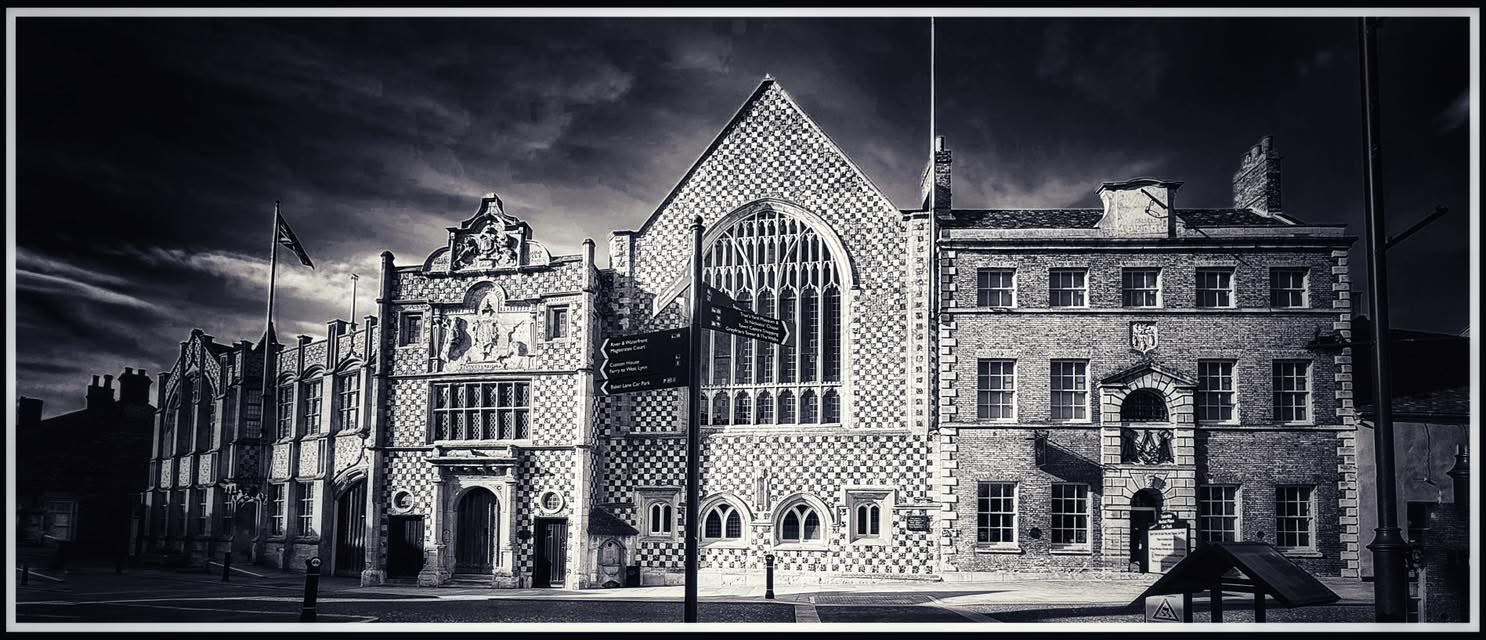
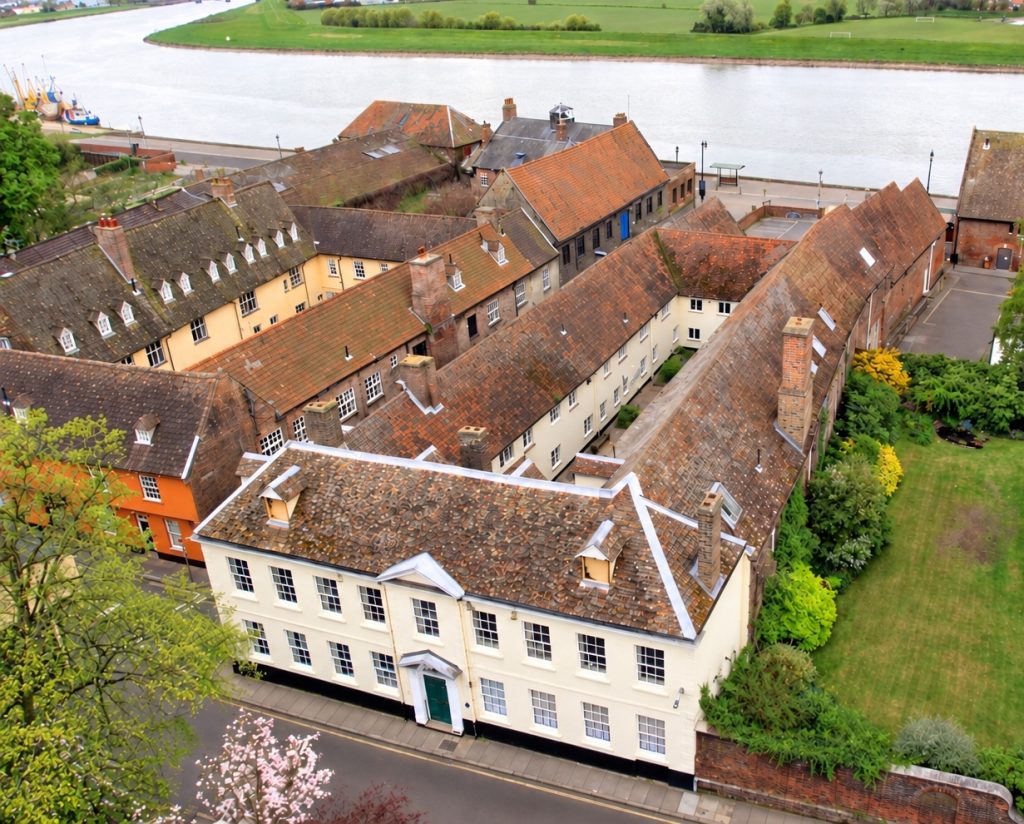
AI improved image. Source of original: Dr Paul Richards https://www.spab.org.uk/news/building-focus-hanse-house-kings-lynn
In April 1475 Edward IV transferred a collection of houses opposite St Margaret’s Church in Lynn to the German Hanseatic merchants. They acquired accommodation, storage space, a courtyard, and access towards the river. Warehouses were subsequently developed within the property.
The grant was not simply intended to encourage foreign trade. It was one of the concessions England made after a damaging maritime conflict with the Hanseatic League. The Treaty of Utrecht, concluded in February 1474, restored the Germans’ commercial privileges, awarded them £10,000 compensation, and required England to provide trading establishments in London, Boston, and Lynn.
The conflict is sometimes mistaken for a fifteenth-century Anglo-Dutch War. England’s opponent was the Hanseatic League, led during the war by towns including Lübeck, Danzig, Hamburg, and Bremen. Holland and Zeeland were involved in the surrounding commercial rivalries, and the negotiations took place at Utrecht in the Netherlands, but this was an Anglo-Hanseatic War.
The Hanse, its Kontore, and its Steelyards
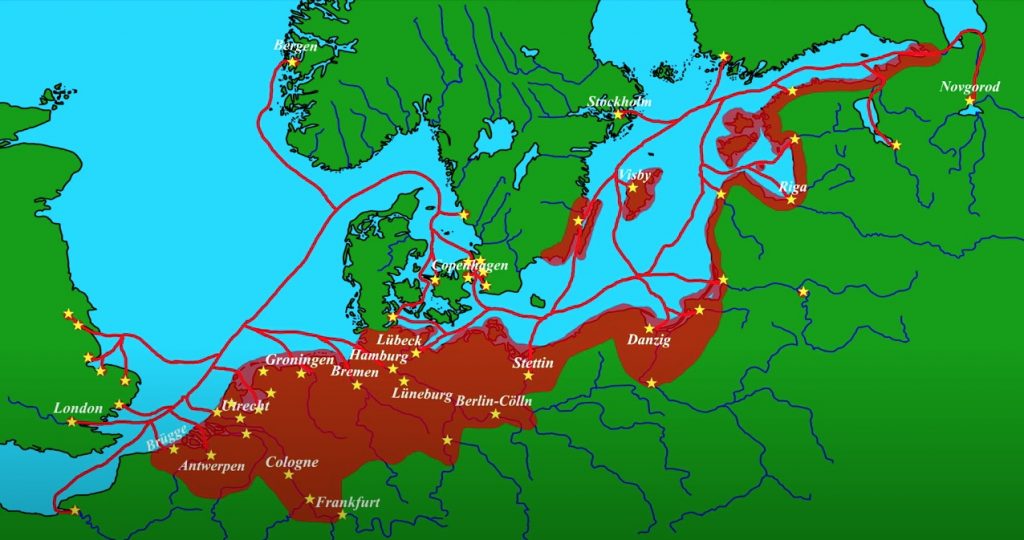
The Hanseatic League was not a country. It was an association of trading towns and merchant communities extending from the Rhineland across northern Germany to Prussia and Livonia. Lübeck, Danzig, Hamburg, Bremen, and Cologne were among its most influential members, although their commercial interests frequently differed.
The Hanse maintained four great foreign trading centres known as Kontore. These were at Novgorod, Bergen, Bruges, and London. A Kontor was not simply a warehouse or office. It was an organised merchant community with its own officers, treasury, seal, regulations, and authority over the Hanseatic merchants who traded there.
The London Kontor occupied a walled compound beside the Thames known as the Stalhof, translated into English as the Steelyard. It contained warehouses, offices, accommodation, wine cellars, kitchens, a chapel, a weigh house, and a guildhall. It was both a physical trading compound and the headquarters of the Hanseatic merchant community in England.
The origin of the word Stalhof is uncertain. “Steelyard” was probably a misleading English rendering and had no direct connection with making or selling steel. One suggestion associates the name with the inspection, sampling, or sealing of merchandise, but no explanation has been universally accepted.
Smaller Hanseatic establishments existed in English provincial ports. Lynn’s property was called the Stileyard or Steelyard in local records. It was not one of the four autonomous Kontore. It was a dependent trading house under the authority of the London Kontor, to which it paid an annual contribution.
German merchants had visited Lynn for centuries before the Steelyard was established. The town’s records mention Easterlings, residents from Lübeck and Cologne, correspondence with Baltic towns, and Lynn merchants conducting business in Prussia. What Lynn acquired after 1474 was a permanent Hanseatic trading house owned by the German towns.
Why English merchants resented the Germans
Hanseatic merchants enjoyed valuable privileges in England. They paid favourable customs charges, received royal protection, and could organise their affairs through their own commercial institutions.
English merchants complained that they did not receive equal treatment in Hanseatic territory. Those travelling to Prussia, Livonia, Scandinavia, and other northern markets encountered local tolls and restrictions. They could not always buy directly from producers or sell to customers of their choice.
There was also resentment about a practice known as “colouring”. A merchant who did not possess Hanseatic privileges might consign goods in the name of a German associate. The merchandise then appeared to be Hanseatic and qualified for lower customs charges. This reduced the Crown’s income and disadvantaged English competitors.
English merchants increasingly wanted to carry their own cloth overseas and purchase northern goods at source. Timber, wax, fish, iron, pitch, grain, furs, and naval supplies were among the commodities available through the Hanseatic networks. The Germans were determined to preserve their position between English producers and northern European consumers.
The long road to war
The war of 1468–74 developed from disputes that had remained unresolved for decades.
In 1431 Parliament increased the customs paid by foreign merchants. The Hanse responded with commercial pressure and an embargo. The Treaty of London in 1437 restored Hanseatic privileges and promised English traders access to Hanseatic markets.
The apparent equality concealed a practical problem. Hanseatic privileges could be enforced throughout England by the Crown. The English promise depended upon numerous autonomous towns, each with its own regulations and commercial interests.
In 1447 Henry VI withdrew Hanseatic privileges after further complaints that English merchants had not received reciprocal treatment. Two years later English privateers captured a large fleet carrying salt towards Lübeck and Danzig. The German losses were considerable.
Negotiations eventually produced an eight-year truce in 1456, but attacks at sea continued. Another Hanseatic salt fleet was seized in 1458. Talks held at Hamburg in 1465 then failed to settle the outstanding arguments about compensation, responsibility, and commercial access.
The crisis that finally produced war began in Iceland. English fishermen and merchants had become increasingly active there, although the island belonged to the Danish-Norwegian Crown. In 1465 England and Denmark reached an agreement regulating the English presence. Two years later Englishmen killed the Danish governor and were accused of further violence.
Christian I of Denmark retaliated in 1468. He ordered the seizure of English ships passing through the Sound between Denmark and Sweden. Seamen from Danzig serving the Danish king helped capture six English vessels. At least two were reportedly connected with Lynn. (See When Lynn went fishing in Iceland.)
The English shipowners blamed the Hanse collectively, even though the operation had been ordered by Christian I. In July 1468 Edward IV demanded that the German merchants in England provide security for the losses. Hanseatic merchants were arrested, and their goods were confiscated.
War in the North Sea and Channel
The war was fought through embargoes, privateering, convoys, and attacks upon merchant shipping. The Hanse had no permanent navy, and there was no attempt to invade England. Lübeck, Danzig, Hamburg, and Bremen commissioned armed vessels and carried most of the military burden.
By 1472 Hanseatic squadrons were operating through the Channel and as far west as Ushant. Their captains attacked English vessels and neutral ships suspected of carrying English property.
The best-known commander was Paul Beneke of Danzig, captain of the Peter von Danzig. In 1473 he captured the galley St Matthew. Its valuable cargo included Hans Memling’s Last Judgement, commissioned for a chapel in Florence. Beneke took the painting to Danzig, and it remains in the National Museum in Gdańsk.
The capture reveals the international reach of the war. A painting produced in Bruges for an Italian banker was seized from a galley associated with Florentine interests because the captors believed that English property was being carried aboard it.
Edward IV needs peace
The conflict damaged both sides. German merchants lost access to English markets, while English cloth exporters struggled to reach northern customers. Shipping became more dangerous, freight costs increased, and merchants risked losing entire cargoes.
Edward IV had an additional reason for ending the war. He was preparing an invasion of France and needed ships, customs revenue, merchant loans, and secure relations with Charles the Bold of Burgundy. Continuing warfare in the Channel threatened his plans.
Negotiations opened at Utrecht in the summer of 1473. Edward’s leading representatives were John Russell, Archdeacon of Berkshire, and William Hatcliffe, the king’s secretary. The Hanseatic delegation included experienced diplomats led by Hinrich Castorp, mayor of Lübeck.
Preliminary articles were agreed in September. Parliament approved reconciliation in October, but important details remained unsettled. Negotiations resumed early in 1474, and the final treaty was concluded on 28 February.
What England conceded at Utrecht
Both sides agreed to abandon claims arising from earlier injuries. Hanseatic merchants and their property were protected against further reprisals, while English merchants were formally permitted to trade in Hanseatic territory.
The wording appeared reciprocal, but the Germans obtained more precise guarantees. Their privileges in England were restored and confirmed. Maritime cases involving Hanseatic merchants were to be heard by specially appointed judges rather than left entirely to the ordinary Admiral’s Court.
The Hanse received secure possession of the London Steelyard and recovered its former establishment at Boston. England also agreed to provide a new house near the waterfront in Lynn.

Source: PortalMorski.pl
Edward accepted a Hanseatic claim for £10,000. This was a single indemnity, not an annual payment. The Germans recovered it by retaining or offsetting customs duties on later imports and exports until the debt had been discharged.
The treaty also helped preserve Hanseatic unity. If a member town broke away, Edward was to suspend its privileges in England until it returned. This provision was directed at Cologne, which was eventually readmitted in 1476.
English cloth was another source of complaint. Edward promised action against material that failed to meet the expected width, length, or quality. The London Germans also retained the right to sell Rhenish wine by retail and continued their ancient responsibility for guarding Bishopsgate.
The Treaty of Utrecht was a Hanseatic diplomatic victory. Edward obtained peace and reopened commercial routes, but the Germans recovered their property, privileges, compensation, and collective authority. English merchants received another general promise of access to northern markets that remained difficult to enforce.
Lynn prepares for the settlement
Lynn was involved before the final treaty was signed. On 3 November 1473 a royal letter concerning the proposed terms was read to the town council. Mayor William Wales, Walter Coney, Thomas Leighton, and Thomas Thoresby were appointed to assist with the arrangements.
The Hanseatic negotiators apparently wanted a property on King Street. Merchants’ houses there stood on long plots extending towards deeper water in the Ouse. They did not obtain their preferred location.
Instead, existing properties opposite St Margaret’s Church were selected. The site stood on what is now St Margaret’s Place, close to Thomas Thoresby’s house. Edward IV purchased the premises from local owners and transferred them to the German merchants on 29 April 1475.
An early description mentions seven houses with ten rooms, eight chimneys, a kitchen, a hall, and a courtyard. This was not the completed warehouse complex seen today. The Germans redeveloped the property in stages, creating accommodation and warehouses extending towards the river.
The establishment became known as the Allemayne Mansion or Steelyard House. It provided storage, accommodation, offices, and a base from which German merchants could conduct their affairs. By 1505 the Hamburg merchant Lutkyn Smith was acting as governor of the Lynn Steelyard. German merchants continued to trade through the establishment, although the size of its permanent community is uncertain.
The title to the property belonged to the Hanseatic towns rather than to Lynn’s corporation or an individual German merchant. Its affairs remained subject to the London Kontor.
A victory that concealed weakness
Hanseatic exports from England recovered after the peace. The treaty secured the German merchants’ legal position, and Lynn became an important point of contact between East Anglia and Prussia.
The war had nevertheless exposed serious weaknesses within the League. Cologne had placed its own trade before Hanseatic solidarity. Danzig delayed ratifying the settlement, while some eastern towns feared renewed English competition. Dutch merchants continued to expand into Baltic markets.
The privileges restored at Utrecht could not prevent these changes. During the sixteenth century English merchants renewed their attacks upon the Hanse’s commercial advantages. The London Steelyard’s privileges were finally withdrawn by Elizabeth I in 1598.
Lynn’s Steelyard remained the property of Lübeck, Hamburg, and Bremen until 1751. Its warehouses still stand behind the later façade on St Margaret’s Place. They preserve the physical result of a war fought from Iceland and the Danish Sound to the North Sea and English Channel.
© James Rye 2026
Book a Guided Tour with a Trained and Qualified King’s Lynn Guide Through Historic Lynn
References
- British Library. “Add MS 48006: Negotiations for the Treaty of Utrecht with the Hanse.” Archives and Manuscripts Catalogue. https://searcharchives.bl.uk/catalog/040-001951015.
- Colvin, Ian D. The Germans in England, 1066–1598. London: Kegan Paul, Trench, Trübner, 1915. https://www.heritage-history.com/index.php?author=colvin&book=germans&c=read&readAll=true.
- Fudge, John D. Cargoes, Embargoes, and Emissaries: The Commercial and Political Interaction of England and the German Hanse, 1450–1510. Toronto: University of Toronto Press, 1995.
- Friedland, Klaus, and Paul Richards, eds. Essays in Hanseatic History: The King’s Lynn Symposium 1988. Dereham: Larks Press, 2005.
- Lloyd, T. H. England and the German Hanse, 1157–1611: A Study of Their Trade and Commercial Diplomacy. Cambridge: Cambridge University Press, 1991. https://doi.org/10.1017/CBO9780511560279.
- Norfolk Record Office. “King’s Lynn’s Trading Links with Europe: King’s Lynn and the Hansa.” 15 July 2020. https://norfolkrecordofficeblog.org/2020/07/15/kings-lynns-trading-links-with-europe-kings-lynn-and-the-hansa/.
- Richards, Paul. King’s Lynn and the German Hanse, 1250–1550: A Study in Anglo-German Medieval Trade and Politics. Cromer: Poppyland Publishing, 2022.
- Richards, Paul. “The Hanseatic League and Eastern England in the Middle Ages.” Gresham College, 14 June 2007. https://www.gresham.ac.uk/watch-now/london-forgotten-hanseatic-city-hanseatic-league.
- Rymer, Thomas. Foedera, Conventiones, Literae, et Cujuscunque Generis Acta Publica. Vol. 11. London, 1739–45. https://www.british-history.ac.uk/rymer-foedera/vol11.