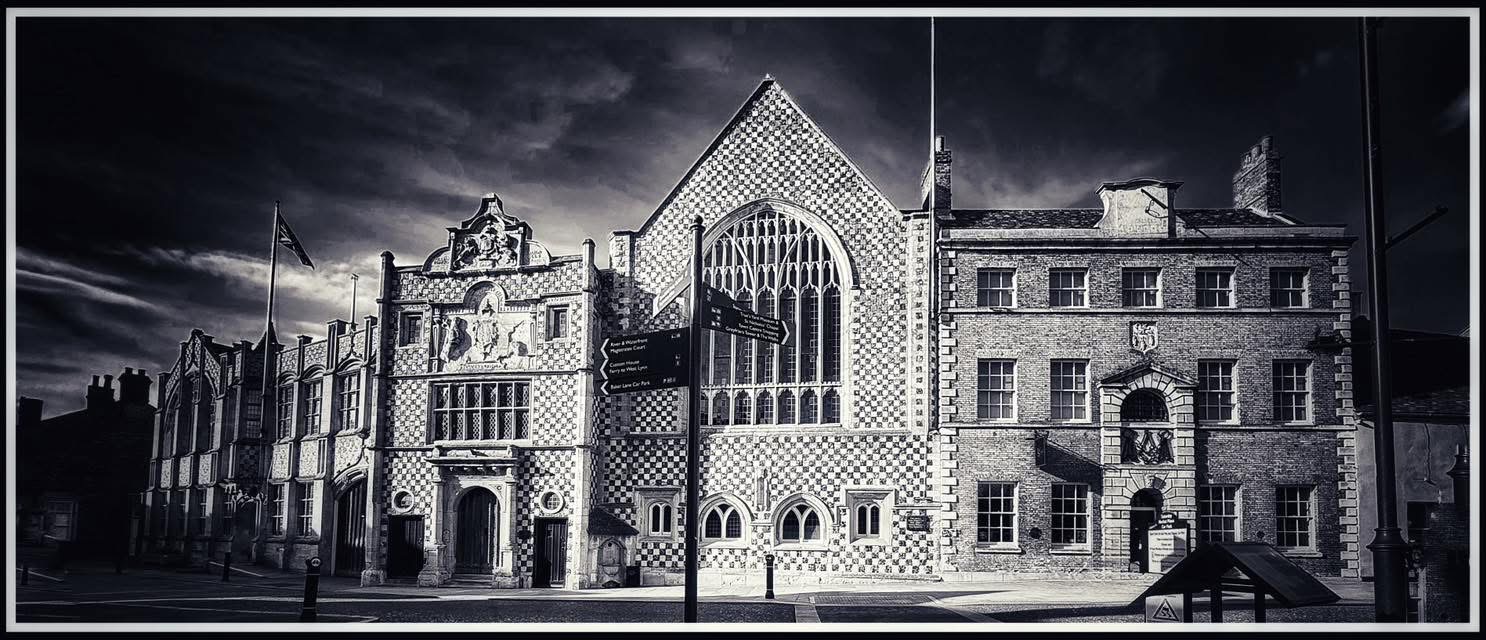
A chronology with 73 entries in the town. The entries trace the growth of the port and the spread of housing, along with changes in public health, town life, and the historic centre.
| Date | Event | Why it mattered and sources |
| 1800–1899 | ||
| 1800 | The medieval East Gate was demolished. | The gate had guarded the road to Gaywood. Its removal cleared a bottleneck on the eastern approach.Hillen |
| May 1803 and 1805 | The King’s Lynn Paving Act received royal assent, and London Road was built. | The Act provided powers to improve the streets and required a direct route from the South Gate towards the centre. The new road encouraged housebuilding in South Lynn.Borough archaeology report · Historic England |
| 1821 | The Eau Brink Cut was completed. | The new channel removed a large bend in the Great Ouse upstream of Lynn. Works extended it northwards in 1853, continuing efforts to improve drainage and navigation.Borough archaeology report |
| 1829–1832 | The market cross and shambles were removed, and a Market House rose on the Angel Inn site. | The Corporation authorised the removal of Henry Bell’s cross in 1829. Clearing the cross and butchers’ stalls opened up the square, while the Market House shifted some trade to its western edge. The Corporation took over the new building in 1832.Hillen · Borough Council · Historic England |
| July 1832 | Cholera broke out in Lynn. | Henry Hillen reproduces a near-contemporary account of the deaths in the Ormiston household, which shows how rapidly the disease could devastate a family.Hillen |
| 1835 | Parliament reformed Lynn’s municipal government. | The Municipal Corporations Act brought Lynn into the new system of elected councils. The borough was divided into three wards.Legislation · Hillen |
| April 1835 | The West Norfolk and Lynn Hospital opened off London Road. | The hospital provided inpatient and outpatient care for the town and the surrounding district. The Queen Elizabeth Hospital succeeded it in 1980.Trade directory · Historic England |
| 1844 | Lynn’s public museum was founded. | The first museum opened at Welwick House in Union Street. It moved to the purpose-built Athenaeum ten years later.Lynn Museum |
| 27 October 1846 | Lynn’s first railway opened to Downham Market. | The line reached Ely in October 1847. The railway gave Lynn a new route for passengers and goods, and a branch reached the riverside quays in 1849.Fen Line Users · Railway campaign archive |
| 1850 | Frederick Savage set up his engineering business. | The firm began with agricultural machinery and became known for steam-powered fairground rides. Its works were a major part of Lynn’s engineering industry.Lynn Museum · Borough archaeology report |
| 1853 | William Lee’s report on Lynn’s sanitary conditions appeared. | The official inquiry examined sewerage, drainage, and drinking water. It records what the authorities knew about the conditions in which people lived.Lee’s 1853 report |
| 16 August 1854 | The Athenaeum opened at Baxter’s Plain. | Cruso and Maberley designed the building. It brought the museum, library, and a hall for lectures and concerts together in premises built for public learning and entertainment.Hillen · Norfolk Chronicle · Lynn Museum · Heritage statement |
| August 1854–June 1856 | The old St James’ workhouse partly collapsed. A replacement was built in Extons Road. | Two people died in the collapse. The new Union workhouse, completed in 1856, shows the scale of provision for people who had to seek poor relief.Norfolk Chronicle · Workhouse history |
| 1854–1855 | The Corn Exchange was built on the Tuesday Market Place in 1854 and opened on 9 January 1855. | Cruso and Maberley designed the building to replace the Market House. Farmers and merchants gained a dedicated grain market, with a statue of Ceres above the entrance. The date on the building records construction in 1854. Trading began the following January.Historic England · Norfolk Chronicle |
| September 1862 | The railway to Hunstanton opened. | The line linked Lynn to the growing seaside resort. Wolferton station gave the royal household rail access to Sandringham.Railway campaign archive · Norfolk Heritage Explorer |
| 7 July 1869 | Alexandra Dock opened. | The enclosed dock could handle larger ships and made cargo handling less dependent on high tide. A rail connection followed in 1870, helping shift commercial port activity northwards.Kelly’s Directory · Borough archaeology report |
| 1875 | Alfred Dodman established the Highgate Ironworks. | The firm made boilers and traction engines, among other products, and helped establish engineering as a significant source of employment in Lynn.Borough archaeology report |
| 1877 | The Corn Exchange received a new glazed roof. | The building was already serving as a venue for concerts, exhibitions, and sport. Its later conversion into a theatre continued a use that had begun in the nineteenth century.Historic England |
| 1883 | The Post Office took over part of the Athenaeum. | The Athenaeum became a shared building. An 1886 map identifies the museum, music hall, and General Post Office on the same site.Historic site assessment |
| 1883–1884 | Bentinck Dock opened as an inner extension to Alexandra Dock. | The second basin increased the port’s capacity and gave it more space for timber storage and warehousing. Hillen dates the opening by the Duke of Portland to 18 October 1883. Kelly’s Directory gives 1884 for the start of traffic.Hillen · Kelly’s Directory · Borough archaeology report |
| December 1889–1893 | The steamship Wick Bay ran aground and broke its back in the Lynn Channel, the tidal approach to the Great Ouse through the Wash. | The wreck posed a hazard to shipping until it was cleared in 1893. Hillen estimated the burden on Lynn’s ratepayers at about £20,000. The expense helped prompt the creation of the Conservancy Board.Conservancy Board · Dersingham history · Hillen |
| 1894 | Thomas Cooper founded his engineering company in Lynn. | His split roller bearing, designed in 1907, gave Lynn a manufacturing specialism that outlasted several of its other major engineering works.Cooper Bearings · Borough archaeology report |
| 1897 | Parliament created the King’s Lynn Conservancy Board. | Responsibility for marking the harbour channel, collecting dues, and removing wrecks passed from the Corporation to a specialist body.Conservancy Board · Legislation |
| October 1897 | An epidemic of typhoid struck Lynn. | Local doctor Charles Bagge Plowright analysed 50 cases in the British Medical Journal. The outbreak also prompted a Local Government Board investigation.British Medical Journal · Mivart’s report |
| 1900–1959 | ||
| 1904 | Lynn Museum moved to the former Union Baptist Chapel. | The move from the Athenaeum took the collection a short distance to the building it still occupies.Lynn Museum |
| 18 May 1905 | The Carnegie Library opened. | Andrew Carnegie helped fund the building and attended the opening, giving Lynn a new home for its public library service.Historic England |
| 5 November 1906 | Edward VII opened the new grammar school buildings on Gaywood Road. | The move gave the school a permanent home beyond the old centre following its amalgamation with Lynn’s technical school.Old Lennensians · Historic England |
| 19 January 1915 | A German Zeppelin bombed King’s Lynn. | Alice Gazeley and Percy Goate were killed. The attack on Lynn and Great Yarmouth that night brought aerial bombardment to British civilians early in the war.The Gazette · National Army Museum |
| After the First World War | Lynn began building council housing beyond the crowded town centre. | The houses around Holcombe Avenue are an early example associated with the national Homes for Heroes programme.Civic Society · Borough Council |
| 1927 | The sugar beet factory opened on Saddlebow Road. | The plant linked Lynn manufacturing with the surrounding farming district and had its own railway connection.Norfolk Heritage Explorer · Borough archaeology report · Hansard |
| 1930s–1950s | Council housing expanded in Gaywood, North Lynn, and South Lynn. | Many of the densely packed yards off Norfolk Street were cleared in the 1930s. Housebuilding on the outskirts gave families new places to live as the borough addressed poor housing and continued to grow after the war.Borough archaeology report · Borough Council 1 · Borough Council 2 · Hansard |
| 1 April 1935 | The municipal borough expanded. | The boundary change brought Gaywood and North Lynn civil parishes, and parts of West Lynn and North Runcton, into Lynn’s administration. It preceded the much larger post-war housing programme.Norfolk Record Office · Vision of Britain |
| 1939 | The new Post Office and Telephone Exchange opened at Baxter’s Plain. | The building replaced the nineteenth-century Athenaeum, linking a familiar site with a new phase in the town’s communications.Historic site assessment |
| c. 1940–1941 | Two air raid shelters were built beneath the Tuesday Market Place. | Together they could shelter an estimated 350 to 400 people. Survey work for the square’s refurbishment later brought them back to public attention, and a shelter opened to visitors in September 2014.Visit West Norfolk |
| 12 June 1942 | A bomb struck the Eagle Hotel in Norfolk Street. | The raid killed 42 people, according to the Norfolk Record Office. The borough’s wartime bomb map identifies the site.Norfolk Record Office |
| 1947 | King’s Lynn Civic Society was founded. | It gave residents a sustained voice in debates about the town’s historic buildings and helped lay the groundwork for organised conservation.Civic Society |
| 1951 | The first King’s Lynn Festival marked the restoration of St George’s Guildhall. | Ruth, Lady Fermoy launched the festival, and Queen Elizabeth, later the Queen Mother, opened the restored building.King’s Lynn Festival |
| 31 January–1 February 1953 | The North Sea flood inundated parts of King’s Lynn. | Fifteen people died in the town. The disaster remains a defining event in Lynn’s history of tidal flooding.GOV.UK |
| 24 October 1958 | King’s Lynn Preservation Trust was formally launched. | Its first project was Hampton Court in Nelson Street. The trust gave the town a means of acquiring and repairing historic buildings whose future was uncertain.Preservation Trust |
| 1959 | Campbell’s opened its factory at South Lynn. | The company’s first major factory outside the United States marked a new phase of food manufacturing in Lynn. Its cooling tower became a town landmark.Borough archaeology report |
| 1960–1999 | ||
| 1961–1962 | Lynn was selected for London overspill, and a town development scheme followed. | The programme brought new residents and employers. It greatly enlarged the borough’s housebuilding programme and accelerated industrial development at Hardwick.Borough archaeology report · Borough Council · Hansard |
| 1962–1971 | Much of the historic centre was cleared for redevelopment. | Historic England estimates that roughly one fifth of the medieval core was lost. New shopping streets changed the layout of the town centre.Borough Council · Historic England |
| Mid-1960s–1970s | The large housing estates expanded, including Fairstead. | The Ministry of Housing recorded 1,086 overspill houses completed by the end of 1968 against a planned 3,500. The borough also built for local applicants. Fairstead took shape in the 1960s and continued to develop in the 1970s. A new phase of the wider eastward expansion at Reffley was advertised in 1971.Ministry of Housing · Hansard · Norfolk Pubs · Borough Council · British Newspaper Archive |
| Late 1960s–early 1970s | The council built Hillington Square. | The town-centre estate comprised 320 homes in 15 blocks, an example of high-density building close to the historic centre while housing also spread outwards.Freebridge Housing · Hillington Square study |
| 1969 | The first King’s Lynn Conservation Area was designated. | The designation gave the character of surviving historic streets formal recognition in planning. The conservation area was subsequently extended.Borough Council |
| May 1969 | The Hunstanton passenger railway closed. | Lynn lost a rail link to the coast that had operated for more than a century.Railway campaign archive · Norfolk Heritage Explorer |
| 1 April 1974 | The old municipal borough became part of the new West Norfolk district. | National reorganisation put Lynn within a larger local authority. The district gained borough status in 1981 and took the name King’s Lynn and West Norfolk later that year.Borough Council |
| 1975 | The A47 southern bypass opened. | A new Great Ouse crossing allowed through traffic to avoid the congested town crossing and increased the importance of the Hardwick junction.Roads.org.uk · Hansard |
| 27 June 1976 | An explosion at the Dow chemical factory killed one man. | The blast damaged the plant and nearby buildings. The Health and Safety Executive published a dedicated investigation.HSE |
| 11 January 1978 | A North Sea storm surge flooded the town centre. | The Great Ouse overflowed and water reached St Margaret’s Church, now Lynn Minster. The flood prompted the installation of new flood gates and barriers.Environment Agency |
| 1980 | The Queen Elizabeth Hospital opened. | The new district general hospital succeeded the old West Norfolk and Lynn Hospital and shifted the main centre of hospital care to the eastern edge of town.NHS · QEH · Historic England |
| 1991 | True’s Yard Fisherfolk Museum opened to the public. | The museum preserved part of the old North End and recorded the lives of fishing families. The formal royal opening followed in 1993.Borough Council · Museums.co.uk |
| 1992 | Electric trains began running on the Fen Line to Lynn. | Electrification modernised the surviving main passenger railway through Ely and Cambridge and secured its place on the electrified route to London.Railfuture · Beckett on the Fen Line |
| 1996 | The Corn Exchange reopened as a concert and community venue. | Conversion gave the Victorian grain market a permanent role in the town’s cultural life and kept the building in public use.Corn Exchange · Historic England |
| 2000–2026 | ||
| 24 October 2000 | The statue of George Vancouver was erected at Purfleet Quay. | Penelope Reeve’s bronze gave the Lynn-born navigator a public memorial beside the Custom House.Royal Museums Greenwich |
| Early 2000s | New migration changed the town’s population and workforce. | Research recorded substantial Portuguese migration from about 2001, centred on Lynn. Migration from Central and Eastern Europe grew in the following years, with agriculture and food processing among the main sources of work.Migrant Working in West Norfolk · Parliament 1 · Parliament 2 |
| 2005 | Lynn joined the modern Hanseatic League. | Membership renewed links with other European towns and made Lynn’s medieval trading connections more visible in local cultural life.The Hanse |
| 2007 and 2012 | The former Campbell’s factory closed, and its cooling tower was demolished. | Production ended in December 2007. The demolition in 2012 removed the most visible reminder of an employer that had been part of Lynn since 1959.Premier Foods · Borough archaeology report |
| 2008 | Lynn Museum reopened with its Seahenge gallery. | Timbers from the Bronze Age monument discovered at Holme-next-the-Sea went on permanent public display in Lynn.Lynn Museum exhibition · Leisure Opportunities |
| 2009 | Palm Paper began newsprint production in Lynn. | The mill brought large-scale manufacturing investment at a time when older industrial sites were disappearing.Palm Paper · DHA Planning |
| December 2011 | St Margaret’s Church becomes a Minster | The Bishop of Norwich gave it the title in recognition of its ministry beyond its own parish. It serves as West Norfolk’s civic church and hosts services and events for the western part of the Diocese of Norwich. The title didn’t make it a cathedral or change its status as a parish church; it recognizes its broader role in the area. |
| 5 December 2013 | A tidal surge flooded South Quay and Purfleet Quay. | The river reached a higher level at Lynn than in 1953 or 1978. The flooding showed the quays’ continuing exposure to exceptionally high tides.Environment Agency · GOV.UK |
| 2013–2015 | The borough resurfaced and reorganised the Tuesday Market Place. | The works reduced the space given to parking and created a pedestrian area for events and stalls. Traders relocated during the works, and stalls returned to the pedestrianised section in September 2015.Borough Council 1 · Borough Council 2 · Borough Council 3 · Borough Council 4 |
| 25 March 2016 | Stories of Lynn opened at the Town Hall. | The Old Gaol House redevelopment created an exhibition for the borough’s collections and renewed public access to the archives. The formal royal opening followed in 2017.Borough Council · Town Hall · Norfolk Record Office |
| 2017 | Historic England designated Lynn a Heritage Action Zone. | The programme supported research into historic sites and led to the creation of the King’s Lynn Urban Archaeological Database.Borough Council · Borough archaeology report |
| 2020 | A two-screen cinema opened at the Corn Exchange. | The cinema extended the range of public uses of the Victorian building on the Tuesday Market Place.Corn Exchange |
| 30 December 2020 | The Queen Elizabeth Hospital began COVID-19 vaccinations. | The hospital vaccination centre marked a new phase in the local response to the pandemic.QEH Media Hub · QEH |
| June 2021 | King’s Lynn was awarded a £25 million Town Deal. | The award funded a programme that included the new library and the redevelopment of St George’s Guildhall.Vision King’s Lynn · Invest West Norfolk · Borough Council |
| November 2025 | The Government approved the strategic outline case for a replacement Queen Elizabeth Hospital. | This was the first business-case approval. Work on a new multi-storey car park, a preparatory project for the replacement hospital, began in July 2026.QEH · GOV.UK |
| November 2025 | The main renovation phase at St George’s Guildhall moved ahead. | The project provided for repairs to the historic roof and work to bring the site back into use as a performance venue and creative hub.Borough Council 1 · Borough Council 2 |
| 26 February 2026 | The county council announced a government funding commitment for Lynn’s transport and regeneration scheme. | The commitment advanced a roughly £21 million project covering walking and cycling routes and improvements at Baxter’s Plain.Norfolk County Council |
| 16 March 2026 | The new King’s Lynn Library opened. | The £17 million investment brought library services and space for learning and community use into a new town-centre building, 121 years after the Carnegie Library opened.Borough Council · Historic England |
| 25 March 2026 | The Government approved Lynn’s Pride in Place regeneration plan. | The approval unlocked a ten-year, £20 million investment programme for the town centre and local communities.Borough Council |
| 10 November 2026 | Public consultation opened on Lynn’s Sustainable Transport and Regeneration Scheme. | Residents were invited to comment on proposals for walking and cycling, and on changes to Baxter’s Plain.Norfolk County Council |