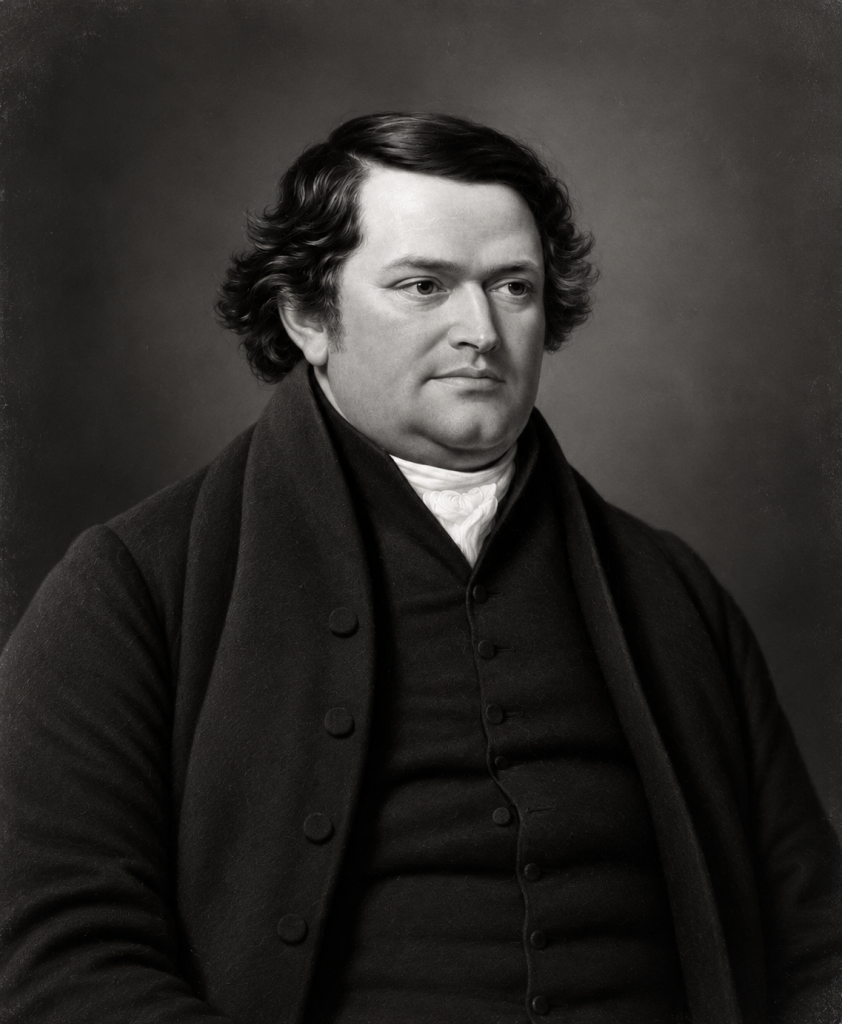
Image AI enhanced image of John Hazlitt’s painting of Joseph Lancaster about 1818 in the National Portrait Gallery.
On Wednesday, 11 May 1808, a new school opened in King’s Lynn for 230 boys. One master was expected to teach them all.
Under conventional arrangements, this would have required several teachers. The new school relied upon selected pupils, known as monitors, who taught and supervised groups of other boys. Its founders believed that this carefully organised system could bring elementary education to hundreds of poor children at a cost the town could afford.
The school took its name from Joseph Lancaster, a Quaker educational reformer who had visited Lynn only three months earlier. By 1810, Lancaster claimed that the school had room for 300 children but had received 700 applications.
A town with no charity school for boys
Lynn was not without schools before 1808. It possessed a grammar school, private academies, small fee-paying schools, dame schools, and Sunday schools. They did not provide a systematic elementary education for most boys from poorer families.
The grammar school concentrated upon classical learning and served a limited number of pupils. Private schoolmasters depended upon fees, while Sunday schools generally offered religious instruction for only part of the week.
William Richards, writing in 1812, claimed that Lynn had no public charity school for boys before the Lancasterian foundation. Townspeople complained about “idle and disorderly boys” gathering in the streets and sometimes damaging property. His account reflects a common Georgian anxiety that children without schooling would become troublesome adults.
There was also a financial obstacle. A master was normally thought capable of teaching thirty or forty boys effectively. Educating several hundred would require more teachers, higher subscriptions, additional accommodation, and a considerable annual income.
Lancaster claimed that one trained master could direct almost as many pupils as a schoolroom could hold.
Joseph Lancaster’s visit
Joseph Lancaster had opened a school for poor children in Borough Road, Southwark, during the 1790s. He developed a highly regulated system of pupil teaching, classroom movement, printed lessons, rewards, and public discipline.
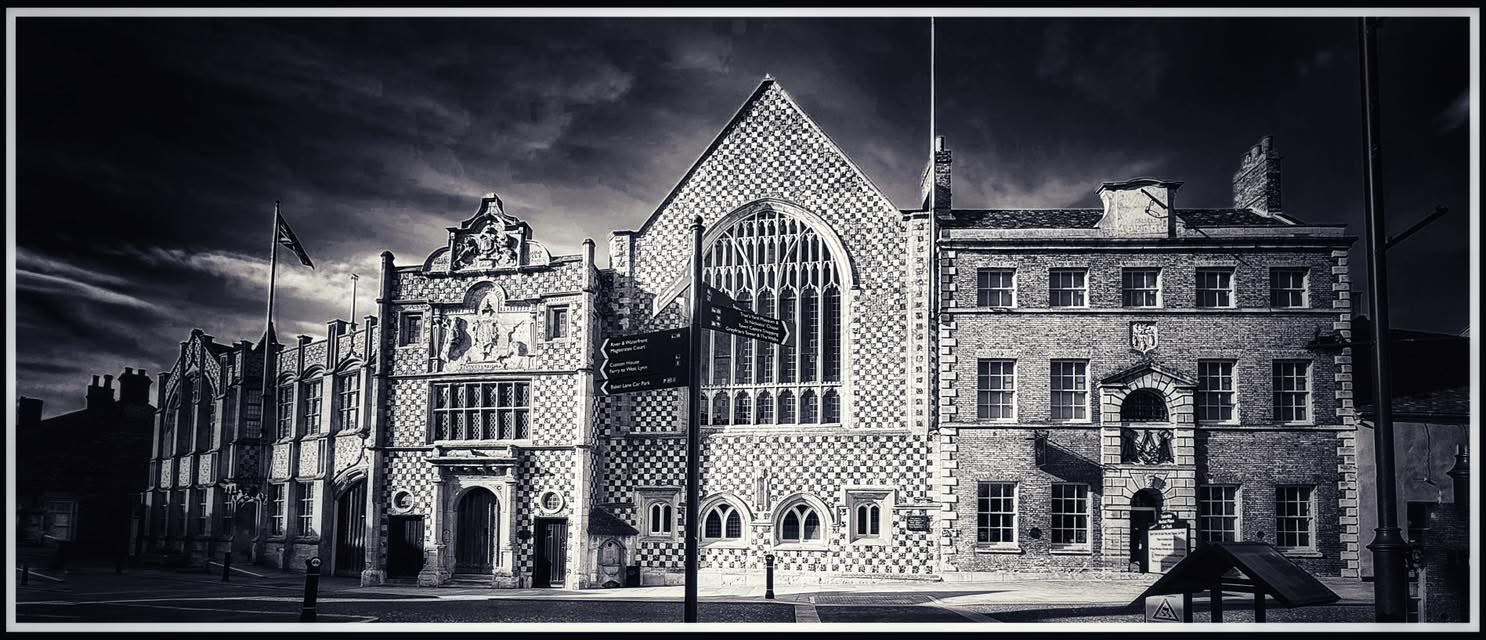
A group of Lynn’s clergy and leading inhabitants invited him to explain his methods. On 8 February 1808, he delivered a public lecture in the Assembly Room. Lancaster’s own account calls the venue the Guildhall, but the Assembly Room belonged to Lynn’s Town Hall and Guildhall group, so the difference may simply reflect the names used for adjoining civic rooms.
The response was immediate. Lancaster reported that more than £100 was promised before the audience left. Resolutions supporting the creation of a school were approved, and a committee of fifteen subscribers was appointed to manage it. The Corporation offered accommodation, and a prospective master was chosen.
That man was sent to Lancaster’s Borough Road establishment for training. Lancaster insisted that a teacher should not claim to understand his system without practical experience and a certificate from him. The name of Lynn’s first Lancasterian master has not yet been recovered from the accessible published sources.
Only thirteen weeks separated Lancaster’s lecture from the opening of the school.
A classroom run by monitors
The Lancasterian system divided pupils according to attainment rather than age. Beginners learned their letters, while more advanced boys practised spelling, reading, writing, and different rules of arithmetic.

At the centre stood the master, usually on a raised platform from which he could see across the schoolroom. Rows of narrow desks faced him. Passages allowed groups to move between their seats and teaching stations arranged around the walls.
The master instructed the most capable boys and trained them as monitors. Some monitors taught lessons, while others checked work, recorded absences, maintained order, and replaced pupils who were unavailable. Each had a defined duty and might wear a labelled ticket identifying his position.
Groups of about eight boys stood in semicircles around large lesson cards. A monitor pointed to a letter, word, number, or sentence and questioned the pupils in order. If one boy gave a wrong answer, the next could correct him and take his place. Advancement within the group became a visible reward.
The system reduced the need for individual books. Several groups could use the same printed lesson during a morning. Slates replaced paper for much of the writing and arithmetic, while beginners could trace letters in shallow trays of dry sand. The surface was smoothed after each exercise and immediately reused.
Lancaster described a school in constant motion. Boys recited, copied, calculated, changed places, and corrected one another. The master’s task was to control the organisation rather than teach every child personally.
The arrangement made mass education cheaper, but it encouraged repetition and memorisation. A monitor could check an arithmetic exercise against a printed answer without possessing a deep understanding of the calculation. Children might become competent at familiar tasks while receiving little individual explanation.
The extraordinary demand for places
Richards recorded that the school opened for 230 boys. Lancaster stated two years later that it could admit 300 but had 700 applications in its books.
The figures can be reconciled if the school increased its capacity after opening. Lancaster’s publications were promotional, so his claims require some caution. Nevertheless, his description shows that Lynn was regarded as one of the conspicuous early successes of his movement.
The demand also challenges the assumption that poor parents were indifferent to education. In a commercial port, the ability to read instructions, write a letter, keep simple accounts, and work confidently with figures could widen a boy’s prospects. Those skills had value in shops, warehouses, workshops, counting houses, shipyards, and better-paid forms of manual employment.
Attendance was probably less regular than the application figures suggest. Children might be required to earn money, assist a parent, perform domestic work, or care for younger family members. Illness, inadequate clothing, seasonal employment, and movement between lodgings could all interrupt schooling.
Richards reported annual subscriptions of £111 6s in 1812. He believed that the institution had fulfilled reasonable expectations and given widespread satisfaction.
Where did the boys go to school?
The sequence of school buildings is not entirely certain.
Richards says that the Corporation provided a building well adapted to the purpose. Henry Hillen, writing from borough records in 1907, states that temporary accommodation was first offered. He then places the earliest Lancasterian school in the Corporation yard near the corn watermill, on the site later occupied by Framingham’s Almshouses.
This placed it near Millfleet and St James’s End, on what was then the eastern edge of the town. Mills, waterways, gardens, burial grounds, Corporation property, and new development occupied the surrounding area.
The school was later moved to St James’s Road, opposite the burial ground. Hillen describes its second home as a long, low-roofed building, but does not give the date of the transfer.
After the school left, the building became the Corporation carpenters’ workshop. It was demolished in 1883 when the site was cleared for the Stanley Library. That library, designed by Adams and Son, opened on 7 November 1884.
Neither of the early schoolrooms survives.
Lancaster’s discipline
Lancaster opposed the habitual beating of pupils, but his alternatives were not always humane by modern standards.
Success brought merit tickets, promotion within a class, and public approval. Failure meant losing one’s position. Monitors watched for talking, idleness, inattention, and disorder. A boy accused of misbehaviour might receive a printed card describing his offence, which he had to carry to the front of the room.
Lancaster’s manuals recommended punishments that included cumbersome wooden logs worn around the neck, shackles that restricted a boy’s movement, humiliating labels, confinement in a sack, and suspension in a basket. They were intended to replace flogging with inconvenience and shame.
There is no evidence that every one of these devices was used in Lynn. The local master had been trained at Borough Road, however, and probably employed Lancaster’s wider system of competition, observation, public correction, and prescribed penalties.

The monitors occupied an ambiguous position. An able boy gained responsibility and reinforced his own learning by teaching others. He also became part of the machinery through which pupils watched, reported, ranked, and disciplined their companions.
A separate school for girls
Lynn also had a girls’ school operating on Lancasterian principles, although it had been founded long before Lancaster’s visit.
The Charity School for Girls began after a meeting of women at the Town Hall on 13 April 1792. It opened on 28 May with thirty pupils. The girls learned reading, sewing, and spinning, and received some clothing.
The school initially occupied a hired room in Purfleet Street. In 1805, it moved to an apartment adjoining the north tower of St Margaret’s Church, apparently over or beside the engine house.
By 1812, the school accommodated fifty girls under Miss Harriet Howell. Richards credited her with successfully adapting the Lancasterian method. Advanced pupils were presumably used to help teach and supervise the others, although no detailed account of the Lynn girls’ classroom has been found.
Their education remained shaped by assumptions about women’s work. Reading was combined with needlework, textile skills, domestic usefulness, and habits of obedience. There is no evidence that the girls received the same range of arithmetic teaching as the boys.
The school supplemented its subscription income by accepting plain sewing. In 1812, annual subscriptions amounted to only £49 7s, making the pupils’ work an important source of support.
Richards described both establishments as Lancasterian, but called the boys’ institution Lynn’s “proper Lancasterian school”. The girls’ charity school was an older foundation that had borrowed Lancaster’s teaching method.
A Quaker system under Anglican control
Lancaster intended his schools to be Christian without being controlled by one denomination. Scripture was central, but disputed doctrines were supposedly excluded. This allowed Quakers, Nonconformists, liberal Anglicans, and other supporters to subscribe to the same movement.
Lynn modified that principle. Richards states that the Lancasterian schools were directed by Church of England clergy and that the Church Catechism was taught.
The boys’ school therefore combined Lancaster’s economical teaching system with Anglican religious supervision. This probably reassured the Corporation and local clergy, but it compromised the religious neutrality that Lancaster advertised nationally.
These disagreements produced two competing networks during the nineteenth century. Lancaster’s supporters developed into the British and Foreign School Society, whose establishments became known as British Schools. The Anglican National Society created National Schools in which Church of England teaching occupied a more explicit position.
Local arrangements were less tidy than the national labels suggest. Lynn’s early Lancasterian School operated under Anglican direction, while the later British School was described as undenominational.
Education and social order
The subscribers wanted poor children to acquire useful abilities. They also expected schooling to produce regular habits, religious obedience, respect for property, and a willingness to work.
A boy who could read, write, and calculate possessed real advantages. A monitor might also gain experience of leadership and teaching. The school did not prepare most pupils for university or give them the classical education offered by the grammar school. It was designed to make working children more capable within the society they already inhabited.
The classroom reflected that purpose. Every pupil occupied a defined place. Progress was rewarded, time was closely organised, and disobedience became publicly visible. The children learned elementary skills while becoming accustomed to bells, commands, ranks, inspection, and repetitive tasks.
Charity and social control were not competing explanations for the school. Its founders could genuinely wish to improve children’s lives while believing that education should preserve social order.
The British School in Blackfriars Road
A much larger British School was erected in Blackfriars Road in 1841. Hillen describes a two-storey building designed for 250 boys and 250 girls.
The purchase of the land, construction of the building, and provision of equipment cost £1,301 14s 2d. A preliminary government grant supplied £261 10s, but the remaining debt placed considerable pressure upon the managers.
In 1846, the government’s Committee of Council on Education offered another £200 if £204 could be raised locally. A subscription organised through Massey and Jarvis’s Bank produced the required amount and released the school from debt. Lynn Town Council later voted an annual subscription of two guineas in 1858.
An infants’ school was erected beside St John’s churchyard in 1886.
The Blackfriars Road institution belonged to the British School movement that grew from Lancaster’s work. It was larger, more permanent, and increasingly dependent upon government inspection and grants. What has not yet been proved is whether it was legally the continuation of the school founded in 1808 or a new establishment created within the same educational tradition.
The missing children
The surviving histories tell us far more about Lancaster, subscribers, committees, buildings, and educational theories than about the pupils.
The name of Lynn’s first master remains uncertain. No accessible admission register has yet revealed the boys’ ages, addresses, family circumstances, length of attendance, or reasons for leaving. We do not know how many reached the higher arithmetic classes or became monitors. Nor can we readily follow them into apprenticeships, maritime work, shops, warehouses, or later teaching careers.
Records may survive among Lynn Corporation papers and the archives of the British and Foreign School Society. The latter collection contains minute books beginning in 1808, correspondence concerning individual schools, annual reports, inspection returns, and material about teachers trained in Lancaster’s system.
Somewhere within those papers may be the identity of the master who returned from Borough Road in the spring of 1808 and faced 230 boys in a King’s Lynn schoolroom.
© James Rye 2026
Book a Guided Tour with a Trained and Qualified King’s Lynn Guide Through Historic Lynn
References
- Educational Opportunity Foundation. “Archive.” Accessed 12 September 2026. https://educationalopportunity.org.uk/home/shared-learning/archive/.
- Hillen, Henry J. History of the Borough of King’s Lynn. Vol. 2. King’s Lynn: East of England Newspaper Company, 1907. https://archive.org/stream/historyofborough02hill/historyofborough02hill_djvu.txt.
- Lancaster, Joseph. The British System of Education: Being a Complete Epitome of the Improvements and Inventions Practised by Joseph Lancaster. Washington, DC: Joseph Milligan, 1812. First published in London in 1810. https://constitution.org/1-Education/lanc/epitome.htm.
- Richards, William. The History of Lynn, Civil, Ecclesiastical, Political, Commercial, Biographical, Municipal, and Military. Vol. 2. Lynn: W. G. Whittingham, 1812. https://classic-literature.net/william-richards-1749-1818/the-history-of-lynn-vol-2-of-2/.